Two Courts, Two Verdicts: What the OpenAI Rulings Mean for Every AI Brand Filing in Classes 42 and 43
Within ten days, courts on opposite sides of the world handed the AI industry contradictory signals on brand protection - one a lifeline on content, the other a rebuke on naming. Brand owners in AI services cannot afford to read only one judgment.
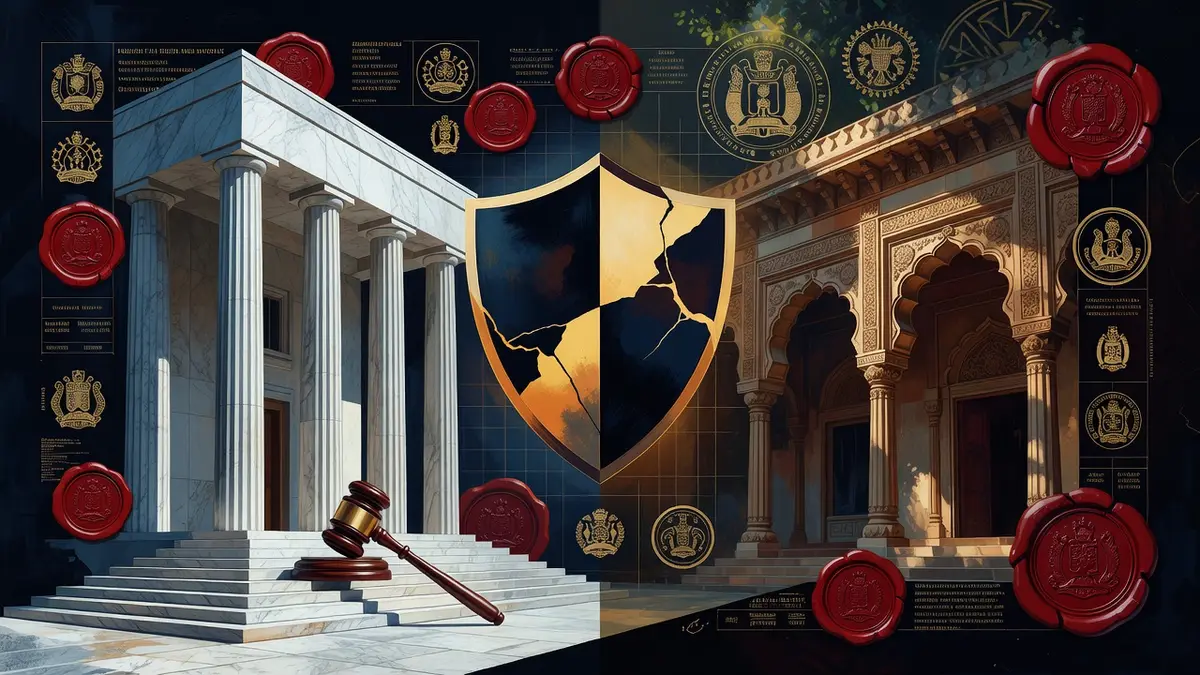
The past fortnight has been unusually productive for IP lawyers billing by the hour. On 15 July, the EU General Court upheld the EUIPO's refusal to register the word mark "OPENAI" for software, cloud computing, and identity-verification services spanning Classes 9, 42, and 45. Nine days later, the Delhi High Court handed OpenAI a provisional win of a different kind, finding that training ChatGPT on copyrighted news content is prima facie fair dealing under Indian law. Two cases, two jurisdictions, two entirely different points of attack on the same company's intellectual property position. Together they draw a map that every AI brand owner should be reading right now.
The EU verdict: your name is not automatically your brand
The General Court's judgment in OpenAI, Inc. v EUIPO (Case T-555/25), delivered on 15 July 2026, is precise in its scope and uncomfortable in its logic. The EUIPO had partially refused OpenAI's application, covering goods and services in Classes 9, 38, 42, and 45, on the ground that the term "OPENAI" was purely descriptive. The Court agreed entirely. In the EUIPO's reading, "open" would be understood by the relevant English-speaking public as meaning freely accessible, and the combination with "AI" - an abbreviation for artificial intelligence - described products and services built on openly accessible artificial intelligence. The General Court dismissed OpenAI's appeal and ordered it to pay costs.
Advertisement

The sting is not in the outcome alone. It is in the reasoning. OpenAI pointed to its registrations in more than thirty other countries. The Court was unmoved: the EU trade mark system is autonomous from national systems, and decisions of third-country offices have no binding effect in Luxembourg. OpenAI's figurative mark, the distinctive logo, survives. The word mark, standing alone, does not, at least not yet. A separate acquired-distinctiveness claim may still be pursued if OpenAI can marshal consumer-recognition evidence. That path remains open; it is simply expensive and slow.
For the broader sector, the lesson is direct. AI companies naming themselves after the technology they sell, open AI, deep learning, neural networks, are building on sand. Descriptive terms cannot be monopolised. Brands built on invented, arbitrary, or fanciful words sit on firmer legal ground and are far easier to register and enforce across multiple jurisdictions simultaneously.
The Delhi verdict: training data, for now, is not infringement
The ruling from the Delhi High Court, delivered on 24 July 2026 by Justice Amit Bansal in ANI Media (P) Ltd. v. OpenAI OpCo LLC, is a different matter entirely. ANI, India's major news agency, sought an interim injunction to stop OpenAI using its archived content to train large language models. The court refused, holding on a prima facie basis that the storage of ANI's articles for training purposes falls within the fair-dealing exception under Section 52(1)(a) of India's Copyright Act 1957. The 135-page order followed 32 hearings. It is not a final judgment; the suit continues. The interim finding is, however, the third major jurisdictional signal globally, after US fair-use cases, that courts are reluctant to halt AI training on publicly accessible content while the legal arguments are refined.
What makes Delhi particularly notable is the jurisdictional holding. OpenAI argued that Indian courts had no business scrutinising training conducted on US servers. Justice Bansal disagreed, reasoning that accepting that logic would allow any infringer to evade Indian law simply by hosting abroad. That finding, less noticed than the fair-dealing headline, keeps this case, and future ones like it, firmly within Indian courts. For publishers and content brands operating globally, it matters enormously.
For trademark and brand-protection professionals, the copyright angle intersects in a specific way. Content brands, news agencies, publishers, data providers, have spent years building value in Class 41 (educational and publishing services) and Class 43 (restaurant and hospitality brands that produce branded content). The Delhi ruling suggests that value cannot easily be ring-fenced through injunctions at the training-data stage. Licensing agreements and contractual restrictions on data use are now the more reliable tools.
Class 43 and the unprotected majority
Which brings us to a quieter but urgent problem: most UK businesses filing under SIC code 69.10 (legal activities), a sector now thick with AI-adjacent legal-tech, compliance, and professional-services ventures, are simply not protecting themselves at the trademark layer at all.
AIBD analysis of Companies House and IPO data, as of July 2026, finds that just 165 new SIC 69.10 companies were incorporated in Q3 2026, a 76.6% drop on the prior period. UK Class 43 trademark filings fell to 530 in the same quarter, down 75% on the prior period. Strikingly, 99.9% of active SIC 69.10 companies hold no Class 43 trademark registration whatsoever, a figure that reflects how rarely professional-services businesses formalise brand protection in the hospitality and catering class, even when they operate branded client-facing spaces or AI-powered service environments that carry real reputational value.
Class 43 covers restaurants, cafés, and temporary accommodation, but also the branded hospitality environments attached to AI-company campuses, law-firm client suites, and professional-services hubs. As AI companies scale into physical spaces and brand experiences, this gap in coverage becomes exploitable.
What the pair of rulings tells brand owners in AI services
The EUIPO decision and the Delhi ruling together make a coherent argument. Your name, if it describes what you do, will not be protected as a word mark in the EU regardless of how famous you become. Your content, if publicly accessible, may be trainable under fair-dealing doctrines in jurisdictions that follow India's path. The brand equity you have built in your name and your content may be less legally defensible than you believed.
Clarivate's trademark filing trends data from earlier this year noted that, despite their rapid commercial influence, most major AI companies did not feature among the highest trademark filers, suggesting brand formalisation in the sector is still emerging. That gap is not a quirk. It is a structural vulnerability that competitors and courts are increasingly in a position to exploit.
The Class 42 and 43 priority is clear: file on invented marks, not descriptive ones. Pair your word-mark application with a distinctive figurative mark as insurance. Audit your Nice-class coverage now that the 13th edition of the Nice Classification, in force since 1 January 2026, has formally codified "artificial intelligence as a service" within Class 42. If your business generates content that trains AI systems, the licensing route is now more defensible than the injunction route.
This week: run a Class 42 and Class 9 audit against your current trademark portfolio at TrademarkDashboard, paying particular attention to any marks that include the words "AI", "open", "neural", or similar AI descriptors, and take specialist advice before the EU acquired-distinctiveness window closes on OpenAI-adjacent terms.