Kitchens Go Agentic: The New AI Tools Reshaping UK Hospitality Back-of-House
A fresh wave of AI software targeting restaurant deliveries, kitchen compliance and guest messaging has landed in UK trade press - arriving precisely as new restaurant company formations slow sharply and branded food businesses continue to skip the trademark step.
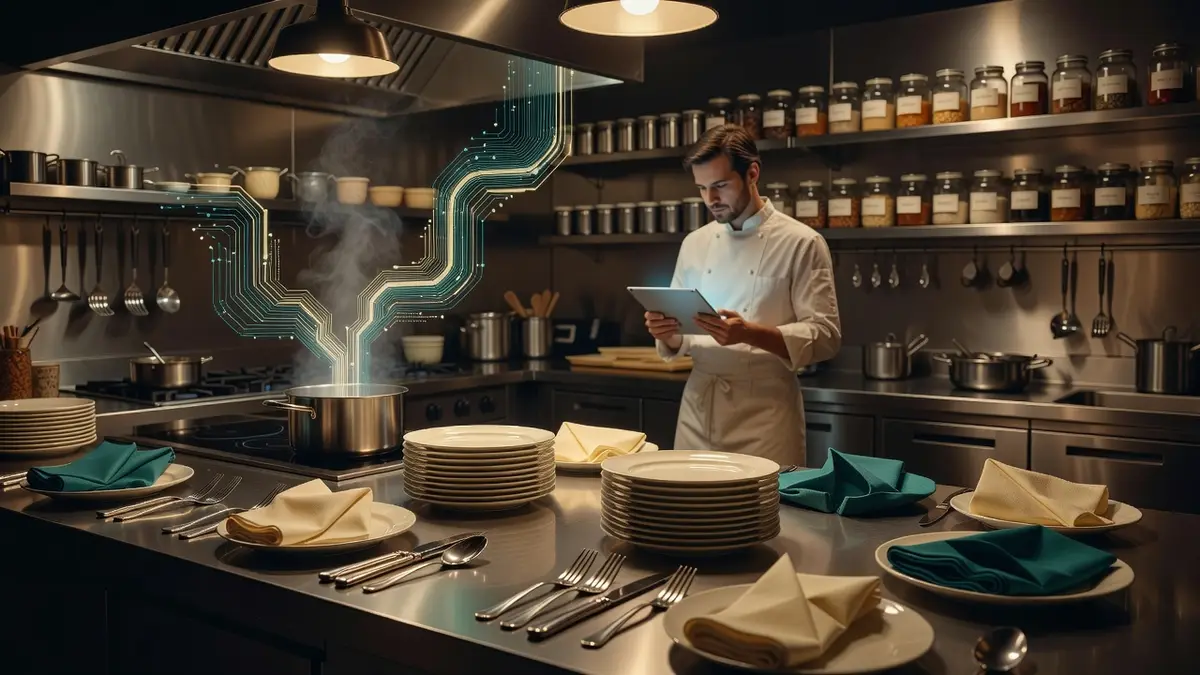
The back-of-house AI moment has arrived
For years the hospitality tech conversation centred on the front door: online booking, digital menus, contactless payments. The tools showcased in The Caterer's latest new-software round-up suggest the action has shifted firmly to the kitchen and the back office.
Three launches stand out. Inpulse has added a smartphone-based delivery processing feature: teams photograph a delivery note and the AI instantly identifies order details, flags discrepancies and updates records in real time, converting handwritten or printed quantities and prices into clean digital data. Chef-Ops-Pro, meanwhile, is positioning itself as the antidote to paper-based kitchen management, offering UK operators a centralised dashboard to handle documentation, kitchen workflow, staff tasks and team communication in one place. And Conduit has expanded its guest messaging platform into a full AI agent suite, with pre-configured agents covering guest support, sales, cleaning and owner communications, plus the ability to coordinate complex workflows across booking systems.
These are not experiments. They are production-ready tools solving problems operators have complained about for a decade: delivery discrepancies that eat into food cost, compliance paperwork that pulls head chefs away from the pass, and guest messages that fall through the gaps overnight.
Margin pressure is the real driver
The timing is not accidental. Restaurant Online's 2026 Trends Report, produced with Square, identifies AI adoption as one of eleven forces actively reshaping the UK dining scene. The operators driving that adoption are doing so because the numbers demand it. Even where top-line sales remain stable, profitability is under pressure, with the gap between strong and underperforming sites often coming down to day-to-day operational execution.
Labour costs are the headline concern: 67% of UK restaurant owners cite them as their top worry, according to industry surveys. Food costs have risen an average of 18% in recent years. Against that backdrop, Inpulse's broader AI inventory platform, used by more than 3,500 restaurants, food kiosks and bakeries, reports that operators see around 2 margin points improvement on food cost once AI forecasting and ordering are embedded. Two points sounds modest. On a site running 65% gross profit, it is the difference between a viable business and an unviable one.
The macro picture supports the shift. Over 60% of UK restaurants are now piloting or actively using some form of AI in operations, up from under 25% in 2023. That is a structural change in the space of three years.
New openings are slowing, but AI spend is not
One detail should concentrate minds. AIBD analysis of Companies House data shows only 2,202 new SIC 56.10 (restaurant and mobile food service) companies were registered in Q3 2026, a fall of 77.6% versus the prior period. The chilling effect of the Economic Crime and Corporate Transparency Act, a Companies House fee rise, and wider macro uncertainty have all contributed to a sharp deceleration in new market entrants. Separately, UK Class 29 trademark filings (covering prepared meat, fish and dairy products, the kind of food brands ghost-kitchen operators build) hit just 270 in Q3 2026, down 74.5% on the prior period, per AIBD analysis of IPO data.
What makes that figure especially striking: 98.6% of active SIC 56.10 companies hold no Class 29 trademark at all. Source: AIBD analysis of Companies House and IPO data, as of July 2026.
The restaurant sector is producing fewer new companies and fewer new branded food marks than at almost any recent point. The operators still standing are the ones investing in operational resilience, which is precisely why tools like Inpulse, Chef-Ops-Pro and Conduit are gaining traction.
The brand gap is a slow-burn risk
The trademark picture deserves a moment. The 13th Edition of the Nice Classification, which came into force on 1 January 2026, introduced notable changes affecting AI, hospitality and food service classifications, including harmonised terms for accommodation-adjacent services under Class 43. For food operators building delivery-only brands, Class 29 protection for prepared food products is the obvious filing. The fact that almost no active restaurant company holds one is not just a curiosity: it is an exposure. A dark kitchen building a recognisable brand name on Uber Eats or Deliveroo without a registered trademark is one copycat listing away from losing the goodwill it has spent years accumulating.
What operators should do now
The software launches reported by The Caterer are all entry-level affordable. Chef-Ops-Pro targets the independent and commercial food business. Inpulse scales from single-site kiosks to 200-location groups. Conduit's AI agents sit inside an existing guest messaging layer operators may already pay for.
The smarter move is to treat the tech investment and the brand investment as the same conversation. Fewer new restaurants are opening. The ones that survive will be defined by operational efficiency and recognisable identity. Right now the tools to achieve the former are proliferating. The discipline to protect the latter, through something as unsexy as a trademark filing, is lagging badly.
Software can automate your delivery notes. Nobody can automate protecting your name.