From Bedroom Inspections to Delivery Notes: AI Becomes the UK Kitchen's New Sous-Chef
A fresh wave of AI tools is landing in British kitchens and hotel back offices this July, promising to cut paper trails and protect already razor-thin margins. The question operators are asking is no longer whether to adopt - it's which tool, at what cost, and who actually owns the brand.
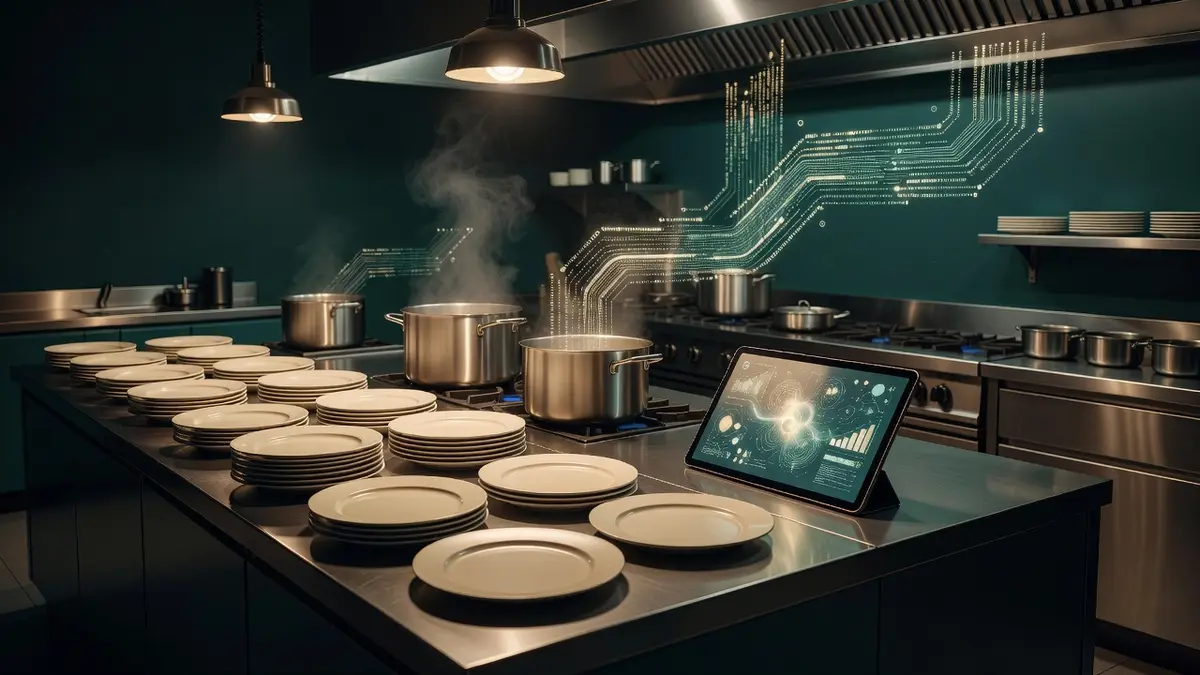
The pace of hospitality software launches has not let up this summer. The Caterer's mid-July roundup of best new hospitality software, published 15 July 2026, spotlighted three products that tell you a lot about where UK operators are focusing their AI spend right now.
The Kit Making Waves
Chef-Ops-Pro is a kitchen operations management platform built specifically for the UK hospitality industry. The software gives operators, head chefs and kitchen managers a centralised dashboard to manage documentation, monitor kitchen workflow, assign and track staff tasks, and communicate with teams, eliminating the clipboard-and-lever-arch-file approach that still governs many sites. Separately, Inpulse is taking aim at one of the most error-prone moments in any kitchen: goods-in. Teams photograph a delivery note on their smartphone and AI instantly identifies the order details, flagging discrepancies before they vanish into a paper drawer.
On the accommodation side, Conduit has expanded its guest messaging software into a full AI platform. Pre-configured agents handle guest support, sales, cleaning requests and owner communications, and the system can co-ordinate complex workflows across booking systems. Conduit has also built an internal operator interface that lets teams configure and improve those agents using natural language rather than code, a design choice that acknowledges most hotel managers are not software engineers and have no interest in becoming one.
These are not blue-sky pilots. They arrive alongside a broader structural shift in UK foodservice. Contract catering platform Kanpla has been rolling out its AI assistant Kai to beta customers, with the tool designed to predict demand, reduce food waste and personalise menus. As Kanpla's co-founder puts it, chefs didn't enter the profession to sit in front of spreadsheets; Kai's job is to take that burden away and give back time for cooking. The platform is now active across more than 4,500 locations in over 13 countries, with UK adoption growing.
Margins Are the Real Driver
None of this is happening in a vacuum. UK restaurants face persistent cost pressure from every direction: food costs, wage floors, energy, and delivery platform commission. According to RestaurantOnline, AI adoption in UK hospitality has moved decisively from experimentation to practical application in 2026, with operators seeking tools that reduce workload, improve accuracy and deliver consistency across multiple sites. Even where top-line sales hold steady, profitability is under pressure, and the difference between a strong site and an underperforming one increasingly comes down to day-to-day operational execution.
The macro picture backs that up. Over 60% of UK restaurants are now piloting or actively using some form of AI automation, up from just 23% in 2023. That is an adoption arc that would make any SaaS founder impatient.
But here's where the data tells a more complicated story.
Formations Up, Brand Protection Not
AIBD analysis of Companies House data shows 2,111 new SIC 56.10 (restaurants and mobile food service) businesses incorporated in Q3 2026, a dramatic -78.5% fall against the prior period, suggesting the post-pandemic formation boom has sharply corrected. Yet across that same cohort, 98.8% of active SIC 56.10 companies hold no Class 33 trademark with the UK Intellectual Property Office. AIBD analysis of IPO data also records only 165 Class 33 trademark filings in Q3 2026, itself down -75.5% on the prior period. (Source: AIBD analysis of Companies House and IPO data, as of July 2026.)
Class 33 covers alcoholic beverages; drinks brands are a significant revenue and identity layer for many restaurant and hospitality concepts. That near-total absence of trademark protection in the sector is striking. A restaurant can invest six months and serious cash building an AI-optimised operation, and still leave its drinks brand exposed to a squatter or a rival.
The pattern is familiar in hospitality. Operators sprint to solve the operational problem in front of them, scheduling, waste, ordering, and treat intellectual property as a problem for later. Later sometimes never comes.
The Practical Calculus
For operators evaluating the current software wave, a few things are worth holding onto. First, modular wins. The tools getting traction in 2026, Conduit, Inpulse, Chef-Ops-Pro, are all designed to slot into existing stacks rather than replace them wholesale. That matters because the average restaurant runs four to five disconnected systems, and a wholesale rip-and-replace is a risk few can absorb mid-trading.
Second, price points are becoming more honest. Flipdish's AI Phone Agent, noted recently on The Caterer, is priced at £99 per location per month but discounted to zero until the end of 2026, a land-grab play that at least makes the unit economics legible.
Third, and this is the one operators tend to underestimate: AI tools surface data that can be used against you in contract renegotiations and tenders, as well as for you. The caterers who thrive will be those who read that data, act on it, and protect the brands those insights help build.
The sous-chef who never clocks off is already in the building. The paperwork to protect what it's cooking up is still sitting in a drawer.