Wall-Finishing Robot Bags $20M and Eyes Europe: What Origin's OG-1 Means for Trades Labour
Robotics startup Origin has emerged from stealth with $20 million to deploy autonomous interior-finishing robots across US and European construction sites. For a UK trades sector short of 41,200 workers a year, it's a signal worth watching.
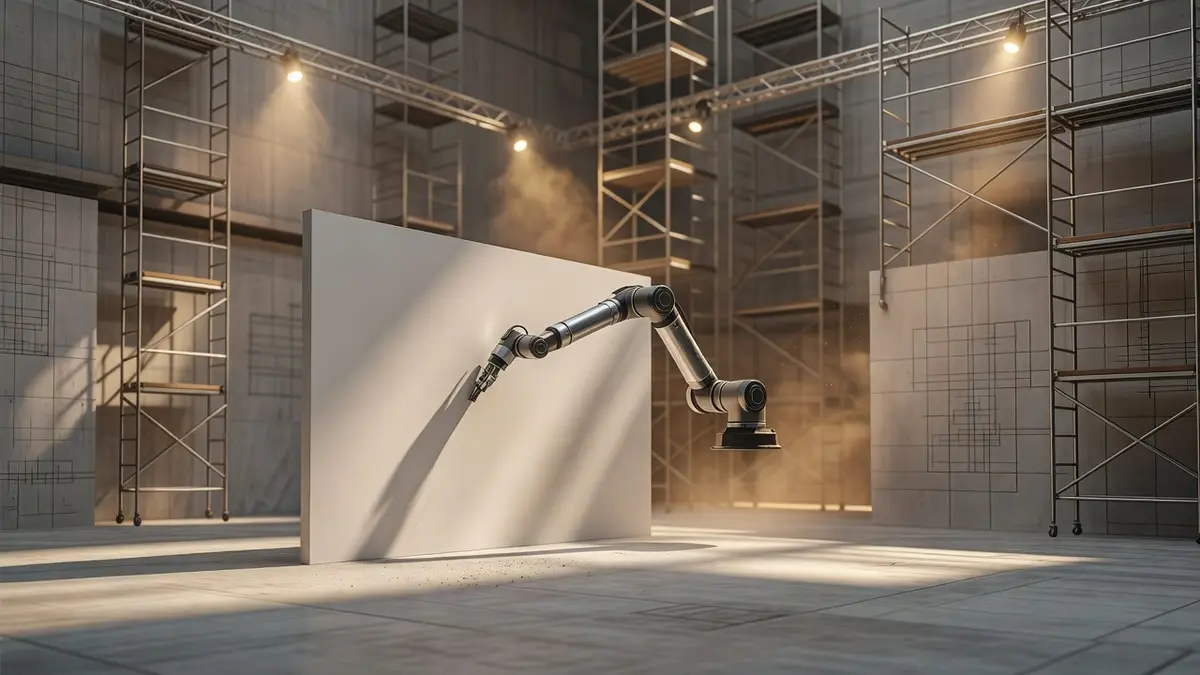
A San Francisco deeptech company nobody had heard of this time last week just put $20 million on the table to automate one of the most labour-intensive corners of the construction trades. Origin, founded in 2025, exited stealth mode on 15 October with a seed round co-led by Accel and Zacua Ventures. Angel money came from people inside Anduril, Tesla and autonomous-systems house 1X. That is not a typical PropTech cap table.
What the Robot Actually Does
Origin's flagship machine, OG-1, is built for interior wall finishing: applying drywall compound, sanding, and priming. Those tasks sound unglamorous. They are also, according to Origin, responsible for around 65% of project time on interior fit-outs, a claim that will ring true to anyone who has watched a large commercial shell sitting idle while finishers queue up. The robot operates on a three-wheeled platform with 360-degree environmental awareness and real-time force control for contact-intensive work like sanding. It can handle high walls, corners, pillars, soffits and edges, and reach up to 14 feet without scaffolding or a separate cordoned exclusion zone.
Under the hood, OG-1 runs on what Origin calls a Construction Action Model: a proprietary foundation model combining a reasoning layer for sub-task planning, an action-policy layer for autonomous navigation, and a feedback-driven controller for physical contact. That architecture is closer to the robotics models coming out of defence-adjacent AI labs than to anything most site managers have seen pitched at them before.
The company claims its robots work at three times human speed while maintaining consistent quality. Contractors will apply their own scrutiny to that figure when pilots land on real sites. Origin is already working with two of the largest drywall finishing contractors in the United States, with New York deployments running across commercial buildings, multifamily apartments, data centres, hotels and warehouses.
Where the $20 Million Goes
The raise funds fleet expansion, targeting 150 deployed robots by end of 2027, plus pilots in Germany, Sweden, France and Saudi Arabia. The UK does not appear on that initial list, though the European direction of travel is clear. Origin's CEO Yogesh Ghaturle has said the ambition is to automate "the full range of interior trades", with taping, drywall installation, drilling and conduit installation all on the roadmap for the same OG-1 hardware platform.
For British contractors, that roadmap matters. CITB's Construction Workforce Outlook 2026-2030 estimates the UK industry must attract an average of 41,200 additional workers every year between now and 2030, more than 206,000 over five years, just to cover growth and replace leavers. Those shortages land hardest in precisely the skilled finishing and specialist trades a machine like OG-1 targets.
The Pilot-to-Practice Gap
The robots are moving faster than most UK firms' ability to absorb them. RICS's AI in Commercial Property and Construction Report 2026, drawn from more than 3,100 industry professionals worldwide, found that two-thirds of construction professionals now use AI in some capacity, up from just over half in 2025. Regular use sits at only 19% in construction, compared with 29% in commercial property. Both sectors have the same proportion of organisations running early-stage pilots, at 39%. The conversion rate from pilot to practice is where construction falls short.
The UK's own trajectory is improving faster than its reputation suggests. In 2025, UK construction was the most cautious region in the global survey; by 2026, the share reporting no AI use had fallen by 17%, the largest single-year drop of any region. Regular use in the UK almost doubled year-on-year. Privacy and security concerns are rising as a barrier, cited by 30% of UK construction respondents versus 22% a year ago, reflecting how much more data these systems now touch.
The environment for a machine like OG-1 arriving on European sites is not hostile. But it is complicated.
What the Trademark Data Says
There is a subtler signal in the intellectual property filings. AIBD analysis of UK Intellectual Property Office data shows just 303 Class 37 trademark filings (construction services) in Q4 2026 to date, down 83.6% on the prior period. Class 37 covers the trades and construction services that robotic platforms like OG-1 directly displace or augment. A sharp drop in trademark activity in this class could reflect caution among new entrants, or consolidation: fewer new brands being built because incumbents are quietly licensing in the technology instead of building competing identities around it.
Either reading is consistent with a market that senses disruption is coming but hasn't yet decided what shape to take.
The Real Question for UK Contractors
Origin's investors are betting that construction, one of the world's largest industries and historically one of the least automated, is finally ready for robots that survive contact with real sites. Zacua Ventures, one of the co-leads, published its own Construction Robotics Report 2026 earlier this year, noting that a first wave of machines has moved from demos to "things we bring back on the right projects". OG-1 is positioned as the second wave: a general-purpose platform rather than a single-task plotter.
The honest answer for any UK finishing subcontractor is this: the machine won't arrive on your site next quarter. The labour arithmetic that makes it inevitable, however, is already in your tender prices. Skills shortages, prelim cost inflation running at 6-8% year-on-year, and a structural deficit of tens of thousands of trained finishers are not problems that apprenticeship campaigns alone will close.
Somebody just spent $20 million on a different answer.