Twelve-Month Clock: AI Datacentre Build Wave Faces UK Planning Revolt
A Nvidia-Microsoft-Cisco taskforce has told ministers they have roughly a year to stop US-style community protests killing datacentre construction programmes in Britain. The warning lands as separate research confirms the built environment sector still can't handle the data foundations that AI actually needs.
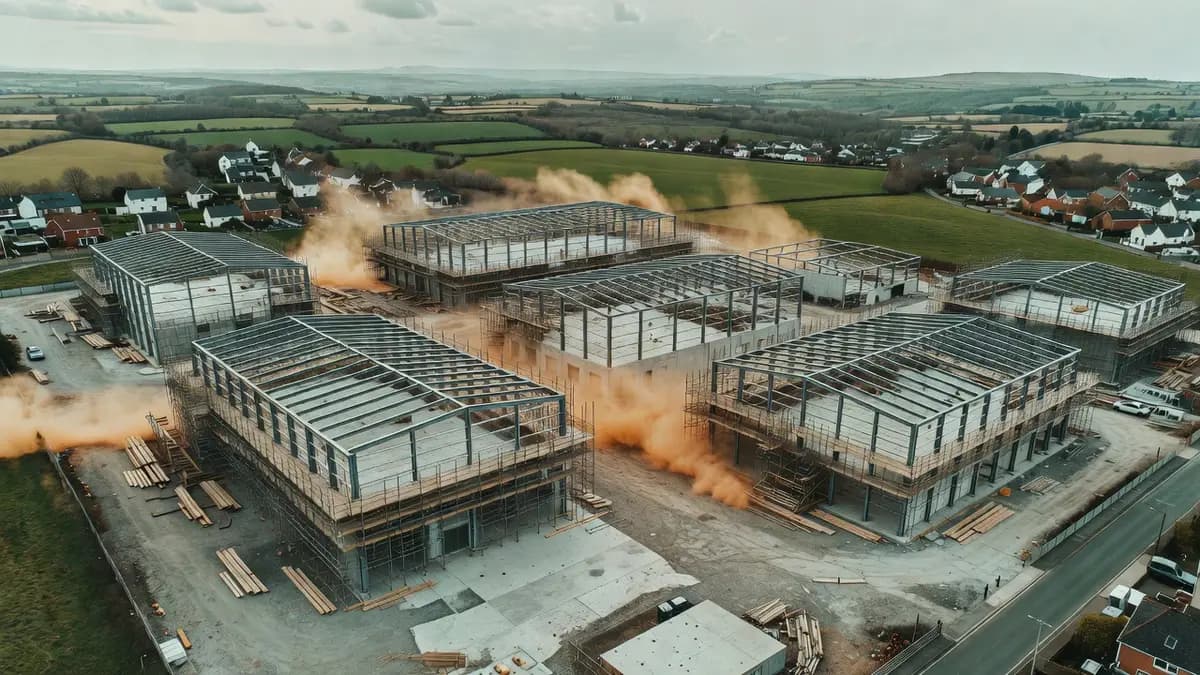
Britain's most capital-intensive construction pipeline faces a threat from below rather than above. Not a credit crunch, not a materials shortage: organised local opposition that, according to a formal submission to the Labour government, could stop permitted schemes dead within twelve months.
The Sovereign AI Leadership (SAIL) taskforce, whose members include Nvidia, Microsoft and Cisco, published that warning on 22 October. Its submission argues that the same pattern that has blocked fully consented datacentre projects in the US, and prompted moratoriums in states otherwise receptive to growth, is already taking root here. Scotland, it turns out, doesn't need convincing: Action to Protect Rural Scotland has counted fifteen active community campaigns opposing hyperscale AI datacentre developments across the country, and its director Kat Jones says the industry has already missed its window to contain the opposition north of the border.
Advertisement

The core grievance, SAIL is candid enough to admit, isn't really about AI at all. Distrust of corporate and government promises, anxiety over electricity costs and fear of stranded assets run deeper. Two successive dry summers have focused minds on the water consumption of server cooling systems, and rising energy bills have made the grid draw of a large datacentre campus hard to present as neighbourly.
What SAIL Is Actually Asking For
The taskforce wants what it calls a Community Prosperity Compact: a national framework giving councils and mayors recommended terms for negotiating local benefits from datacentre developers, with contributions scaled to site size, either financial or in the form of facilities. It also wants host councils to retain more of the business rates generated by the sites.
The government's response was cautious. A spokesperson pointed to existing measures allowing local authorities in designated AI growth zones in England to keep all additional business rates they generate. SAIL has not calculated what allowing full retention outside those zones would cost central government, which left critics room to argue the proposal simply shuffles money already in the system rather than extracting new payments from the tech sector.
Foxglove's Donald Campbell put it bluntly: letting councils keep more rates could reduce funding for central services, rather than increasing what technology companies actually contribute. Joseph Miller of PauseAI UK, which campaigns for a global halt to datacentre expansion, said communities would regard financial incentives as undignified inducements from companies that don't share their interests. He agreed, pointedly, that the tech firms were right to be worried.
The Construction Exposure
For contractors, the stakes are direct. Microsoft has committed $30 billion to UK AI infrastructure, with a completed datacentre in Acton and another currently under construction in Newport. Those schemes, and the pipeline behind them, represent a substantial forward order book for civil and M&E trades. A planning consent can survive a judicial review and still be undone by a sustained local campaign, particularly where grid connections are contested. The US precedent SAIL cites includes projects halted at construction phase, not just at planning.
The energy and water intensity of these buildings also puts them in direct tension with the Part L and sustainability requirements contractors are already managing on other residential and commercial work. A datacentre campus draws the kind of grid capacity that local planners are simultaneously being asked to protect for housing.
The Data Problem Underneath
A second warning, quieter but no less pointed, arrived a day earlier. Speaking at the Housing Forum's annual conference in London, Guy Marshall, founder of Housing AI Leadership and Implementation Exchange (HAILIE), told delegates that data and digital capability is not strong in the housing sector, and that the same weakness extends across the wider built environment. Boards, he said, often lack the basic competence to ask the right questions about cyber security or data protection, let alone AI governance.
That matters because AI adoption in the built environment is being sold as inevitable. The Construction Leadership Council's own mapping exercise, published in July, found that only 0.17% of UK construction businesses had adopted AI by 2025, a figure heavily skewed by the 99% SME composition of the industry. Only 30% of built environment firms provide any AI literacy training at all. The sector cannot run sophisticated AI workflows on the back of that foundation.
The trademark data tells a related story. AIBD analysis of IPO (TMD) data, as of October 2026, shows just 107 Class 19 trademark filings in Q4 2026, a fall of 76.7% against the prior period. Class 19 covers non-metallic building materials: the category where you'd expect to see activity from companies commercialising new construction products, including those with digital or AI-enhanced angles. A collapse that steep suggests product pipeline activity, not just confidence, has cooled sharply.
Reading the Signals
Two stories from the same week, pulling in different directions. On one side, an industry desperate to get large buildings out of the ground fast, worried that the planning system and public opinion will slow it down. On the other, a sector with almost no digital foundation being asked to absorb AI at pace.
Both problems have the same root. The built environment has spent years adding management layers and cutting trades, as CITB data shows trades and site roles fell from 65% of the construction workforce in 2009 to 49% today. The result is an industry with plenty of people to write strategies and not enough people to build things or operate the data systems those strategies assume exist.
SAIL chair Steve Rigby says the compact would enable infrastructure construction, equip workers with future-ready skills and secure Britain's digital future. Fine ambitions. But the twelve-month clock he's describing is a construction programme problem, not a communications one. Consent won in a Whitehall compact doesn't build a substation or cool a server hall. That still needs groundworkers, electricians and a planning system that hasn't been paused by a community group with a good solicitor.