The Manchester Principles Won't Save the Junior Designer Already Eating Toast for Lunch
The UK's creative industries finally agreed a rights-based position on AI last month. The question nobody's answering: who trains the next generation of humans if the entry-level jobs are already gone?
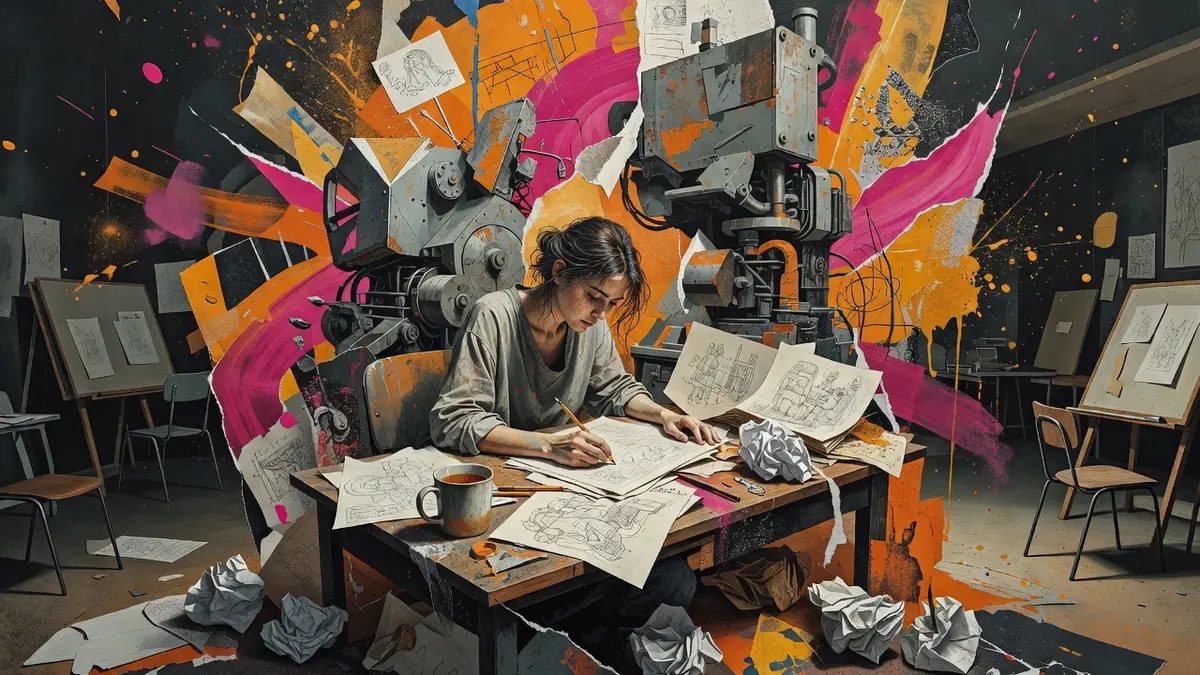
Picture this. A 22-year-old illustrator, three months out of Central Saint Martins, sits in a Peckham flatshare refreshing her emails. She applied to fourteen junior design roles in October. Three auto-replied. Two told her AI tools had changed the hiring brief. None of them called back.
Meanwhile, in Salford.
Manchester Blinked First. That's Actually Good.
On 9 October, at MediaCity in Salford, something genuinely historic happened, or at least historic-adjacent. Prime Minister Andy Burnham convened the Creative Industries AI Summit as the headline event of Beyond The Music 2026, pulling together leaders from music, film, gaming, advertising, and publishing under one roof for the first time. The stated mission was building a unified position on AI: licensing, provenance, attribution, enforcement. They called the output The Manchester Principles.
NME, reporting on 30 October, framed the summit as taking place during "the first five minutes of the next industrial revolution." Ian Murray MP, Minister for Creative Industries, opened by noting that "66 per cent of music creators believe AI poses a direct threat." The Manchester Principles are a four-part policy proposal. Art is a human right, the summit declared. Creators have a moral and material claim to be credited and paid for their work.
Good. Fine. True. But also: abstract enough to park comfortably on a lanyard.
Lewis Silkin, the IP law firm with perhaps the sharpest creative-industry practice in the country, noted after the event that the Burnham government's participation, including the Deputy Director of AI & Society at DSIT, suggested that a policy announcement on copyright and AI may now be closer than it has looked in two years. The UK government concluded earlier this year, in its response to the December 2024 Copyright and AI consultation, that various stages of AI model development are "likely to infringe copyright law if carried out in the UK without permission." Progress. Slow, cautious, lawyerly progress. The creative industries needed a bonfire; they've been handed a tea light.
The Numbers That Keep Me Up
Here's what the Principles won't fix overnight. Creative agency employment fell 14.3% in 2025, according to the IPA Census, even while marketing budgets hit a two-year high. Read that again. Clients spent more money. Agencies employed fewer people. The gap between those two facts is AI-shaped, and it's widening.
Between 36 and 38 per cent of UK agencies surveyed in BenchPress 2026, The Wow Company's annual temperature-check, say clients have taken work in-house because of AI. Forrester forecasts 15% of agency jobs will disappear in 2026 alone. Over at the IBISWorld numbers, the UK advertising agencies market sits at £42.2bn in revenue, compound annual growth of 6.9% over five years. The sector has never been wealthier. It has also never employed a smaller proportion of the humans who made it wealthy.
In the trademark register, which, if you know how to read it, acts as a kind of mood ring for brand confidence, something strange is happening. AIBD analysis of IPO Trade Mark Dashboard data shows just 3,186 Class 41 filings in Q4 2026, a collapse of 64.7% versus the prior period. Class 41 covers education, entertainment, training, cultural activities: the soul of the creative economy. When brand owners stop trademarking in the class that covers creative and cultural services, it signals one of two things. Either the industry is consolidating and rebranding at speed, or a chunk of it has quietly decided the future doesn't require a plaque on the door. Neither reading is comfortable.
TechFirst Is a Sticking Plaster on a Chest Wound
Two weeks after Manchester, the government announced TechFirst: 10,000 work placement opportunities in the digital and tech sector, backed by Microsoft, Cisco, IBM, Arm, and Kainos. The programme targets underrepresented groups, women and young people from disadvantaged areas. Skills England has identified 800,000 digital and tech roles that need filling by 2035. The DCMS Digital and Technologies Jobs Plan sets a target of 20,000 entry-level jobs a year.
Corrected and admirable. But TechFirst is oriented almost entirely toward software, infrastructure, and data engineering. Advertising agencies, design studios, illustration collectives, the creative industries that actually depend on Class 41, don't appear anywhere in the official delivery-partner list. Microsoft will take placements. So will QinetiQ. Nobody's phoning the junior art directors.
CreativePool's analysis of emerging roles in 2026 makes the structural shift plain: a creative team that once needed a designer, copywriter, artworker, and producer might now require "a designer, copywriter, creative technologist, AI workflow lead and producer who understands automation." The roles still exist. The route into them is vanishing. You can't become an AI workflow lead if nobody ever let you be a junior artworker first.
What Paul Rand Would Make of All This
Paul Rand believed design was the silent ambassador of a brand. Bill Bernbach built DDB on the conviction that only a human soul could surprise another human soul. David Ogilvy ran campaigns built on research and wit, the kind of wit that takes years of embarrassing early work to develop. These aren't nostalgic observations; they're structural ones. The craft tradition of advertising and design has always been apprenticeship-shaped: you made bad work for small clients until you made good work for bigger ones, and somewhere in that arc you developed the taste and judgment that can't be downloaded.
AI Creative Summit speakers at BFI Southbank in November, Framestore's creative director for AI Theo Jones among them, are making the case for how machine learning changes the possibilities and costs of visual effects at scale. The conversation is exciting. It is also happening at the top of the pipeline. The bottom of the pipeline, where the 22-year-old illustrator in Peckham lives, has been drained.
Creative Boom's survey of studio leaders heading into 2026 found one voice worth quoting in full context: agencies are "swimming further upstream into design agency territory" as "production on their tail-end is swallowed by AI." Strategy grows. Execution shrinks. The people who get to do strategy are the ones who survived the cull with their craft intact.
The Question Nobody Wants to Answer
The Manchester Principles address what AI owes the creative industries. TechFirst addresses what the state owes young people entering tech. Neither initiative addresses the specific, urgent, grinding problem of how a generation of junior creatives, illustrators, copywriters, junior art directors, motion graphic artists, builds the experiential capital that eventually becomes senior judgment, in an industry that has structurally removed the roles where that capital used to accumulate.
Fifty insolvency notices hit the London Gazette for advertising-agency companies between August and October this year alone: liquidations, winding-up petitions, administrations. Some of those are zombie companies, incorporated in optimism and shuttered in reality. Some of them were the scrappy small agencies where junior creatives used to get their first proper brief.
The Manchester Principles say art is a human right. So is a career. So is the chance to be bad at something before you're allowed to be good at it. Who's writing that principle down?