Siemens Opens the Robot Cage: New Modular Cell Targets Food Manufacturers Priced Out of Automation
A trio of UK engineering firms has launched an open robotics platform aimed squarely at food manufacturers who have found industrial automation too expensive and too specialist to run. The timing lands awkwardly for a bakery sector where new company formation has collapsed and brand investment remains almost non-existent.
The Platform
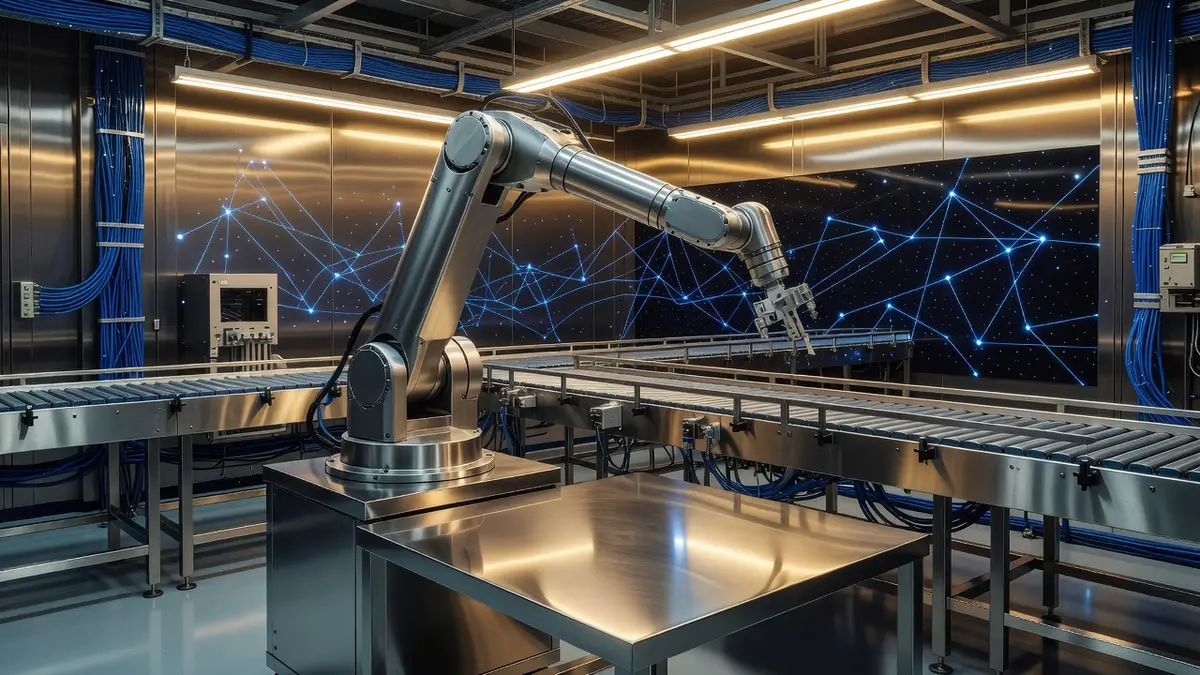
Three UK engineering businesses, Siemens, Wymbs Engineering, and HMK Automation & Drives, have jointly developed a modular robotic cell designed to bring automation within reach of food manufacturers who have historically been locked out by cost and complexity. The platform was unveiled at Siemens Transform 2026, the company's biennial industrial showcase at Manchester Central on 15–16 July.
The logic is straightforward. Robotics in food manufacturing have long relied on vendor-specific controllers, software stacks, and programming environments that demand specialist knowledge most factory teams simply do not have. The new open platform sidesteps that by routing robot control through Siemens' Totally Integrated Automation (TIA) Portal, the same environment operators already use to manage the wider production line. One interface. No separate robot-specific software. No need to call in the original equipment manufacturer every time something changes.
Advertisement

The modular cell is recipe-driven, meaning it can be reconfigured in software rather than by physical rebuild. Tasks range from pick-and-place handling and product depositing to injecting cream into doughnuts, placing fruit fillings into biscuits, and decorating bakery products. That last detail is not incidental. Wymbs Engineering, a family-owned Stockport business with more than 40 years designing specialist food processing equipment, has shaped the platform specifically for the bakery and confectionery production environment, where short production runs, frequent SKU changes, and cramped lines have always made robot integration awkward.
Why the Timing Matters
The announcement lands at a curious moment for UK bakery manufacturing. According to AIBD analysis of Companies House data, just 37 new SIC 10.71 companies (bread and bakery goods manufacturing) were incorporated in 2026-Q3, a fall of 87.1% against the prior period. New entrant activity has, in effect, stalled. At the same time, UK Intellectual Property Office trademark filings for Class 7 (machinery and mechanical appliances) reached only 214 in 2026-Q3, down 79.5% on the prior period, a sign that the broader industrial machinery sector is also pulling back on brand-building investment. Perhaps most telling: AIBD analysis of Companies House and IPO data finds that 97.3% of active SIC 10.71 companies hold no Class 7 trademark whatsoever. Food manufacturers are not registering the machinery brands that automation would logically prompt them to develop. Source: AIBD analysis of Companies House (MC) / IPO (TMD) data, as of 2026-07.
That picture is consistent with what the broader UK manufacturing research community has been saying. A Rockwell Automation survey of more than 1,500 manufacturing leaders published earlier this year found that 87% of UK manufacturers consider digital technology essential and are allocating an average of 27% of operating budgets to industrial technology, yet translating that commitment into consistent operational outcomes remains the core problem. Siemens itself made the same argument at Transform 2026 in its opening keynote: UK businesses can capitalise on AI at pace, but only if the technology is embedded in ways production teams can actually run day-to-day.
The Structural Argument for Open Platforms
The UK warehouse and logistics sector has been moving towards modular, retrofittable automation for some time. Warehouse & Logistics News reported in February that operators are increasingly retrofitting brownfield sites rather than building new distribution centres from scratch, reflecting land scarcity and the desire to extract more from existing assets. The same logic applies on the factory floor. Large-scale, bespoke robotics installations are capital-heavy and slow to reconfigure. A recipe-driven modular cell that plugs into existing automation infrastructure cuts both capex and changeover risk.
The AI layer matters here too. Siemens has incorporated AI capability into the platform to give operators and maintenance teams more accessible diagnostic information during production runs. In a food manufacturing environment, where a line stoppage during a peak overnight bake run costs real money and there may be nobody with robotics programming skills on site, that kind of plain-language machine intelligence is worth more than a sophisticated dashboard nobody can interpret at 3am.
What Comes Next
Siemens also unveiled its Digital Twin Composer at the same Manchester event. Built with NVIDIA Omniverse libraries and part of the Xcelerator portfolio, it allows manufacturers to simulate entire production lines and test configuration changes virtually before touching the physical environment. Early US deployments have demonstrated the tool can identify up to 90% of potential issues before any physical modifications occur, a claim that will get the attention of any plant manager who has lived through a botched line reconfiguration.
Digital twins are, for the moment, an enterprise conversation. The modular robotics cell is a more immediate proposition for the mid-market food manufacturer. The sector needs it. New bakery incorporations are near zero, brand investment is negligible, and the automation gap identified in government research, that only 5% of UK manufacturers currently use AI to optimise operations, is widest in the food processing segment. Injecting cream into doughnuts is not glamorous. It is, however, exactly the kind of application where a well-configured robotic cell pays for itself in a single shift.