China's Robot Army Picks Britain: Geek+ Fills the US Vacuum in UK Warehouses
With Washington banning foreign-made advanced robots on national security grounds, the UK has quietly become China's largest European warehouse robotics market. Tesco, Asda and Next are already running the fleet.
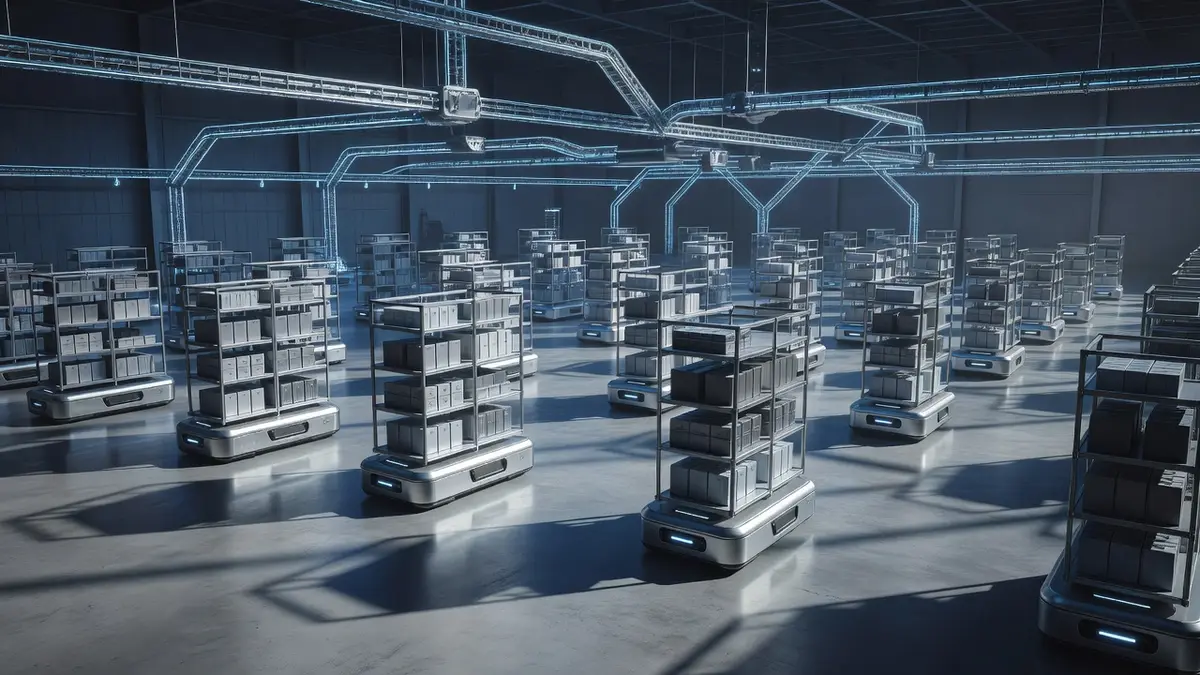
The Shelf That Came from Hefei
Something structural has shifted in British logistics, and it did not announce itself loudly. Squat autonomous robots are now gliding beneath warehouse racks in distribution centres serving some of Britain's biggest retailers, lifting entire shelving units and ferrying them to stationary human pickers. The robots are built in Hefei, eastern China. The company is Geek+. And Britain, almost without public debate, has become its largest European market.
Geek+'s UK deployment partner MotionTech has placed more than 2,000 robots across ten warehouse sites in Britain, serving Tesco, Asda and Next. That footprint, reported by the BBC and confirmed across multiple trade outlets this week, represents a significant concentration of foreign-built autonomous mobile robots (AMRs) inside the UK's critical retail supply chain infrastructure.
Advertisement

What Makes This Different
The usual caveat for warehouse automation stories is that the technology is expensive, slow to deploy, and requires permanent structural modification. Geek+'s case dismantles that argument. Unlike conventional systems that depend on fixed conveyor infrastructure and heavy construction, the Geek+ model deploys using QR code floor markers and safety fencing. Setup is light; the intelligence is computational. That combination of rapid installation, minimal disruption and AI-driven route optimisation is precisely what a logistics operator facing a Brexit-era labour gap and relentless e-commerce throughput demands.
By automating repetitive picking journeys, Geek+ says retailers can increase picking speeds, store more goods in spaces difficult for human workers to reach, and reduce errors substantially. MotionTech's account director Barry Pemberton is direct about the pull: customers want high-volume, high-storage, fast-picking solutions that can be stood up without rebuilding a distribution centre.
The Productivity Verdict
The macro context is uncomfortable reading for any government claiming to revive British industry. In its 2026 SME Technology Adoption report, the OECD described the UK's low uptake of robotics as "surprising" given the country's manufacturing heritage, noting that British firms have adopted mature digital technologies while lagging badly on physical automation. The UK has one of Europe's largest e-commerce and logistics sectors, but many warehouses remain in the early stages of mechanisation. That gap is precisely where Chinese AMR suppliers are inserting themselves.
The numbers back that assessment. UK online retail sales reached £128.6 billion in 2025, representing 29% of total retail, according to the Office for National Statistics. The sector processes over 4.4 billion online orders annually. Manual operations alone cannot process that volume competitively, and the chronic vacancy rate for warehouse operatives has made the case for automation practically self-writing.
Trade unions have not been silent. The TUC has urged businesses to ensure automation improves jobs and productivity rather than simply cutting headcount, and has called for genuine investment in worker retraining alongside any deployment programme. That tension will intensify as Geek+ pursues its stated long-term objective: fully unmanned warehouse solutions covering picking, packing and the entire handling chain.
Washington Slams the Door Britain Left Open
Here is where the story sharpens considerably. On 27 July 2026, the US Federal Communications Commission added all foreign-produced advanced robotic devices to its national security Covered List, effectively banning their import. The FCC determined that such devices (defined as networked autonomous robots weighing more than two kilograms) could create cybersecurity risks threatening critical infrastructure and supply chain vulnerabilities threatening US economic security. The ban covers new models of AMRs, humanoid robots, quadrupeds and wheeled robots with network connectivity.
The determination was rooted in findings from a White House interagency task force, which concluded foreign-built robots could be used to surveil Americans, enhance foreign intelligence services, or be remotely commandeered. Geek+, which listed in Hong Kong in 2025 in one of the biggest robotics share sales of that year, is a direct casualty of that ruling in the US market. Britain's government has issued no equivalent restriction.
The divergence matters strategically. A Chinese robotics sector shut out of the United States will intensify its commercial focus on markets that remain open. The UK, with its structural labour shortage, its underpowered domestic robotics capability and its appetite for rapid-deploy solutions, is the obvious next target. Analysts have already noted that China's robotics push mirrors its electric vehicle playbook: manufacturing scale, dense supplier networks and rapid iteration. Batteries, sensors and electric motors developed for the EV sector are being repurposed across the robotics supply chain, compressing development costs and accelerating deployment cycles.
A Trademark Signal Worth Watching
One ancillary indicator captures the sector's shifting dynamics. AIBD analysis of IPO (TMD) data as of August 2026 shows UK trademark filings in Nice Class 7 (which covers industrial machinery and robots) totalled just 420 in Q3 2026, down 59.7% on the prior period. A sharp fall in domestic brand registrations in the machinery class, at the same moment that foreign-built robot deployments are accelerating, suggests British firms are not rushing to compete. The intellectual property pipeline that typically precedes domestic manufacturing ambition is thin.
Geek+ itself has already signalled where the technology is heading. Humanoid robots for picking and packing are in development, though commercial deployment at scale remains years away by most expert assessments. In the near term, the shelf-lifting AMR is the product. Britain's warehouses are buying it at volume. Washington's ban has, inadvertently, handed Geek+ a less contested Western market in which to entrench itself further.