Siemens Drops Physics-Based Digital Twin on UK Factories - But the Pilot Trap Still Looms
Siemens and NVIDIA unveiled AI-powered simulation software for UK and Irish manufacturers at Transform 2026 in Manchester last week. The technology is credible. Whether British factories can actually absorb it is a different question entirely.
The Demo Was Impressive. The Deployment Problem Isn't New.
At Manchester Central on 15–16 July, Siemens staged its biennial Transform showcase and used the occasion to launch something with real structural weight: Digital Twin Composer, a physics-based simulation platform built on NVIDIA Omniverse libraries and offered through the Siemens Xcelerator portfolio to UK and Ireland customers for the first time.
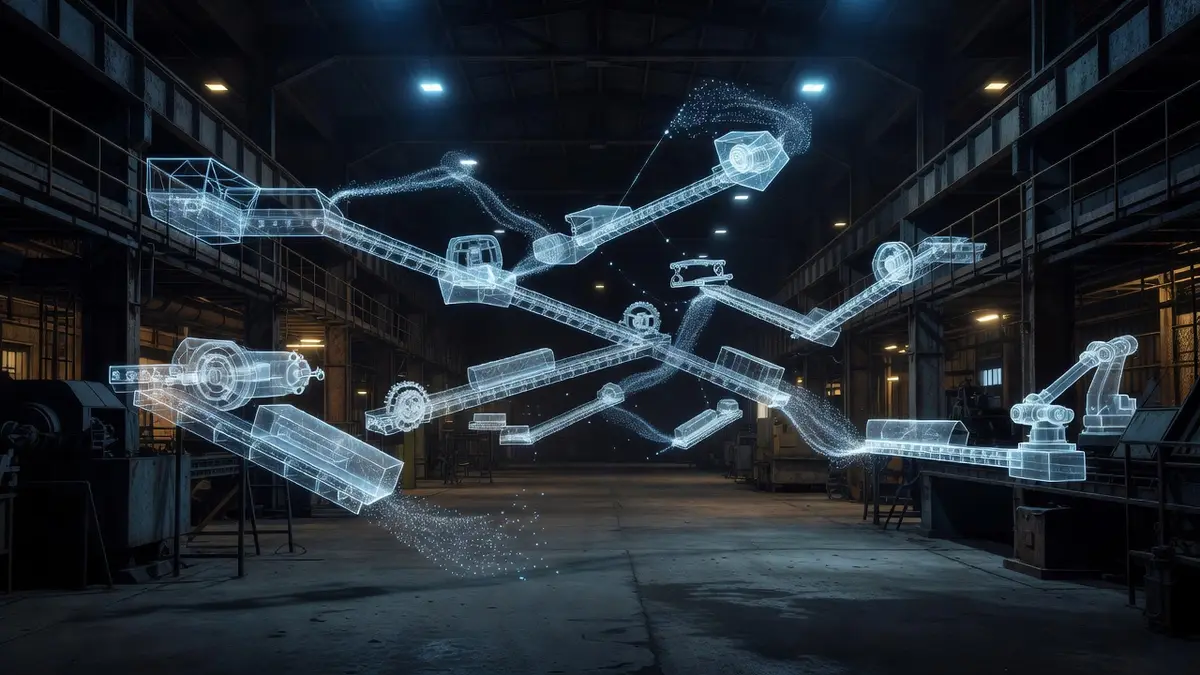
The pitch is direct. The software lets manufacturers combine 2D and 3D digital twin data with live operational data in a photorealistic virtual scene, allowing teams to simulate production line changes, test automation designs and model energy reduction scenarios before any physical works begin. Brian Holliday, CEO of Siemens UK and Ireland, demonstrated the product alongside NVIDIA's UK and Ireland regional director Anthony Hills, framing it as a way to make faster, lower-risk decisions at industrial scale.
Advertisement

Siemens has form here. PepsiCo has already used Digital Twin Composer on US manufacturing and warehouse facilities, reportedly identifying up to 90 percent of potential issues before physical modifications, achieving a 20 percent increase in throughput on initial deployment and cutting design cycles significantly. That is a compelling reference case. But PepsiCo is a global FMCG giant with dedicated digital infrastructure teams. The median UK food manufacturer is not.
The Execution Gap Is Structural
The timing of Siemens' UK push is sharp, because the sector's underlying readiness problem has never been more clearly documented. A report published in June by the High Value Manufacturing (HVM) Catapult, authored by Professor Chris Dungey, the organisation's Chief Technology Officer and the government's own AI Champion for Advanced Manufacturing, found that UK manufacturers remain largely stuck at the experimentation phase, unable to deploy AI at scale despite world-leading research capability.
Dungey's report, From Pilot to Production, puts a number on the stakes: manufacturing contributes around £234bn annually to the UK economy, supports 2.5 million jobs and accounts for nearly half of private sector R&D investment. The AI opportunity is not academic. But the report identifies a structural bottleneck: data quality, not algorithmic sophistication, is the primary constraint for most facilities. You cannot run a physics-based digital twin on a factory floor that cannot tell you, in real time, where its pallets are.
Rockwell Automation's UK managing director Phil Hadfield captured the inflection point earlier this year: "The challenge is no longer access to technology, but the ability to embed it into production environments in a way that improves performance, resilience and competitiveness." That is, if anything, an understatement.
What the Company Formation Data Tells You
The proprietary data compounds the picture. AI Business Dispatch analysis of Companies House and IPO filings shows just 41 new SIC 10.71 companies incorporated in 2026-Q3, an 85.7 percent collapse versus the prior period. Class 12 UK trademark filings, vehicles and transport apparatus, broadly a proxy for applied industrial and automation IP, fell to 236 in the same quarter, down 74.3 percent. And 97.4 percent of active SIC 10.71 companies currently hold no Class 12 trademark at all. (AIBD analysis of Companies House and IPO data, as of July 2026.)
Those numbers are not a sign that the food manufacturing or industrial transport sectors have stopped innovating. They are a sign that new entrant activity has compressed sharply, likely squeezed by input cost pressure, energy costs and cautious capex. The companies best placed to adopt Digital Twin Composer are large enough to afford the integration burden and stable enough to carry a multi-year deployment roadmap. Smaller operators, which make up the bulk of the UK's industrial base, are the ones the HVM Catapult report is actually worried about.
The Scan-Pilot-Scale Problem
The government's AI adoption plan for advanced manufacturing, developed alongside Dungey's work, proposes a national pathway it labels Scan-Pilot-Scale, drawing on existing infrastructure through Made Smarter, Innovate UK, BridgeAI, the HVM Catapult and regional networks. The instinct is right. The framework at least avoids the British institutional reflex of creating a new quango every time a problem needs a solution.
A pathway is not a factory. Transform 2026 showcased digital acoustics twins of the Hallé St Peter's concert hall in Manchester alongside live manufacturing demos. Both are technically interesting. One is immediately deployable for Airbus or a large automotive tier-one. The other is not yet relevant for a 120-person precision components firm in Wolverhampton trying to decide whether to upgrade its ERP first.
Siemens is explicit that it is "already using the product with major customers in the US" and sees "huge potential to underpin the transformation of UK industry." Potential is not a production KPI.
The Energy Angle Nobody Is Ignoring
There is one area where the digital twin case is becoming unavoidable at every scale: energy. UK manufacturers now face grid connection timelines measured in years, not months, and input electricity costs that directly erode margin. Simulating production line energy consumption before physical build is no longer a nice feature. It is cost avoidance in a period when UK energy capacity growth is projected at a modest 16 percent over the next 12–24 months, already below the global average.
If Siemens and NVIDIA can close the software engineering complexity gap, Holliday's phrase was that Digital Twin Composer "fundamentally reduces software engineering effort, a former barrier to digital twin adoption", then the energy optimisation use case alone may drive adoption faster than any productivity argument. That is the number that lands in a board conversation in 2026.
The pilot trap is real. But so is the energy bill.