Siemens Brings Physics-Based Digital Twins to UK Factory Floors - But Most Manufacturers Can't Yet Use Them
Siemens unveiled AI-powered digital twin software for UK and Irish manufacturers last week. The problem: the industry it's targeting is still mostly running on spreadsheets and instinct.
The Pitch from Manchester
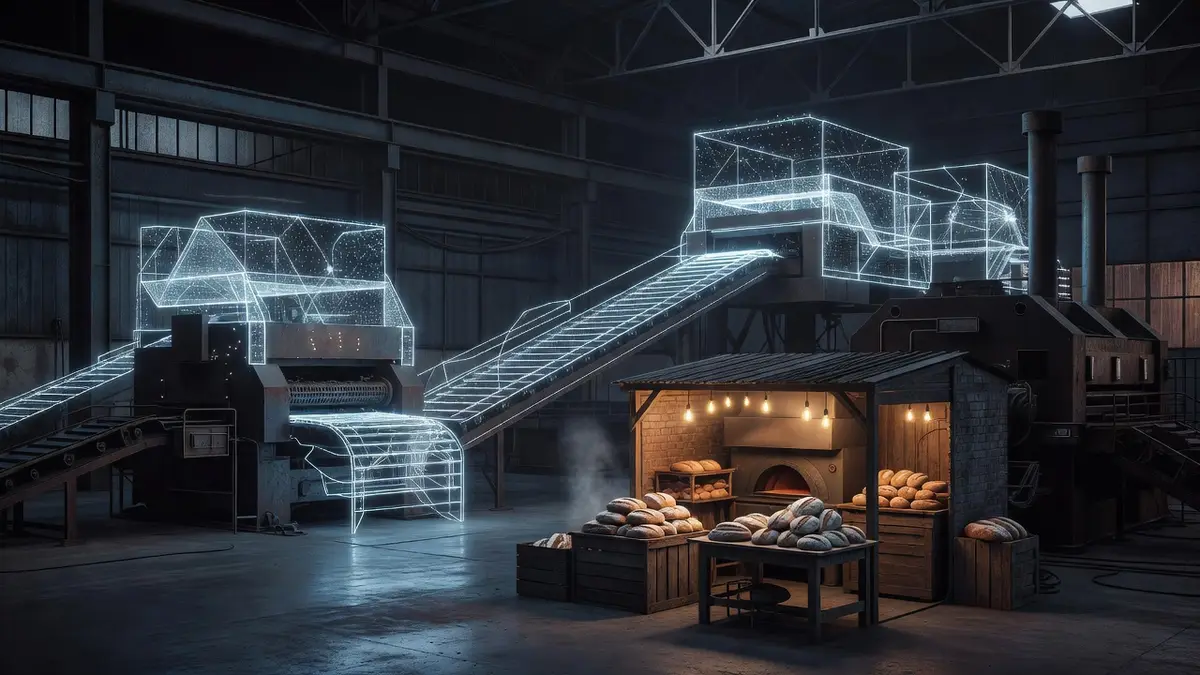
At its Transform 2026 showcase in Manchester last week, Siemens announced that its Digital Twin Composer software, built in collaboration with NVIDIA using Omniverse simulation libraries, is now available to UK and Ireland customers. The proposition is straightforward on paper: give manufacturers a physics-based, real-time virtual copy of their factory or product, let industrial AI run scenarios against it, and make better decisions before committing metal and money.
The Digital Twin Composer, part of the Siemens Xcelerator portfolio, was showcased at Transform 2026 in Manchester, with Siemens UK and Ireland CEO Brian Holliday demonstrating alongside NVIDIA how real-time operational data and physical AI can support faster, lower-risk decision-making. The software itself is not new: PepsiCo has been using the Digital Twin Composer to simulate upgrades to its US facilities, while the Siemens-NVIDIA partnership is targeting AI-native simulation and AI-driven adaptive manufacturing across the full industrial value chain.
Advertisement

Bringing it to UK shores is the news. The question is whether UK manufacturers are in any position to receive it.
The Adoption Gap Is Structural
AI adoption across UK manufacturing remains uneven and slow, particularly in high-value application areas such as operational technology, and too many businesses still struggle to move from experimentation to sustained, operational deployment. The government's own AI Champion for Advanced Manufacturing, Chris Dungey, put it plainly in a June report: the UK does not lack AI capability, it lacks a clear pathway to deploy and scale industrial AI across manufacturing, with many SMEs facing common barriers including legacy capital-intensive operational systems and fragmented industrial data, leaving promising AI projects trapped in pilot phases.
Rockwell Automation's UK managing director Phil Hadfield is more optimistic on direction, if not on pace. Based on feedback from more than 1,500 manufacturing leaders globally, recent research highlights a shift in how UK manufacturers are approaching digital transformation, with 87% of organisations recognising it as essential and allocating an average of 27% of operating budgets to industrial technology. But allocating budget and actually deploying are different things. Nearly half of manufacturers have already invested in AI, and the focus is shifting away from experimentation toward practical use cases that deliver measurable value. Shifting focus is not the same as shifting outcomes.
Siemens frames its digital twin offering as "a practical way to test decisions and designs before they attract cost in the physical world," with examples including improving a production line to increase capacity or reduce energy, and validating automation designs to optimise for a desired business result. That framing is deliberately modest. A physics-based simulation environment built on NVIDIA Omniverse is not, by any reasonable measure, a modest tool.
The Bakery Problem: A Case Study in the AI Divide
To understand what the digital twin pitch is up against, look at SIC 10.71, the UK's bread and bakery goods manufacturers. It's a sector that illustrates the structural gap between enterprise-grade AI tooling and the reality of most British food production.
The UK's bread and bakery goods manufacturing market is worth £8.8bn in 2026, with 2,933 businesses in the sector, a figure that has grown at a CAGR of 2.0% between 2021 and 2026. Yet the sector's relationship with AI remains almost entirely at the conceptual stage. According to AIBD analysis of Companies House data, just 35 new SIC 10.71 companies were incorporated in Q3 2026, a collapse of 87.8% against the prior period. On the brand-building side, UK IPO data shows only 88 Class 4 trademark filings from the sector in Q3 2026, down 79.9% period-on-period. Most striking: 97.6% of active SIC 10.71 companies hold no Class 4 trademark at all. This is not an industry in expansion mode. (Source: AIBD analysis of Companies House and IPO data, as of July 2026.)
German start-up Foodforecast Technologies entered the UK market in May, aiming directly at this problem. Cologne-based Foodforecast Technologies rolled out its AI-powered demand and production forecasting software in the UK, targeting food waste in the baking sector, a sector in which, according to WRAP, bakeries generate 75,000 tonnes of entirely preventable food waste every year, costing the industry £1.1bn. Customers on the platform have achieved food waste reductions of up to 34%, sales uplifts of up to 11%, and more than 90% automation of previously manual ordering and production planning processes, with over 8,800 tonnes of food already saved across Europe.
The Foodforecast model, integrating with existing POS data to forecast intra-day demand using weather, local events and seasonality and automating ordering, sits at the opposite end of the technology spectrum from Siemens' immersive 3D twin. Spreadsheets, historical averages, and the instinct of experienced bakers cannot account for the full complexity of demand: weather changes footfall, local events shift purchasing patterns, and a bank holiday behaves differently from a regular Monday. Fix the spreadsheet problem first. The factory metaverse comes later.
The Grid Question Nobody Has Answered
There is a structural irony sitting beneath both stories. The more manufacturers adopt AI tooling, whether demand forecasting software or full digital twins with real-time physical data feeds, the more compute they need. And UK compute infrastructure is under serious strain.
AI and high-performance computing are pushing data centre demand into the hundreds of megawatts, electricity grid capacity is scarce in key UK locations, and connection dates now sit at board level. Microsoft has warned that without swift grid upgrades some of its UK data centres might wait until the mid-2030s for full power connection, with experts warning of a disconnect between UK AI ambitions and timely power access.
For a large Siemens enterprise customer running a full physics-based digital twin of a manufacturing plant, compute sits in the cloud and the grid problem is abstracted away. For a small bakery in the East Midlands trying to run demand forecasting on its till data, it barely registers. But somewhere between those two points, the infrastructure constraint becomes real.
What the Freshness Window Reveals
Siemens' launch is genuinely significant as a marker: serious enterprise industrial AI tooling, built on NVIDIA silicon, is now being actively pitched at UK manufacturers rather than only at US or German ones. Siemens notes it is already using the product with major customers in the US and sees significant potential to transform UK industry, citing that the software fundamentally reduces software engineering effort, a former barrier to digital twin adoption.
The UK government's own AI adoption plan acknowledges as much. The question for the UK is no longer whether the technology exists, but whether it can be adopted confidently, safely and at pace, and if the UK moves too slowly, it risks weaker productivity growth and falling behind countries already converting AI capability into industrial advantage.
The bakery numbers tell you where most of British manufacturing actually sits in that story. Digital twins built on NVIDIA Omniverse are not the problem. Adoption is. And adoption is a management, data quality, and capital allocation problem that no amount of physics-based simulation can solve by itself.