Siemens Brings Physics-Based Digital Twins to UK Factory Floors - But Can Smaller Manufacturers Catch Up?
Siemens unveiled its AI-powered Digital Twin Composer for the UK and Ireland market at its Transform 2026 showcase in Manchester last week. The timing is pointed: research shows UK manufacturers are finally moving from AI experimentation to industrial execution - yet the evidence from Companies House suggests a startling gap between ambition and brand commitment at the base of the sector.
Virtual Factories, Real Stakes
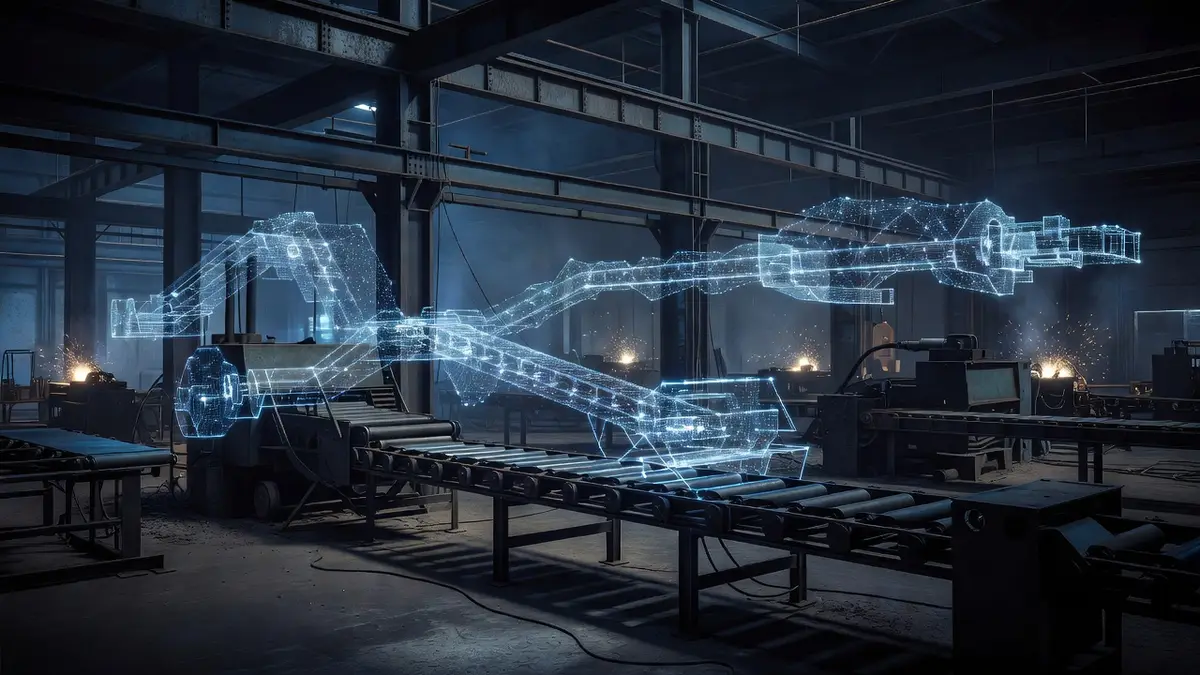
The pitch is straightforward enough. Build a complete, physics-accurate virtual replica of your product or production line. Run every what-if you can think of. Only then spend money in the physical world. Siemens and NVIDIA are betting that UK and Irish manufacturers are finally ready to buy into that logic at scale.
The Digital Twin Composer, part of the Siemens Xcelerator portfolio, was the headline act at Transform 2026, Siemens' biennial industrial showcase, which ran on 15–16 July at Manchester Central and drew an expected 6,000 delegates across roughly 10,000 square metres of exhibition space. The event brought together manufacturers, infrastructure operators and industrial technology leaders to explore how digitalisation, automation and AI are reshaping how products and industrial systems are designed, built and operated.
Advertisement

The software combines 2D and 3D data from Siemens' digital twin with physical real-time information, rendered in a high-fidelity visual scene built using NVIDIA Omniverse libraries. The collaboration between the two companies, first expanded at CES in January, is framed as an "Industrial AI Operating System" covering the end-to-end industrial value chain from design and engineering through to manufacturing, production and supply chains.
What the Digital Twin Composer Actually Does
The practical use cases are more prosaic than the marketing, but no less significant for that. Siemens' own examples focus on production line capacity improvements and energy reduction: validating an automation design virtually before it becomes a capital project. The claim is that this "fundamentally reduces software engineering effort, a former barrier to digital twin adoption."
That barrier was real. Digital twins were, until recently, the preserve of aerospace primes and automotive giants with armies of simulation engineers. The Composer's pitch is that it collapses that entry cost substantially, putting high-fidelity operational simulation within reach of a broader tier of manufacturer.
Transform 2026 also saw Siemens demonstrate how industrial-grade AI is accelerating production, improving resilience and enabling greener operations, alongside next-generation grid technologies and intelligent electrification for modernising energy systems. The physical-energy nexus is part of the product story, not a side note.
The Execution Gap
The backdrop for the Transform launch is a UK manufacturing sector that has, by most measures, graduated from asking whether to adopt AI to asking how. Research published earlier this year by Manufacturing Management, drawing on feedback from more than 1,500 manufacturing leaders globally, found that 87% of organisations now recognise digital investment as essential, allocating an average of 27% of operating budgets to industrial technology. UK manufacturers are described as among Europe's most active in adopting AI, including generative AI.
That headline figure conceals a structural problem Siemens is implicitly trying to solve. The challenge, in the words of Rockwell Automation's UK managing director Phil Hadfield, is no longer access to technology: it is "the ability to embed it into production environments in a way that improves performance, resilience and competitiveness." Piloting is one thing. Scaling is another.
Cybersecurity has emerged as the leading AI application in UK manufacturing, followed by quality control and process optimisation. Simulation-led design sits further up the maturity ladder, which is precisely why the Composer launch matters as a market signal.
The Brand Commitment Signal
Proprietary data from AI Business Dispatch tells a quieter story at the formation end of the sector. Analysis of Companies House and IPO data as of July 2026 shows that only 42 new companies registered under SIC 10.71 (bread and flour confectionery manufacturing) in Q3 2026, a collapse of 85.3% against the prior period. That is not a pandemic-era blip; it reflects a broader consolidation dynamic in food manufacturing where energy costs, input inflation and margin pressure have made new market entry increasingly unattractive.
More telling: 97.3% of active SIC 10.71 companies hold no Class 39 trademark, the class covering transport, packaging, and storage of goods. In a sector where supply chain control and logistics branding are increasingly competitive differentiators, that is a significant exposure. UK Class 39 trademark filings dropped to just 311 in Q3 2026, down 74.7% on the prior period, according to AIBD analysis of Companies House and IPO (TrademarkDashboard) data. Firms that cannot articulate or protect their logistics proposition are poorly positioned to benefit from any of the digital-twin advantages Siemens is selling.
The gap between the Siemens pitch and the Companies House data is, in short, the gap between where the industry wants to go and where most of it actually sits.
The Brownfield Problem
No software launch resolves this structural reality on its own. Warehouse and logistics automation in the UK is shifting from greenfield new-builds to retrofitting existing brownfield sites. That shift reflects both the scarcity of suitable new development land and operators' need to sweat existing assets harder. Modular, scalable automation cells are replacing full-warehouse redesigns, because the capital risk of a single large system is too high for most operators.
Digital twins fit naturally into that modular logic: simulate the retrofit before you commit the capex. But the software engineering effort, even reduced, still requires a baseline of data quality and connectivity that many mid-tier manufacturers have not yet achieved. As one industry analysis put it bluntly: AI's real barrier is no longer culture; it is data quality and unclear ROI.
Siemens is selling the solution. The industry still has to build the foundation.
Manchester as Signpost
There is something fitting about Manchester Central hosting this. The city that gave the world the industrial revolution's first mechanised cotton mills is now being used to demonstrate physics-based virtual factories. The distance between those two things, in time, in complexity, in capital intensity, is roughly the measure of how far British industry has come, and how much further it needs to travel.
The Composer is a credible tool. The question is whether the 97% of SIC 10.71 companies with no logistics trademark and the 80% of UK manufacturers yet to embed AI meaningfully into operations will ever get close enough to use it.