SaaSpocalypse Rebound Hides a Structural Fault Line: Infrastructure SaaS Pulls Away as Per-Seat Pricing Collapses
Six months after AI agents erased roughly $2 trillion in software market cap, valuation multiples have bifurcated sharply - data infrastructure commands premiums while horizontal workflow tools trade at distressed levels. The engineering reason matters for every UK SaaS vendor still pricing by the seat.
Something quietly extraordinary happened to software valuations this August. Six months after the market coined a word for what felt like an existential crisis, the post-SaaSpocalypse landscape has split cleanly in two, and the fault line runs exactly where the architecture dictates it should.
How We Got Here
The immediate catalyst is well-documented by now. Anthropic's Claude Cowork announcement in February 2026 served as the catalytic event: the product demonstrated that a single AI tool could replace functions spread across multiple enterprise software platforms, including legal document management, compliance automation, financial analysis, and workflow orchestration. In roughly 48 hours, approximately $285 billion vanished from SaaS company valuations. A rolling correction that had already wiped more than $1 trillion from software stocks pushed sector-wide declines past 20% year-to-date by February 2026.
Advertisement

The term SaaSpocalypse was coined by a Jefferies trader in February 2026, which tells you something about the speed at which sell-side vocabulary crystallises when the fear is genuine. Jefferies had just downgraded Workday and DocuSign. Thomson Reuters posted its single worst day on record. The market was not rotating; it was reassessing.
The part that gets less attention: unlike previous tech corrections driven by valuation multiples or macroeconomic conditions, this decline reflects a fundamental reassessment of whether traditional SaaS business models can survive when AI agents perform the same tasks without dedicated software interfaces. That is an engineering question dressed up as a finance question. And engineering questions have engineering answers.
The Architecture Explains the Divergence
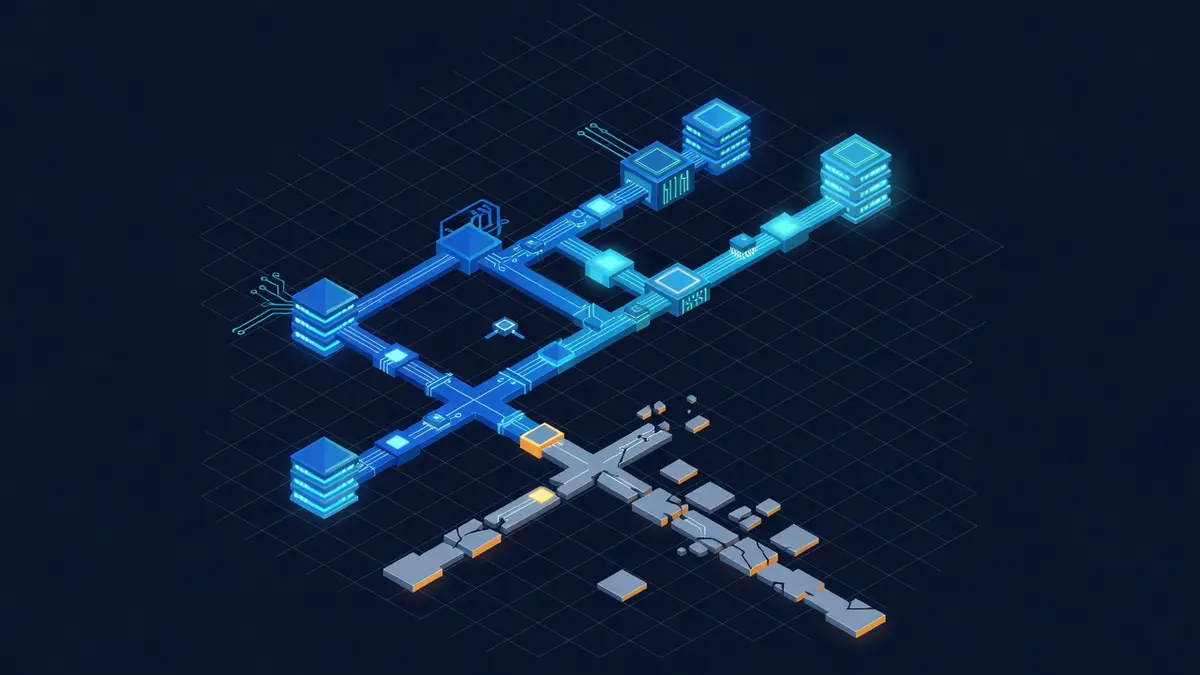
Think of the SaaS stack as a city's water system. Applications sitting on top, the taps and fixtures, are exactly what AI agents have learned to operate directly. The pipes, the treatment plant, the pressure-management infrastructure: those remain necessary regardless of who or what turns the tap.
Horizontal SaaS public comps in August 2026 show wide valuation dispersion, a sign of AI's creative destruction. Design and engineering software commands premium multiples, as companies like Autodesk and Adobe successfully integrate AI features that enhance rather than cannibalise their core products. Meanwhile, infrastructure SaaS is pulling ahead of everything else. Data infrastructure commands the highest multiples across all categories, driven by the AI data boom. Every enterprise AI initiative begins with the data layer, and companies like Snowflake and Databricks have made themselves indispensable to that buildout.
The mechanism is almost tautological: you cannot run AI agents without the data pipelines AI agents need. Andrej Karpathy has been making this point since 2023. The model is the easy bit; the data infrastructure underneath is the hard engineering problem that compounds in value over time. The market has now priced that insight in.
At the other end of the stack, the problem is equally architectural. The era of predictable, recurring revenue based on per-seat licensing is under existential threat as autonomous AI agents begin to replace human workflows at scale. Not every SaaS company charges per seat for automatable task-level work. Companies that sell infrastructure, security, compliance, and data platforms are genuinely different from companies that sell per-seat access to productivity tools. That distinction, which once looked like a pricing philosophy, now looks like a survival variable.
The Agentic Completion Rate Nobody Is Talking About
Only 3.8% of tasks can be resolved end-to-end by AI agents as of August 2026, meaning that although AI agents can start a task, they aren't yet capable of replacing SaaS workflows at scale. That number deserves a moment. The entire SaaSpocalypse, the $2 trillion drawdown, the Jefferies downgrades, the frantic product pivots, was priced on a capability that currently closes fewer than 4% of tasks end-to-end. Alan Turing would have found the market's epistemology fascinating.
The trajectory matters as much as the snapshot. AI agents are getting better every quarter. Their cost is dropping every quarter. Their integration depth is increasing every quarter. The 3.8% completion rate is not a ceiling; it is a current reading on an instrument that moves fast. Vendors building on per-seat assumptions have, at best, a few product cycles to replatform.
Payroll costs are fixed and forecastable. AI-powered SaaS costs are dynamic, distributed, and often invisible until it's too late. That asymmetry in cost visibility is already reshaping how enterprise CIOs think about procurement, which is exactly the pressure that UK SaaS vendors with legacy pricing contracts will feel first.
The ONS Just Made This Legible in Policy Data
A quiet but consequential administrative story is running in parallel. Artificial intelligence-related activities are now explicitly recognised in SIC 2026, with important changes including the separation of general-purpose AI software and AI model development from broader software categories at the 5-digit level. The SIC 2026 structure with integral explanatory notes was published on 3 August 2026.
Why does this matter for the SaaSpocalypse story? Because SIC 2007 has long been unfit for purpose, failing to capture high-growth, modern industries, or keep up with how real businesses actually describe themselves. For the first time, UK policy and statistical infrastructure can formally distinguish between a company building general-purpose AI models and one writing vertical workflow software. That distinction will feed into everything from HMRC categorisation to ONS productivity measurement to public sector procurement frameworks and, critically, into how UK AI-native businesses present themselves to investors.
What the Trademark Signal Adds
Brand registration behaviour is a leading indicator. Companies file trademarks when they believe in a product's commercial future; they stop filing when confidence drains. AIBD analysis of IPO TMD data shows Class 38 UK trademark filings, covering telecommunications and data transmission services, the class most associated with connectivity-layer software infrastructure, reached just 624 filings in Q3 2026, down 48.2% versus the prior period. That is a dramatic contraction in a class that had been expanding steadily as software-defined networking and communications-API businesses proliferated.
The interpretation is not simple. It could reflect genuine confidence loss in the connectivity-layer SaaS market as AI agents reduce the need for discrete communication tooling. It could equally reflect consolidation: fewer new entrants bothering to file because the moat has moved elsewhere, specifically toward the data infrastructure layer that the valuation multiples are now rewarding. Either reading points in the same direction. The market's centre of gravity has shifted, and the brand-protection filings are following.
The So What
The SaaSpocalypse rebound is real but selective. Software stocks have rebounded by 13%, and top investors like Thoma Bravo say AI is actually helping software companies, not killing them. That is broadly true for companies sitting at the infrastructure layer. It is considerably less true for companies whose primary value proposition is putting a clean interface on top of a workflow that an agent can now handle directly.
For two decades, SaaS companies built moats around user habits, data lock-in, and workflow integration. AI agents are eroding each of these advantages simultaneously. The engineering response is not to add an AI chatbot to the sidebar. It is to move down the stack: own the data layer, own the orchestration layer, own the compliance and security primitives that agents cannot bypass. Every other product decision is rearranging fixtures while the pipes are being rerouted.
Six to Twelve Month Implications
The bifurcation in valuation multiples will harden. Vendors with data infrastructure or vertical AI-native positioning will continue to command premiums; horizontal workflow tools without a credible infrastructure story will face further compression, particularly as the agent completion rate climbs past single digits.
For UK SaaS businesses, the ONS SIC 2026 reclassification creates both an opportunity and a deadline. Companies that can genuinely classify under the new AI-specific five-digit codes will find it easier to access AI-focused procurement frameworks and investor screening criteria. Those that cannot will be statistically invisible in the policy data that shapes funding allocation.
The Class 38 trademark contraction suggests the connectivity-layer market has already digested the shock. Watch Class 42 filings, covering software and IT services, for the next signal. If those begin contracting at similar rates, the market is telling you the re-platforming window is closing faster than most vendor roadmaps assume.