HFCL's OptiQ AI Enters UK Market as Optical Fibre Emerges as a Third Constraint in AI Data Centre Builds
Compute and power get all the headlines, but a new optical connectivity play from HFCL reveals that fibre density is quietly becoming the third leg of the UK's AI infrastructure stool - and the brand IP strategy behind it signals a maturing market.
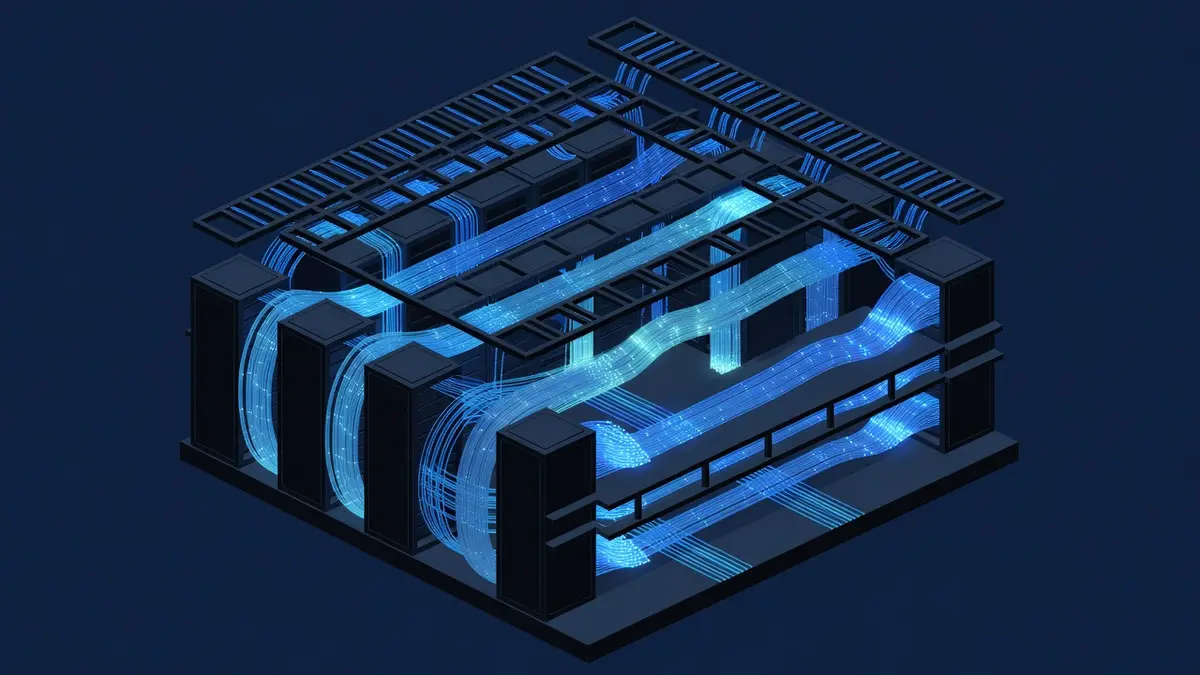
Something quietly extraordinary happened in the UK's AI infrastructure stack last week. HFCL Limited, a Mumbai-listed telecoms and network infrastructure company, announced the UK launch of OptiQ AI: an integrated optical connectivity portfolio aimed squarely at hyperscalers, cloud providers, and data centre operators building out capacity inside Britain's five designated AI Growth Zones.
The announcement is, on the surface, a product portfolio rebrand. Look at the engineering rationale underneath it, and you find something more interesting.
The Third Constraint Nobody Is Talking About
AI data centre conversations in 2026 follow a fairly predictable script: GPU allocation, power procurement, grid access. Those three topics consume most of the oxygen in planning meetings and trade press alike. HFCL's own executive framing of the launch was unusually direct in naming what that conversation leaves out.
The constraint is fibre density. Moving data between GPUs, servers, storage, and switches at scale requires optical infrastructure built for higher bandwidth and higher physical density, while letting operators deploy, maintain, and upgrade networks quickly. This is a plumbing problem. And like most plumbing problems, it becomes catastrophically visible only when it fails.
Think of it this way: a GPU cluster is the engine; the power grid is the fuel supply; the optical interconnect fabric is the manifold that routes everything between them. Manifold failures don't make headlines until the engine stops.
What OptiQ AI Actually Is
The OptiQ AI portfolio consolidates HFCL's established optical fibre and connectivity capabilities - IBR cables, fibre assemblies, patch cords, pigtails, trunks, cassettes, and enclosure panels - under a single unified brand identity built around five declared attributes: high quality, quantum bandwidth, densely quantified, quick rollout, and q-class uptime. HFCL describes these five pillars as forming "a complete optical ecosystem" purpose-built for AI, cloud, and hyperscale environments, explicitly positioned to reduce interoperability challenges across large-scale builds.
Three of those five attributes - densely quantified, quick rollout, and q-class uptime - map directly onto operational pain points that any network engineer who has commissioned a multi-rack AI cluster will recognise. Density: how many fibres can you route per rack unit without thermal or mechanical compromise. Rollout speed: how quickly can you reconfigure interconnects as workloads shift. Uptime class: what SLA discipline is built into the passive layer, which typically gets none.
The IBR (Intermittent Bend Radius) cable specification merits attention. IBR cables are designed for tight-routing environments inside densely populated racks and overhead cable management systems - precisely the environments that 400G and 800G GPU interconnects produce. As Applied Optoelectronics flagged in its Q1 2026 earnings, hyperscaler demand for 800G transceiver products is in active volume ramp; the passive fibre infrastructure underneath those transceivers has to keep pace.
The UK AI Growth Zone Context
The geographic logic here is not subtle. The UK is Western Europe's largest data centre market, with five AI Growth Zones - spanning the south east, north east, North Wales, South Wales, and Scotland - designated specifically to fast-track planning consent and grid access. As that build-out accelerates, optical connectivity is emerging as a delivery priority alongside power.
For a global supplier entering this market under a unified brand, timing the UK launch to coincide with the Growth Zone planning momentum is sensible positioning. The question for UK data centre operators is whether a single-vendor optical framework genuinely reduces interoperability friction across a multi-supplier build, or whether it introduces a different set of lock-in trade-offs. That calculus is real, and it doesn't resolve neatly.
The Brand Layer: Class 9 in a Contracting Quarter
There is a trademark dimension here that deserves its own paragraph, because it illuminates broader market dynamics. OptiQ AI is being launched as a unified brand identity across a product hardware portfolio - the kind of brand consolidation that typically involves Class 9 (scientific and technological apparatus and instruments, including software and electronics) filings at the UK IPO.
Class 9 is the single most-filed trademark class in the UK, per TrademarkDashboard's analysis of the full UK IPO register. AIBD's analysis of IPO Trade Mark Data (TMD) shows that Class 9 filings in Q3 2026 reached 8,685 - a decline of 8.3% against the prior period. That contraction runs counter to what the AI infrastructure build-out narrative would predict. More hardware, more sensors, more optical connectivity products entering the UK market should, in theory, produce more Class 9 applications as vendors protect their brands.
The explanation is probably multifactorial. The UK IPO's filing fee increase from £170 to £205 (effective 1 April 2026) introduced real cost friction for multi-class applications, particularly for smaller vendors. The end of the IPO's multi-mark application option - previously allowing up to six similar marks under a single filing - added further administrative cost. The Nice Classification 13th Edition, in force since January 2026, shifted several goods categories out of Class 9 entirely: standard eyewear moved to Class 10, emergency vehicles to Class 12. Some of Q3's apparent Class 9 decline may simply be reclassification artefact rather than reduced filing intent.
The signal from the trademark data is ambiguous. What it does confirm: the IP layer of the UK's AI infrastructure market is under fee and classification pressure at exactly the moment when vendor differentiation through brand is becoming strategically more important.
The ONS Recognises the Shift
The UK's statistical machinery has begun to catch up with the infrastructure reality. SIC 2026, published by the ONS, explicitly separates general-purpose AI software and AI model development from broader software categories at the 5-digit level. The earliest planned use in national accounts is the 2031 Blue Book - an almost comically long lag for a sector moving at this pace. But the classification infrastructure is being built, which matters for how regulators and investors will eventually read company formation and revenue data in this space.
What the Next Six to Twelve Months Look Like
HFCL's UK push is a leading indicator of something structural. As 800G optical interconnects move from hyperscaler pilots to volume deployment inside UK AI Growth Zone builds, the passive fibre layer will face qualification cycles, procurement standardisation pressure, and interoperability testing demands that didn't exist at 100G speeds. Vendors who arrive with a unified portfolio identity and pre-qualified component sets have a clear RFP advantage over those asking operators to assemble piecemeal from commodity catalogues.
Expect at least two or three competitive responses from established UK-market optical vendors over the next two quarters: either portfolio rebrands of their own, or partnership announcements with systems integrators already embedded in Growth Zone projects. The interoperability certification bodies, including those tied to the Open Compute Project's optical standards work, will become more prominent in vendor procurement conversations.
Watch the Class 9 filing volumes. If the Q3 dip persists into Q4, it will be genuinely informative: a hardware-intensive AI build-out that is not producing commensurate brand registration activity suggests that either the vendor field is dominated by a small number of large incumbents with existing IP portfolios, or that UK IP strategy in this sector is running behind commercial deployment. Neither reading is comfortable.