Robot Dogs on Site: McLaren's FieldAI Deal Signals AI Is Now a Compliance Tool, Not a Gimmick
McLaren Construction's partnership with US robotics firm FieldAI, announced on 6 July 2026, puts autonomous quadruped robots on live UK sites for the first time at scale. The timing is no accident: Building Safety Act pressure and HSE enforcement costs are turning site AI from a conference talking point into a commercial necessity.
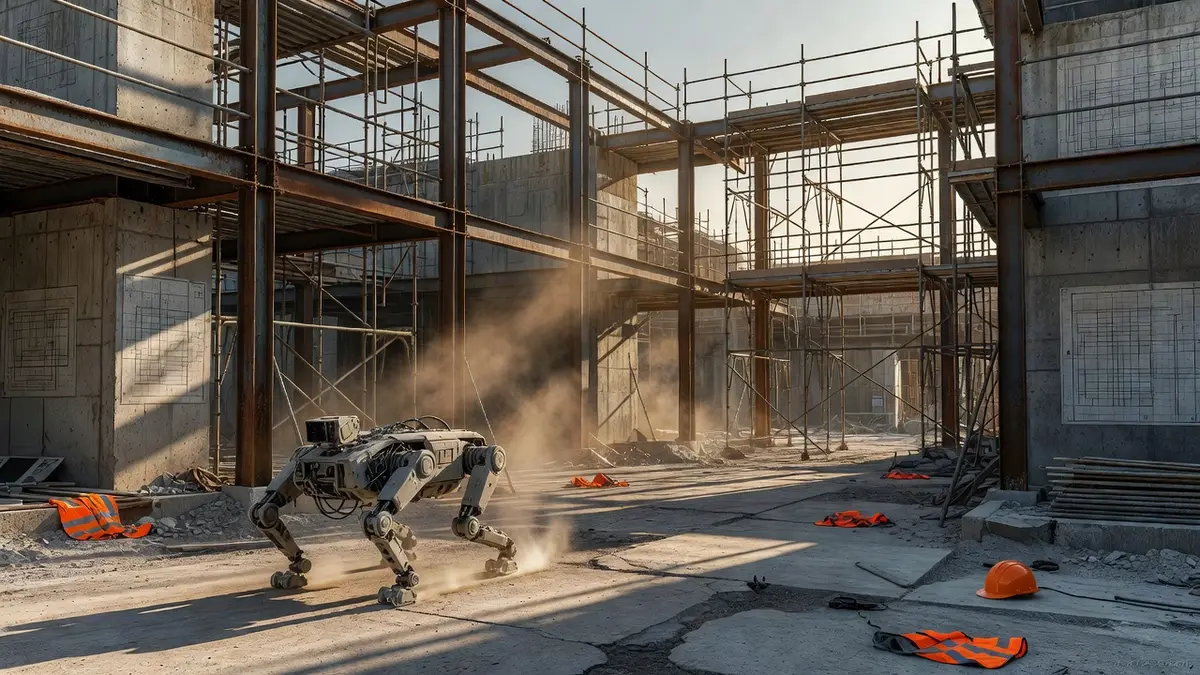
The Dog Has Landed
For years, robot dogs on construction sites were something you saw in a keynote deck, right between the drone footage and the slide about "Industry 4.0". McLaren Construction has just made the concept operational. Its new partnership with California-based FieldAI deploys autonomous quadruped robots across McLaren's UK project portfolio, with the announcement dropping on 6 July 2026.
This isn't a pilot. McLaren's group pre-construction director, Adam Nicholson, was explicit: "We now have autonomous robots navigating stairs, doors and other obstacles and constantly working with our human teams to support productivity, safety and quality." That's a step change in language from the usual "exploring the potential of" press release boilerplate.
What the Robots Actually Do
The immediate use case is monitoring, not manual labour. The FieldAI robots capture 360-degree site imagery and generate point cloud data, supporting progress verification, model-to-site deviation analysis, safety compliance patrols and quality assurance. Regular automated scans create a rolling visual and spatial record of work as it is installed.
The smarter part is what happens next. AI-enabled analysis compares that captured data against the design model, flagging installation deviations faster than any weekly site walk ever could. For a contractor working under Building Safety Act Gateway 2 requirements, where the Golden Thread of verifiable, auditable information is now a legal obligation, that real-time deviation detection has direct commercial value.
FieldAI's Field Foundation Models combine data-driven AI with physics-based reasoning and what the company calls "uncertainty quantification", which allows the robots to operate in the kind of chaotic, constantly changing environments that defeat most pre-programmed machines. The platform has already been deployed on hundreds of sites across Europe, Asia and North America; the McLaren deal is its formal UK market entry.
McLaren trialled the technology on its Passivhaus refurbishment of the London School of Economics' building at 35 Lincoln's Inn Fields, using a Boston Dynamics Spot robot. That trial gave the contractor confidence to move to scale deployment.
Compliance Is the Real Driver
The timing tells the whole story. On the same day McLaren made the announcement, the government amended the UK Building Safety Levy, removing an exemption for medium-sized sites and extending the tax on new residential developments. That levy is expected to raise £3.4 billion for building safety remediation, though industry groups have warned the change will hit SMEs disproportionately hard.
The HSE's enforcement record is not something you want to test. It secures convictions in 94 percent of its cases, with fines scaled to company turnover. Construction already accounts for a disproportionate share of UK workplace fatalities, and the Building Safety Regulator's latest figures, covering the 12 weeks to 28 June 2026, show a Gateway 2 application approval rate of 77 percent. Nearly one in four higher-risk building applications is not sailing through. The paper trail matters.
Across the sector, the shift is visible in the numbers. As of 2026, 74 percent of construction firms report using AI in some form, with 65 percent using BIM on at least half of their projects. The direction is clear, but the distribution is not even.
The Brand Gap Nobody Talks About
Here is a figure worth sitting with. According to AIBD analysis of Companies House and IPO data (as of July 2026), there were 835 new SIC 41.20 (general construction of buildings) companies registered in Q3 2026, a fall of 84 percent on the prior period. At the same time, UK Class 19 trademark filings in the same quarter came in at just 94, down 80 percent on the prior period. Class 19 covers non-metallic building materials: the product category most associated with branded construction components and systems.
More striking: 99.5 percent of active SIC 41.20 companies hold no Class 19 trademark whatsoever. That points to a sector where the vast majority of building firms have no formal brand protection over the materials and systems they specify, install or recommend.
For the new wave of construction tech vendors, that gap is a commercial opportunity. McLaren and FieldAI are the headline act. But the real market is the thousands of contractors below that tier who have no robotics, no AI workflow, and no brand architecture to distinguish themselves in a market about to bifurcate hard between digitally capable firms and those left managing compliance on clipboards.
The Liability Question Nobody Has Answered
Scaling autonomous robots on live sites raises a question UK legislation has not yet cleanly resolved. Existing health and safety frameworks, the Health and Safety at Work Act 1974, PUWER 1998, CDM 2015, were not written for autonomous decision-making. The Building Safety Act adds pressure because higher-risk projects increasingly depend on traceable, digital records. When a robot generates that evidence, the question of who owns the data and who validates it sits uncomfortably across the principal contractor, the robotics manufacturer, the software provider, and the client.
McLaren and FieldAI have confirmed they will work together to ensure the technology meets UK regulatory requirements and data security standards as deployments expand. But "working together" is not the same as a resolved liability framework. That gap will need closing before the rest of the industry follows.
The robot dogs are real, the compliance pressure is real, and the commercial logic is sound. The regulatory infrastructure to match is not yet there. On a sector that builds the spaces we live and work in, that matters.