UK's AI Manufacturing Roadmap Meets Its Hardest Test: An Order Book at a Six-Year Low
The government published its AI Adoption Plan for Advanced Manufacturing this week, promising £5-6bn in annual GVA gains. It landed into a sector where the CBI's latest survey shows order books at their weakest since 2020.
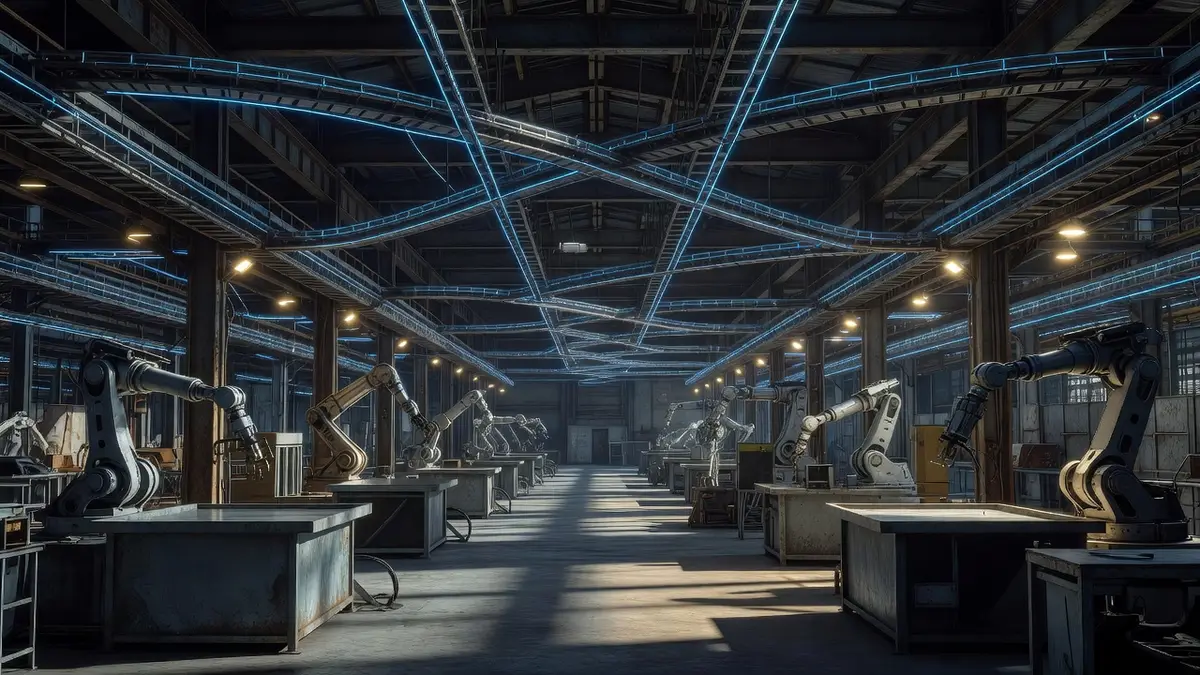
The timing is either brave or tone-deaf, depending on where you stand on Whitehall's capacity for irony. The government's AI Adoption Plan for Advanced Manufacturing, authored by government AI Champion Professor Chris Dungey and published on 30 July, sets out a compelling arithmetic: wider AI deployment could add £5-6bn in gross value added to the UK economy every year and lift sector productivity by 2.5%. Manufacturing already contributes around £234bn annually, supports 2.5 million jobs and drives almost half of all private-sector R&D investment in the country.
The plan is part of a wider £200m-plus package announced at the government's AI Adoption Summit, aimed at moving AI out of the lab and into everyday use across eight priority sectors. The political ambition is clear enough. The industrial reality is rather more complicated.
Advertisement

Order Books Say Otherwise
The CBI's Industrial Trends Survey, also published this month, reports UK manufacturing order books at their weakest level since 2020. Businesses cite soft demand, export challenges and ongoing cost pressures on labour, energy and materials. Make UK's own Manufacturing Outlook echoes the contradiction: many manufacturers remain focused on investment and long-term growth, even as the near-term numbers squeeze them from every direction.
This is the structural trap any AI roadmap must confront. Capital expenditure on automation requires confidence in future demand. When order books are thin, the ROI case for a major robotics programme looks shakier on a CFO's spreadsheet than it does in a government policy document.
The MTC's Answer: De-Risk Before You Commit
The most practical response to that dilemma came not from Westminster but from Coventry. The Manufacturing Technology Centre launched its Robot Experience Centre at Ansty Park in June, supported by Innovate UK through the High Value Manufacturing Catapult. The vendor-neutral facility lets manufacturers explore, test and validate robotic systems before making any purchases.
The centre comprises three dedicated areas: a modular automation and robotics sandpit for project development; a demonstration space for applications including welding, palletising and machine tending; and a collaborative robot development area. Alongside equipment access, it offers training and expert support to help businesses build skills and confidence before committing capital.
The initiative was built explicitly to tackle barriers among SMEs, where skills gaps, procurement complexity and implementation risk have historically stopped automation projects before they start. A new training programme, Robotics and Automation Adoption for Small to Medium Sized Enterprises, will provide practical guidance on evaluating, procuring and integrating robotics technologies. To support manufacturers beyond initial adoption, the MTC is establishing partnerships with system integrator partners, helping businesses move from proof of concept to production without costly re-engineering.
Richard Parker, Mayor of the West Midlands, opened the centre. His presence was not incidental: the West Midlands has a denser concentration of mid-sized manufacturers than almost anywhere else in England, and most of them are exactly the SME cohort the REC is designed to reach.
The Adoption Gap Is the Real Problem
The government's own plan acknowledges the core tension plainly: the UK has world-class strengths in AI capability and innovation, but adoption in manufacturing businesses and supply chains remains uneven and slow. That sentence could have been written in 2019.
The trademark data offers a structural footnote. UK Class 12 filings, which cover vehicles and transport machinery, reached just 346 in Q3 2026, a drop of 62.3% versus the prior period, according to AIBD analysis of IPO (TMD) data as of July 2026. Class 12 is a reasonable proxy for capital goods confidence in the transport and machinery segment. A collapse of that magnitude does not suggest a sector surging toward automation investment.
None of this means the government's plan is wrong. It means timing matters. Industrial AI adoption is not a campaign to be won by announcement. It is a 10-year infrastructure project, requiring stable demand signals, skilled workforces and the kind of patient capital that is notoriously scarce in UK manufacturing.
What Needs to Happen Next
The MTC's hands-on, de-risk-first model is structurally sounder than a roadmap alone. If manufacturers can trial before they buy, the capital commitment barrier drops. If system integrator partnerships reduce re-engineering risk, the implementation failure rate drops. Those are the two variables that have killed more UK automation programmes than any shortage of ambition.
The question is whether the government's £200m-plus package will flow toward that kind of practical infrastructure, or accumulate in pilot funds that never reach the factory floor. Gartner's research suggests 60% of supply chain disruptions will be resolved without human involvement by 2031, a reasonable forecast, but one that assumes the adoption work happens in the years between now and then.
The order books will recover. They always do. The question is whether the automation capability will be in place when they do, or whether UK manufacturers will find themselves scrambling to catch up with a German Mittelstand that never stopped investing.