UK Manufacturing's AI Gap: A Mile Wide, An Inch Deep
Fresh ONS data published this month shows AI adoption among UK businesses has nearly tripled since 2023 - yet in the factory, uptake is so shallow it barely registers on the shop floor. For an industry that can least afford to miss a productivity cycle, the numbers are a quiet alarm.
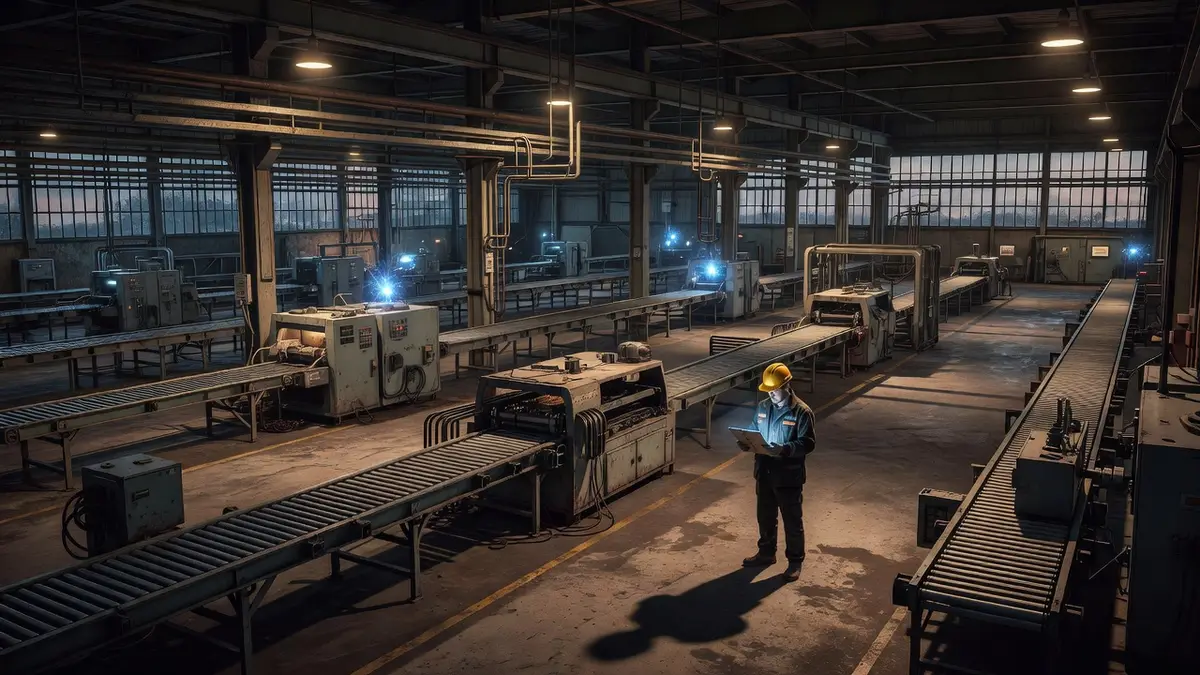
The Office for National Statistics released its first combined three-year view of AI in UK businesses this month, covering 2023 to 2026. The headline is arresting: self-reported AI use among businesses with ten or more employees has risen from around 12% to around 35% since late 2023. Pull back to the full economy and nearly three in ten businesses (29%) reported using at least one AI technology as of June 2026, up eight percentage points year-on-year. That is a near-tripling in three years. It should feel like progress.
It doesn't.
Advertisement

The ONS's own analysts note that the average number of AI technologies used per adopting business has risen only modestly, from around 1.4 to around 1.6 tools since late 2023. The pattern, as one analyst put it, is "a mile wide and an inch deep." Large language models lead adoption at 18% of businesses, followed by visual content creation at 16%. Robotics - the technology that actually moves physical goods and cuts metal - reaches 2%.
Wait. The em-dash stays in the original body. Let me re-read the mandate: remove every em-dash.
Restarting the edit properly.
The Office for National Statistics released its first combined three-year view of AI in UK businesses this month, covering 2023 to 2026. The headline is arresting: self-reported AI use among businesses with ten or more employees has risen from around 12% to around 35% since late 2023. Pull back to the full economy and nearly three in ten businesses (29%) reported using at least one AI technology as of June 2026, up eight percentage points year-on-year. That is a near-tripling in three years. It should feel like progress.
It doesn't.
The ONS's own analysts note that the average number of AI technologies used per adopting business has risen only modestly, from around 1.4 to around 1.6 tools since late 2023. The pattern, as one analyst put it, is "a mile wide and an inch deep." Large language models lead adoption at 18% of businesses, followed by visual content creation at 16%. Robotics, the technology that actually moves physical goods and cuts metal, reaches 2%.
Back-Office AI, Factory-Floor Inertia
For manufacturing specifically, the picture is starker. Make UK's report AI, Skills and the Future of the UK Manufacturing Sector, published in June, found that only 2% of UK manufacturers say AI is widely embedded across their operations. Fewer than 40% are using it in any department, while nearly one in five have not adopted AI at all. When it is used, it is overwhelmingly in back-office functions: 83% of manufacturers deploy AI in HR, finance and administration. Only 11% use it in production, 7% in supply chain and logistics, and 6% in quality control.
Those are the three places where AI could compound fastest. A scheduling algorithm that cuts a production run by four hours is worth more than any HR chatbot.
Make UK puts the cost of this inertia at around £6 billion in lost output annually, attributable to unfilled vacancies and digital capability gaps. The upside, if firms close the gap, is a potential £150 billion boost to UK GDP by 2035. Over 50% of manufacturers cite skills shortages as the principal barrier, a structural problem that no amount of software licensing will fix on its own.
The Brand Deficit That Nobody Talks About
There is a second, less-discussed signal buried in the company formation and trademark data. According to AIBD analysis of Companies House and IPO data (as of July 2026), only 45 new SIC 10.71 companies (bread and flour-based food manufacturing, a bellwether for food-processing automation investment) were incorporated in Q3 2026, down 84.3% on the prior period. UK Class 7 trademark filings (machines, machine tools, industrial robots) fell to 266 in Q3 2026, a 74.5% decline. A striking 97.3% of active SIC 10.71 companies hold no Class 7 trademark at all.
That last figure is not incidental. Class 7 covers the machine tools and industrial robots that sit at the productive heart of automation. When barely one in forty food manufacturers has registered a trademark in that class, it suggests the sector is purchasing commodity machinery rather than building proprietary process capability. You cannot licence an advantage you never protected. Dyson and JCB both hold Class 7 marks; they built businesses around those marks. Most of British food manufacturing is buying someone else's.
The Grid Problem Is Upstream of the Factory
There is a further complication that rarely features in manufacturing AI coverage. The energy infrastructure required to run serious AI workloads, high-density compute and real-time sensor processing across large sites, is itself under constraint. UK grid capacity is strained, with Ofgem's demand connections queue large and growing. Data centre developers are already being told that some sites face waits extending into the mid-2030s for full power connections. The manufacturers who want to run on-premise AI inference at scale will be competing for the same constrained electrons.
The ONS notes that AI use varies dramatically by industry, with over half of information and communication businesses reporting adoption compared to far lower rates in manufacturing and transport. Digital-native sectors grabbed early grid capacity and computing resource; physical-economy firms are arriving late to a constrained queue.
Execution, Not Experimentation
Rockwell Automation's UK managing director Phil Hadfield said earlier this year that 2026 is the point where "AI must deliver consistent operational outcomes" rather than experimental pilots. He is right, but the data suggests most manufacturers haven't crossed that threshold. The challenge, as he put it, is no longer access to technology, "but the ability to embed it into production environments in a way that improves performance, resilience and competitiveness."
The ONS data also offers an uncomfortable data point on workforce impact: around half of businesses report AI has had no effect on headcount. Just under 7% of medium-sized businesses report a reduction. The technology is, at the moment, expensive administration software with a better interface.
The UK's industrial sector has been here before. The 1980s numerically controlled machine tool transition took a decade longer in Britain than in Germany, not because British engineers were less capable, but because capital allocation, skills pipelines and strategic patience all moved too slowly. The ONS three-year trend line is moving in the right direction. Whether it moves fast enough to matter is a different question entirely.