The Junior Cull: How AI Is Eating the Bottom of the Agency Talent Pipeline - and Why Nobody Wants to Say It Out Loud
Agencies are boasting about AI productivity gains while quietly eliminating the very roles that used to grow the next generation of creative directors. The numbers from Companies House tell a brutal story.
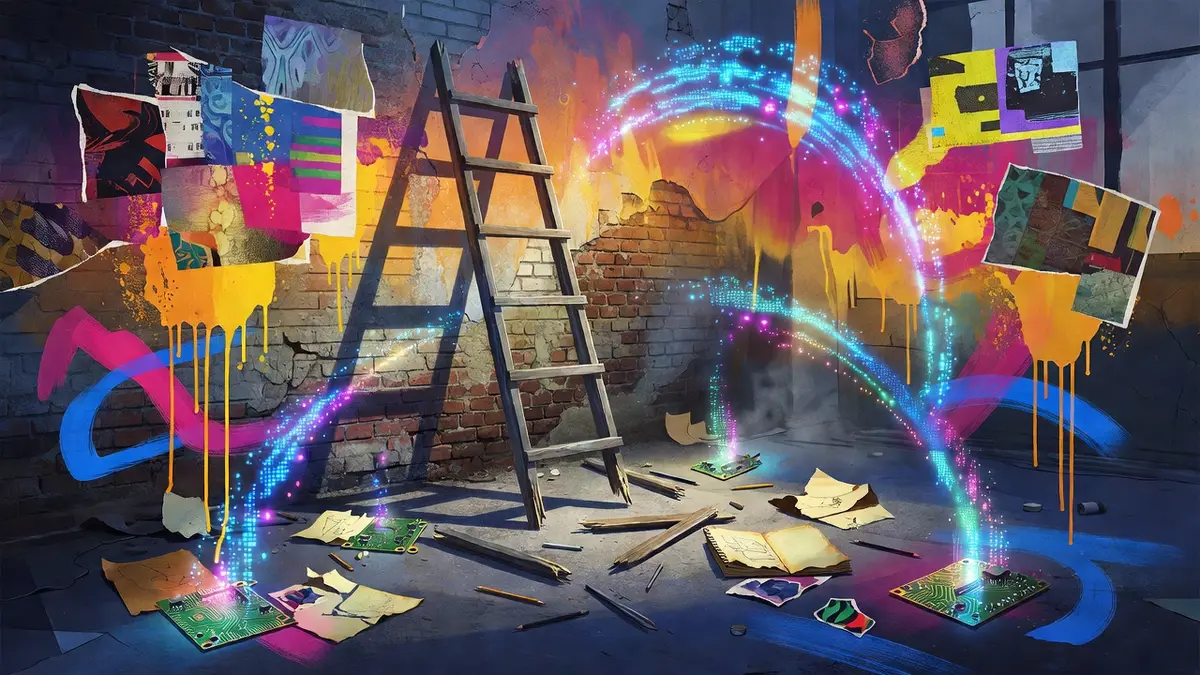
It's a Tuesday morning somewhere in Shoreditch. A 24-year-old junior art director, two years out of Central Saint Martins, £32k salary, student debt like a second mortgage, opens Slack to find a 'restructuring update' from HR. She was hired to do the work that AI now does in seconds. Nobody told her that when she signed the offer letter.
This is the industry's dirty secret in July 2026, and it's written in the numbers if you're willing to read them.
Our analysis of Companies House data shows just 222 new SIC 73.11 (advertising agency) incorporations in Q3 2026 so far, a staggering 94.1% collapse compared to the prior period. The pipeline of new creative businesses isn't just slowing. It's fallen off a cliff edge, silently, while the holding groups post efficiency reports and the trade press photographs Cannes Lions champagne receptions.
Speed Is the New God
The Forrester and 4As study published this week makes the position plain: 87% of US marketing agencies are already using generative AI, while 50% have deployed agentic AI directly into campaign execution. That second number is the one that should keep creative directors awake. Agentic AI doesn't just assist a brief. It executes one.
WPP has reportedly claimed 50 to 70% time efficiency gains across AI-powered production cycles. One agency replaced portions of its human media buying team with bots, cutting campaign launch times by 65%. These aren't pilot programmes anymore. They're business models. And they have a particular shape: small, senior, and expensive at the top; dark, automated, and very cheap in the middle.
Forrester's Jay Pattisall called it the 'workforce inversion.' Historically, agencies made money on labour arbitrage, expensive creative directors overseeing cheap junior talent doing the volume work. AI doesn't just accelerate that model. It eliminates one of its two layers entirely. You don't need the junior layer anymore. The model flips to small teams of senior talent working directly with AI systems. Forty-seven thousand agency positions projected gone in 2026 alone, according to Forrester estimates cited widely across the industry press. Not over a decade. This year.
The Human Authorship Paradox
Then there's the legal dimension that every creative shop is quietly panicking about, even as their IP lawyers charge £800 an hour to panic on their behalf.
In March 2026, the US Supreme Court declined to hear Thaler v. Perlmutter, confirming without comment that works created solely by AI are not eligible for copyright protection. Human authorship remains the law of the land. The Copyright Office's position, tested through every layer of the federal judiciary: if a machine made it autonomously, nobody owns it.
Here's the paradox that should make every creative director's vision blur slightly. Agencies are producing AI-generated assets at industrial scale, because clients demand speed and volume, while simultaneously being told that assets without meaningful human creative contribution may not be protectable intellectual property. The legal framework, in 2026, has arrived at 'structured complexity' rather than settled law. Works created with meaningful human involvement may qualify. A junior designer selecting and iterating across fifty AI image variations probably passes the bar. A prompt typed into Midjourney and shipped to the client by 3pm probably doesn't. The line between those two things is precisely where most agencies are operating right now.
Brands that built campaign assets this way through 2025 are sitting on potentially unprotectable work. And the junior talent who might have provided that 'sufficient human creative contribution'? They're the ones being culled.
The Forrester Ratchet
Back in 2022, Forrester projected 7.5% of US agency jobs automated away by 2030, around 32,000 positions over eight years. Gradual. The kind of thing an industry can absorb, like it absorbed desktop publishing killing paste-up artists in the 1980s. Paul Rand survived the Mac. Bernbach's 'big idea' philosophy outlasted a hundred technological disruptions.
Late 2025, Forrester revised their estimate. Not 7.5% by 2030. Fifteen percent in 2026 alone. They didn't just move the timeline. They doubled the severity and compressed eight years into twelve months.
The Federal Reserve's Q1 Business Outlook Survey tells a companion story: 74% of service firms that have deployed AI reported reducing headcount in marketing, customer communications, or content production departments by an average of 22% since initial deployment. Twenty-two percent. At firms that had only recently adopted these tools.
The US Bureau of Labor Statistics put a harder number on it: over 28,400 marketing and advertising positions eliminated in Q1 2026 alone, driven by platforms like Google Veo 3, Adobe Firefly 4, and GPT-5-powered marketing suites rolling into Fortune 500 workflows. Britain's Office for National Statistics found job openings in advertising and marketing had already fallen 7.5% between 2022 and 2025, before the current acceleration.
What the New Incorporation Collapse Means
Back to those 222 new SIC 73.11 companies. That number deserves to be held up to the light.
New agency incorporations are a leading indicator, the canary in the creative industry coalmine. Creative people start agencies when they believe the market rewards their craft. They stop when the economics no longer make sense. A 94.1% collapse in new advertising agency formations in a single quarter is not a blip. It's a signal that the entrepreneurial case for starting a creative shop has cratered. Why build a ten-person studio when your prospective client can run AI production in-house, or sign with a platform like Monks that deploys agents across an entire marketing operation?
In March 2026, The One Show created a brand new awards category specifically to honour AI-native agency work. Adweek handed out its inaugural AI Agency of the Year. Trophies for the revolution. Meanwhile, the Companies House data shows the small shops, the ones historically seeded by junior talent who learned their craft, got frustrated, left, and started something brilliant, are simply not forming.
This is the talent pipeline question nobody in the holding groups wants to answer at Cannes. John Berger wrote that 'the relation between what we see and what we know is never settled.' The relation between what agencies tell clients about AI and what they're doing to their own workforces is equally unsettled. The business case for AI is real. The efficiency gains are real. The 63% of agencies expressing concerns about accuracy and bias in AI tools, the 62% citing legal risk: those concerns are real too.
But the junior designer in Shoreditch whose role was the industry's learning ground, its apprenticeship system, its Ogilvy-in-the-making incubator? That role is gone. And nobody has explained where the next generation of creative directors is supposed to come from when the bottom rung of the ladder has been sawn off.
Only 19% of workers who undertook AI retraining in 2025 successfully transitioned into newly defined AI-adjacent roles within twelve months. Retraining intent and measurable career outcome are not the same thing. The industry has known this. It's been choosing not to say it.
So here's the question nobody wants to answer: if you remove the entry-level roles that trained every creative leader currently running a holding group, and the new agency formation rate drops by 94%, where exactly does originality, the one thing Forrester says AI cannot automate, come from next?