The Governance Paradox: As CEOs Seize AI Control, the Board Becomes a Bystander
New research reveals that boards are being structurally marginalised precisely when AI decision-making demands more oversight, not less. The CEOs acquiring that power may be walking their organisations into a governance vacuum.
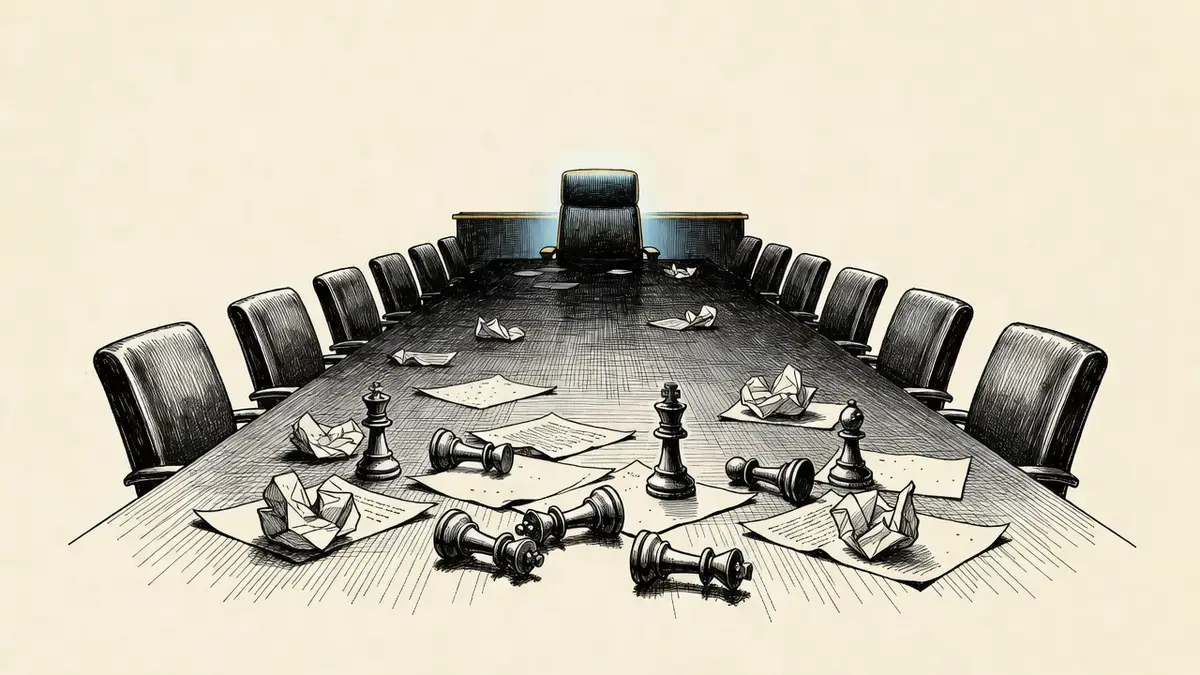
Here is the counterintuitive truth that no one on your board wants to hear over the biscuits: the more capable your CEO becomes at AI-driven decision-making, the less your board matters. And the less your board matters, the more dangerous your CEO becomes.
This is not rhetoric. It is, as of this week, empirical.
Advertisement

The Data Arrives, Inconveniently
Board Intelligence, EMEA's largest board technology and advisory firm, published its Summer 2026 Board Value Index on June 11th, surveying more than 400 non-executive directors, CEOs, and CFOs from companies with over £50 million in turnover across the UK, US, Nordics, and Middle East. The findings are, to deploy the technical term, alarming. 86% of directors say overly rigid or inconsistent decision-making frameworks have contributed to delayed, rushed, or poor decisions in the past six months. Meanwhile, more than four in five boards are actively debating which decisions should remain human-led versus AI-led - which is, when you think about it, rather like debating the distribution of lifejackets while the ship accelerates toward the iceberg.
Pippa Begg, CEO of Board Intelligence, put it plainly: "The environment boards are operating in today is fundamentally different from even a few months ago, but governance has not kept pace." She continued: boards "are increasingly being measured by the quality, speed, and clarity of their decision-making in much more uncertain and fast-moving conditions." What she is too polite to add is that most boards are failing that measurement comprehensively.
The structural absurdity is this: 40% of respondents believe there will be either no meaningful change or only minor adjustments to how boards themselves operate over the next five years. They are governing AI transformation using the institutional equivalent of a fax machine.
Let Me Translate the CEO Survey
Now consider the view from the other end of the table. BCG's AI Radar 2026, which surveyed 625 CEOs and board members globally, found that nearly three-quarters of CEOs say they are their company's key decision maker on AI, twice the share as last year. Four out of five are more optimistic about AI ROI than a year ago.
What the press release says: CEOs are engaged, bullish, and driving the transformation agenda.
What it actually means: power over the single most consequential strategic variable in modern enterprise has concentrated in one executive. The board has been administratively removed from the conversation. Not by malice. By capability asymmetry.
Daniel Ferreira, Professor of Finance at the London School of Economics, presented a paper at the 2026 Corporate Governance Symposium that provides the mechanism. With AI tools producing rapid summaries, scenarios, and comparisons, a CEO may feel less need to involve directors early, reducing both the board's input and the board's visibility into how the decision is being made. The paper argues that AI makes CEOs less dependent on their boards, which disrupts the information flows that hold the CEO-board relationship together, leaving firms with more entrenched CEOs, weaker monitoring, and governance structures that may be worse for shareholders.
So the technology that your CEO claims will transform the business is, as a side effect, dismantling the mechanism that keeps the CEO honest. Drucker spent a career arguing that management is a practice requiring accountability structures. What happens when the practice outpaces the structures by two fiscal years?
Today's Deal: A Case Study in Compressed Oversight
This morning, Robo.ai Inc. (NASDAQ: AIIO), a UAE-based company listed on Nasdaq, announced an agreement to acquire 100% of the equity interests of QC Capital Limited, an AI-driven technology holding and venture-building platform, for US$60 million in newly issued Class B ordinary shares. The consideration shares are subject to a vesting and release schedule of up to eight years, and QC Capital's operating model is based on AI technology and operational enablement capabilities, with a focus on AI agents, vertical AI applications and industrial technology enablement.
Robo.ai's CEO Benjamin Zhai said the acquisition would bring "capabilities in AI investment decision-making, data asset accumulation, venture building, M&A integration and global resource networks." Read that sentence again. The company is acquiring, specifically, the capacity to make better AI-assisted acquisition decisions. It is buying a machine to tell it what to buy next.
This is not a criticism of Robo.ai. It is a perfectly rational strategic move in a market where acquirers are not paying premium multiples for revenue alone, but for capabilities that would take years and hundreds of millions of dollars to replicate internally: proprietary data sets, specialised AI talent, trained models, and distribution advantages in specific verticals. The logic is sound. The governance question is who, precisely, is stress-testing the recursive loop - an AI investment engine selecting AI acquisition targets - and whether any non-executive director has the technical literacy to do so.
The Pilot Proliferation Problem
One number from the Grant Thornton 2026 Q2 CFO survey, published this week, deserves to be cross-stitched onto every boardroom wall: sixty percent of finance leaders say technology and AI-driven transformation is their top value creation priority over the next 12 to 24 months, far exceeding any other priority. As Grant Thornton's Global Practice Lead Paul Edwards noted: "A business running 25 AI pilots doesn't have a strategy. A business running two or three does."
This is Porter's competitive advantage in miniature. Differentiation requires choices. Choices require trade-offs. Trade-offs require someone with both the authority and the information to make them. CFOs are moving away from spreading AI thin and favouring proven use cases with a defined ROI and defined KPIs. But CFOs can only operate on the information they receive. And the boards above them cannot govern what they cannot see.
The CIO.com analysis, drawing on enterprise data from January 2026, maps the problem with uncomfortable precision. In most organisations, AI is far more pervasive than executives initially acknowledge: models operate in risk functions, marketing automation, underwriting engines, fraud systems, supply-chain optimisation tools and workforce routing platforms. Meanwhile, acquisitions bring unfamiliar models, vendors evolve their products without transparency, and employees increasingly rely on open-source or lightweight AI tools without disclosing them. The enterprise intelligence layer becomes, in the paper's elegant phrase, "a patchwork - powerful, distributed and often undocumented."
A patchwork. That is what your board is being asked to govern.
The Structural Fix Nobody Wants to Commission
Fortune published analysis on June 2nd that identified the real constraint with the kind of candour that earnings calls carefully avoid: "AI can't fix a broken C-suite running on an antiquated operating system." The article quotes Carolyn Dewar, co-author of A CEO for All Seasons: "If the operating model at the top does not evolve to support faster, more integrated enterprise decision-making, the market, the technology, or the organisation will eventually force the issue."
Note the word "eventually." Markets are not patient. The ECGI paper is more direct: organisations that fail to make deliberate adjustments to monitoring, compensation, and the flow of information between executives and directors may discover that their AI investments, far from improving decision-making, have quietly worsened their governance.
Quietly. That adverb is doing a great deal of work.
The IBM data, published in May, adds the structural dimension: 76% of organisations surveyed have established a new executive office - that of the chief AI officer - up from 26% in 2025. The CAIO role has tripled in twelve months. Whether it has any actual authority over board-level strategy remains, in the majority of cases, an open question shaped more by org-chart politics than by governance design.
The Prediction
Within eighteen months, a significant enterprise - FTSE 100 or S&P 500 calibre - will experience a material governance failure subsequently traced to an AI-assisted decision made below board visibility. The settlement documents will be illuminating. The subsequent governance reforms will be mandatory, expensive, and roughly three years late.
Boards that want to avoid providing the case study should start by answering a question that Board Intelligence's index implies but does not ask directly: when your CEO last made a consequential strategic call, how much of the underlying analysis was AI-generated, who reviewed it, and did anyone in the boardroom know?
If the answer to any part of that question is "we're not sure," you already have your answer.