The Execution Layer Land Grab: Why Enterprise Software's Next War Is Not About Features, It Is About Who Controls the Layer Where AI Decisions Become Actions
Somewhere between $674 billion in annual enterprise software spend and the 56% feature-utilisation rate that haunts every CFO's renewal conversation, a structural crisis has been building quietly for two years. The acquisition patterns of the past thirty days suggest that the largest vendors have finally understood where the new defensible moat lies - and it is not in the user interface.
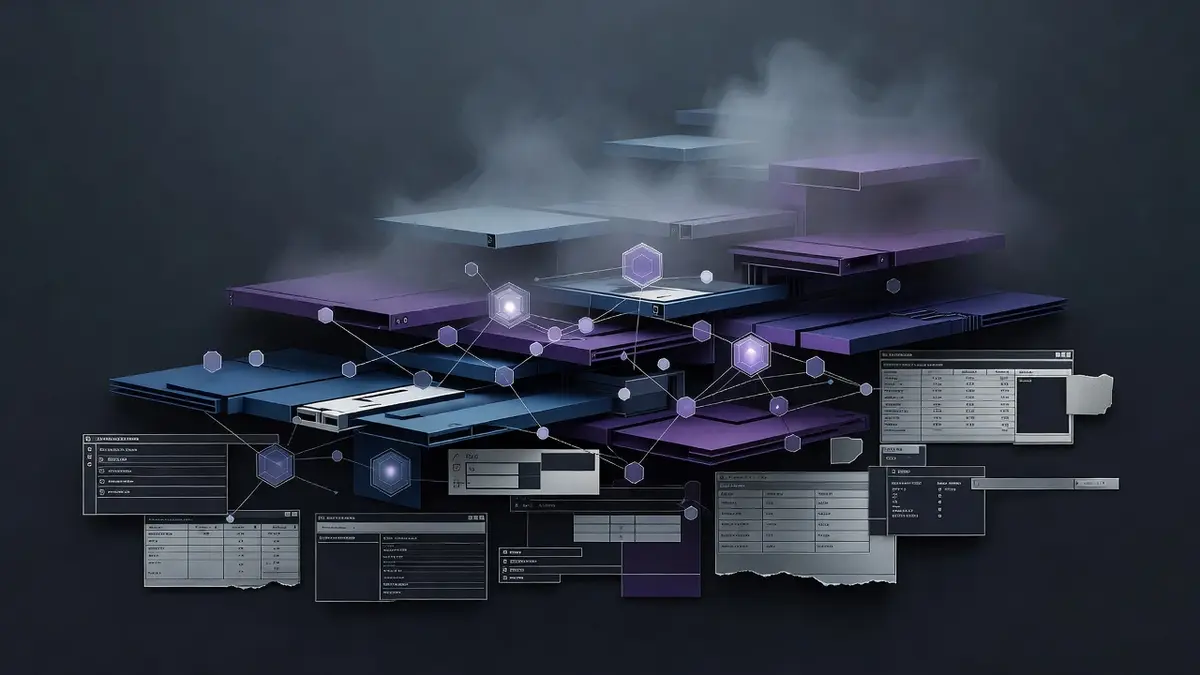
The Acquisition Signal Nobody Is Reading Correctly
Four enterprise software deals closed in early June 2026. They sit in entirely different software categories: workflow orchestration, ERP integration, document intelligence, AI agent tooling. Analysed individually, each looks like a routine capability acquisition. Analysed together, they trace something more consequential.
As ERP Today documented this week, "enterprise software is being restructured around the question of who controls the layer where AI decisions become actions." The most illustrative deal in the cluster: Asana's acquisition of StackAI, a no-code AI workflow platform that connects agents across ERP, CRM, ITSM, document systems, Salesforce, AWS, DocuSign, and Oracle. The deal positions Asana around what it calls "human-agent teams," with StackAI executing cross-system workflows and Asana supplying the project context, ownership structure, and history of work.
Advertisement

This is a project management company recognising that the cross-system orchestration layer is the only remaining surface where a non-hyperscaler can build durable leverage. Clayton Christensen would have named it precisely: the modular interface between components is becoming the new locus of value capture, and whoever standardises that interface first extracts the rent.
The Per-Seat Model's Structural Decomposition
The underlying pricing data is now unambiguous. Seat-based pricing fell from 21% to 15% of SaaS companies in a twelve-month window, while hybrid models surged from 27% to 41% of the market. A further 43% of SaaS companies now operate on hybrid structures, with projections placing that figure at 61% by year-end. Companies running hybrid pricing report 38% higher revenue growth and 38% higher net revenue retention compared to pure subscription peers.
The mechanism behind these numbers deserves careful unpacking. Traditional per-seat pricing rests on what we might call the Attendance Assumption: that value delivered is proportional to the number of humans logged in. This assumption was already fraying before the agent era. Research consistently shows the average enterprise uses only 56% of the features they pay for, meaning roughly half of every SaaS renewal cheque funds capabilities the organisation has never touched.
AI agents have not merely weakened the Attendance Assumption. They have rendered it incoherent. When a single agent completes work formerly requiring ten analysts, a user-based price does not undervalue the product slightly; it misrepresents the entire economic relationship. Zendesk now charges $1.50 per resolved conversation. Intercom's Fin AI agent reached nine-figure revenue charging $0.99 per resolved support ticket. Salesforce closed 29,000 Agentforce deals in Q4 fiscal 2026 alone, with the platform delivering 2.4 billion "Agentic Work Units," a metric Salesforce invented to quantify discrete tasks completed by AI agents because no existing metric was adequate. These are not experiments. They are revenue lines built on a single insight: when software does measurable work autonomously, the correct unit of pricing is the work, not the worker.
The Budget Visibility Problem Is Becoming a Governance Crisis
Record labels in 2003 also believed their distribution model was defensible. Their error was not failing to see digital distribution coming; it was assuming that the transition would be orderly, and that they would have time to renegotiate terms from a position of strength. Enterprise finance teams are making the same miscalculation today.
Zylo's survey of IT leaders found that 61% of organisations cut projects or initiatives because of unplanned SaaS cost increases in the past twelve months. Budgets are not failing because organisations bought too many tools; they are failing because the tools they already own are becoming more expensive in ways that annual planning cycles were not designed to absorb. Atlassian's hybrid model illustrates the compounding effect: standard plans bundle 25 Rovo AI credits per user per month, but consumption overages at $0.30 per conversation can accumulate in ways that neither procurement nor finance modelled during renewal. HubSpot charges $10 per 1,000 AI credits beyond plan allotments. The consumption layer is invisible to the spreadsheet that approved the initial contract.
Gartner projects that by 2027, 70% of leading SaaS vendors will offer consumption-based pricing across at least part of their portfolio. The implication for enterprise finance is structurally serious: the predictability that justified the SaaS subscription model in the first place, the reason CFOs were willing to move from capital expenditure to operating expenditure, is being eroded by the very vendors those CFOs trusted. This is not a pricing dispute. It is a governance failure propagating through every renewal cycle.
The Execution Layer as the New Systems-of-Record Moat
The build-versus-buy data adds further pressure from the demand side. Retool's 2026 report found that 35% of enterprises have already replaced SaaS tools with custom-built software, with 78% expecting to build more in-house tools this year. As large language models have improved and AI-assisted development has become widespread, enterprises can build custom tools in days rather than months. The Attendance Assumption's collapse is not just a vendor-side pricing problem; it is also a customer-side substitution threat.
This explains why the June acquisition cluster makes strategic sense even where individual deal prices look high. The execution layer, the coordinating infrastructure that translates AI reasoning into actions across live enterprise systems, cannot be easily replicated by an internal tool built over a weekend. It requires deep domain-specific data, workflow history, and cross-system authentication infrastructure that takes years to accumulate. As ERP Today put it this week, "generic AI cannot substitute for domain-specific data, document context, and workflow history." Enterprise architects should ask every vendor platform they evaluate one direct question: what proprietary data layer do you control? That is where execution capability will diverge.
Geoffrey Moore's concept of the "whole product" applies with unusual precision here. The whole product for enterprise AI is not the model; every buyer has access to roughly equivalent foundation models. The whole product is the orchestration layer, the data connectors, the audit trail, the compliance certification, and the workflow memory that makes an agent's action reversible, inspectable, and governable. Vendors who own that layer own the renewal conversation.
A Structural Prediction
By Q2 2027, the enterprise software market will have bifurcated along a single axis: vendors that control a proprietary execution layer with domain-specific workflow data, and vendors that do not. The latter group, primarily horizontal point-solution SaaS products charging per seat for capabilities that agents can now replicate, will face sustained multiple compression that no pricing adjustment will repair. The former group will discover that consumption pricing, combined with execution-layer lock-in, generates net revenue retention economics that per-seat models never approached.
The unsettling corollary: the execution layer that each vendor is racing to control sits largely on top of data that the enterprise itself generated. The organisations that realise this first, and negotiate accordingly, will determine which vendors survive the next renewal cycle. The ones that do not will simply fund someone else's moat.