Siemens Brings Physics-Based Digital Twins to UK Factory Floors - But Who's Actually Ready?
Siemens has launched AI-powered simulation software for UK and Irish manufacturers, promising virtual factory testing before a single bolt is tightened. The timing is sharp: Make UK data shows only 2% of manufacturers have AI properly embedded in operations.
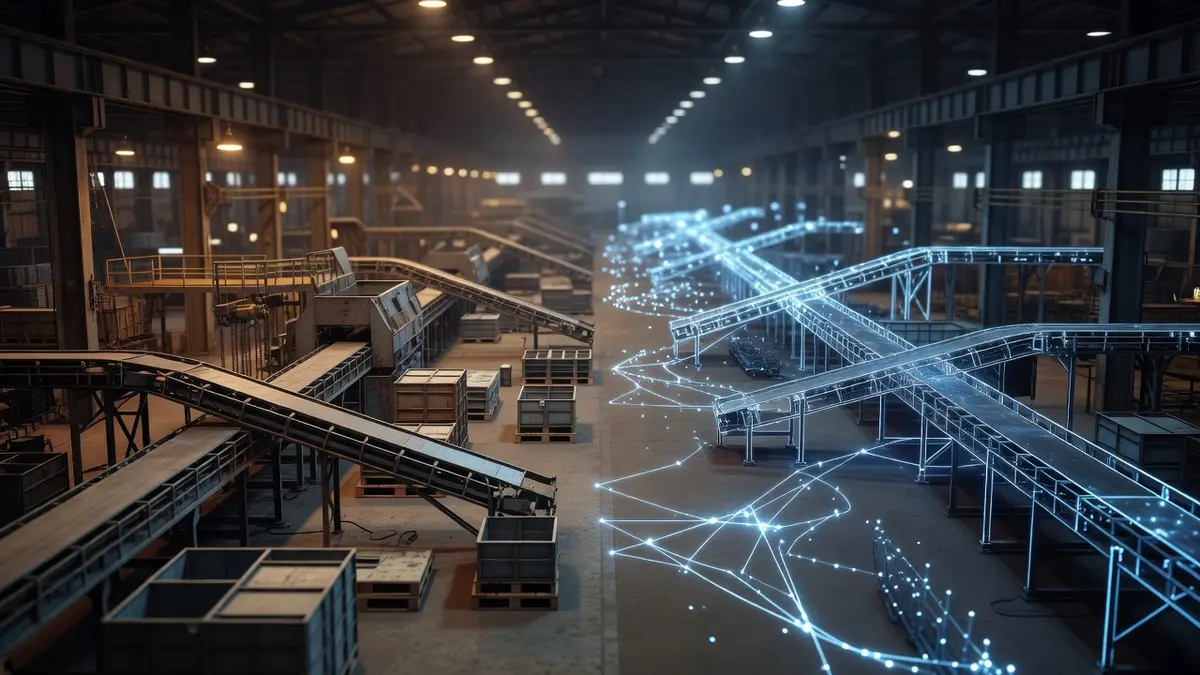
A Virtual Factory, Courtesy of Manchester
Siemens unveiled its Digital Twin Composer software to UK and Irish industry at Transform 2026, its biennial showcase held at Manchester Central on 15–16 July. The product, built on NVIDIA Omniverse libraries and forming part of the Siemens Xcelerator platform, lets manufacturers combine 2D and 3D design data with live operational data in a single physics-based environment. The pitch: test production line changes, capacity increases, or energy reconfigurations virtually before they cost anything in the physical world.
The collaboration with NVIDIA runs deeper than a shared press release. The two companies have been building what they call an Industrial AI Operating System, covering design, engineering, manufacturing, production and supply chain in one connected architecture. PepsiCo has already been using Digital Twin Composer to simulate facility upgrades in the US. UK and Irish customers are now being brought into the fold.
Advertisement

Brian Holliday, CEO of Siemens UK and Ireland, demoed the product alongside NVIDIA regional director Anthony Hills at the Manchester event. The sell was practical, not philosophical: reduce the software engineering burden that has historically made digital twin adoption too expensive and specialist for most mid-sized manufacturers.
The Gap Between the Demo and the Shop Floor
Here is the structural problem that any honest reading of the UK manufacturing data surfaces. Make UK's June 2026 report, AI, Skills and the Future of the UK Manufacturing Sector, found that only 2% of UK manufacturers say AI is widely embedded across their operations. Fewer than 40% are using it in any department at all, and nearly one in five have not adopted AI in any form. When adoption does exist, it is concentrated almost entirely in back-office functions: 83% of manufacturers use AI in HR, finance or administration. Usage in production sits at 11%. Supply chain and logistics: 7%. Quality control: 6%.
So the market Siemens is selling into looks, on the numbers, less like a wave about to break and more like a beach at low tide.
Make UK puts the cost of inaction in blunt terms. The sector loses roughly £6 billion in output annually due to unfilled vacancies and digital capability gaps. The upside of getting digitalisation right, not just AI but the full stack, is estimated at a £150 billion boost to UK GDP by 2035. That is the gap between where the industry is and where it could be.
Why the Skill Problem Won't Solve Itself
Over 50% of manufacturers cite skills shortages as their primary barrier to AI adoption, according to the Make UK findings. This is the circular trap: the tools are becoming more accessible and lower-cost in engineering terms, but the workforce needed to deploy, interpret and iterate on them is not materialising at the required speed.
Siemens, to its credit, acknowledged this at Transform 2026. The event's exhibition floor included sessions on workforce upskilling and building digital skills pipelines, framing the AI era explicitly as one demanding a workforce capable of operating in a digitalised environment, not just engineers who can spec a piece of software.
Skilling a mid-sized manufacturer's workforce to operationalise a physics-based digital twin is a different project from signing up to an AI HR tool. The Rockwell Automation State of Smart Manufacturing report was direct: the challenge in 2026 is no longer access to technology but the ability to embed it into production environments in a way that delivers consistent outcomes.
The Bakery Sector Signal
The proprietary data behind this article adds a granular dimension the macro numbers tend to obscure. According to AI Business Dispatch analysis of Companies House and IPO data (as of July 2026), new company formations in SIC 10.71, the bread, fresh pastry and cake manufacturing code, dropped to just 55 in Q3 2026, an 80.8% fall against the prior period. UK trademark filings in NICE Class 4 (industrial oils and fuels, lubricants, energy-adjacent goods) fell to 128 in Q3 2026, down 70.8%.
Perhaps the most telling single figure: 97.5% of active SIC 10.71 companies hold no Class 4 trademark. These are small food manufacturers, bakeries and pastry producers, operating with no formal IP stake in the industrial inputs or energy products adjacent to their processes. It is a reasonable proxy for the wider picture: a manufacturing base where the majority of firms are still far from the kind of structured, IP-conscious, technology-forward operation that digital twin adoption requires.
Siemens is, rationally, targeting the upper tier of UK industry. The Transform 2026 audience skews toward large manufacturers, infrastructure operators and utilities. But the structural health of UK manufacturing depends on whether the capability being demonstrated in Manchester can filter down to the factories that will never send delegates to a two-day showcase at a convention centre.
Simulation Is Not a Strategy
The Digital Twin Composer is a genuinely interesting piece of industrial software. Physics-based simulation at production scale, connected to live operational data, reduces the cost and risk of change decisions in ways that spreadsheet-based planning never could. The NVIDIA Omniverse integration gives it serious rendering and compute credentials.
Software does not fix a skills shortage. It does not train a quality engineer to interrogate a simulation output, or a supply chain manager to act on a predictive maintenance alert. The UK manufacturing sector spent most of 2025 and 2026 being told that AI is now operational, not experimental. The Make UK data suggests that for the overwhelming majority of factories, it is still neither.