Siemens Brings Physics-Based AI Twins to UK Factory Floors - But Who Will Run Them?
Siemens unveiled its Digital Twin Composer for UK and Irish manufacturers at Transform 2026 in Manchester last week. The timing is awkward: Make UK says only 2% of UK manufacturers have AI widely embedded in their operations.
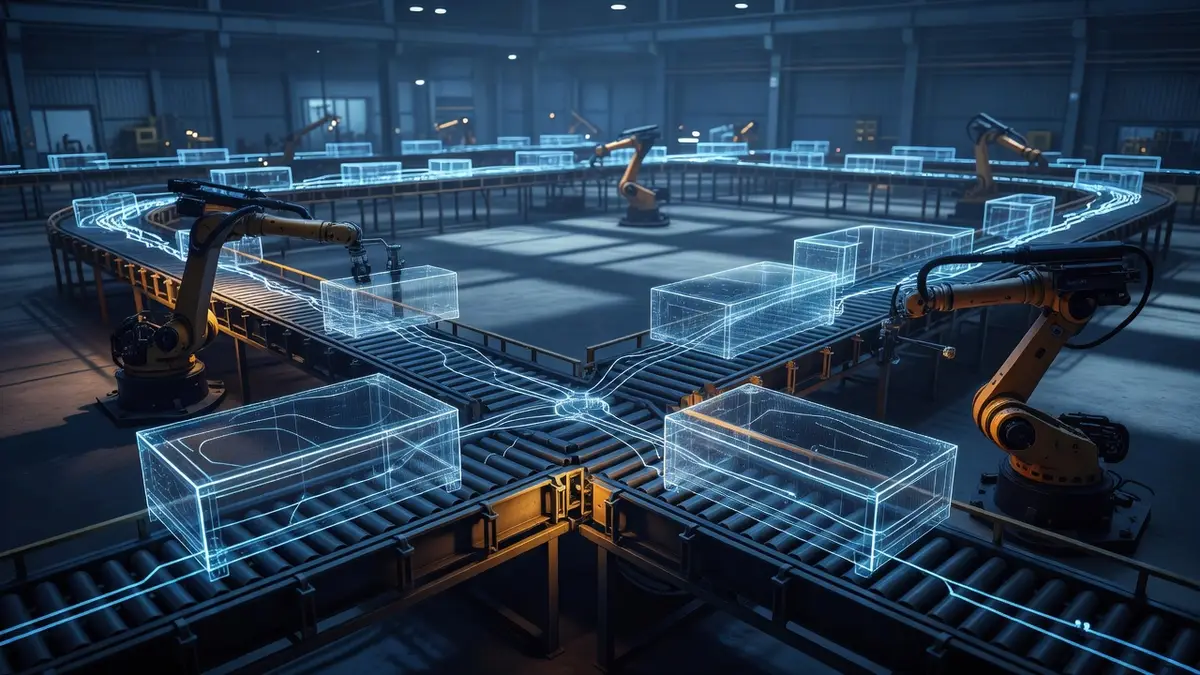
Last week's Transform 2026 event at Manchester Central was, by any measure, a serious piece of kit. More than 6,000 delegates, a 10,000-square-metre exhibition floor, 50-plus speakers. Siemens used the platform to announce something genuinely worth examining: Digital Twin Composer, an industrial AI simulation product built in partnership with NVIDIA, now available to UK and Ireland customers.
The product sits inside the Siemens Xcelerator suite. At its core, it allows manufacturers to build high-fidelity, physics-based 3D digital twins of their products, production lines, and entire facilities, then layer in real-time operational data and run AI-assisted simulations against that environment before committing to physical change. Siemens demonstrated the technology at the Manchester event alongside NVIDIA's UK and Ireland regional director, with the two firms showing how live plant data, NVIDIA Omniverse simulation libraries, and 2D/3D engineering models can be combined into a single managed scene.
Advertisement

What It Actually Does
The pitch is straightforward enough. Instead of modifying a production line and absorbing the disruption and cost of a real-world trial, an engineer simulates the change virtually, runs the AI against it, and validates the design before a single bolt is touched. Siemens gives the example of testing whether a line reconfiguration will increase capacity or reduce energy draw. If the model says it works, the team proceeds with documented confidence. If it doesn't, nobody has paid for the mistake in metal and downtime.
The NVIDIA partnership is the interesting structural piece here. Digital Twin Composer uses Omniverse libraries for the simulation layer, while Siemens supplies the industrial data architecture and software engineering depth. This is not a novel pairing: the two companies announced their Industrial AI Operating System collaboration at CES in January. The Manchester launch is, however, the first time the product has been formally offered to UK and Ireland industrial customers. Siemens noted it is already deployed with major customers in the United States.
Transform 2026 covered considerably more ground than digital twins alone. The event also examined next-generation grid technologies, intelligent electrification, advanced automation, and smart grid innovation: a recognition that UK manufacturers are simultaneously facing decarbonisation mandates and energy security pressures, not just digitisation schedules.
The Adoption Gap Nobody Wants to Talk About
Here is where the enthusiasm requires some structural calibration. A Make UK report published in June, AI, Skills and the Future of the UK Manufacturing Sector, found that only 2% of UK manufacturers say AI is widely embedded across their operations. Fewer than 40% are using it in some capacity. Nearly one in five have not adopted AI at all.
The numbers get sharper when you look at where AI is actually landing. Some 83% of manufacturers using AI are doing so in HR, finance, and administration. Only 11% are applying it in production. Just 7% are using it in supply chain and logistics, and 6% in quality control. A technology arriving with genuine promise for the factory floor is, in practice, mostly filling out expense reports and scheduling interviews.
Make UK estimates the sector loses around £6bn in output every year from unfilled vacancies and digital capability gaps. Wider digitalisation could, the organisation argues, unlock a £150bn boost to UK GDP by 2035. Those are serious numbers. So is the finding that over 50% of manufacturers cite skills shortages as the primary barrier to adoption.
Siemens is not ignoring this. The Transform exhibition floor included a dedicated skills and workforce strand, with Siemens pitching practical training pathways as part of the Xcelerator offer. The company explicitly framed the AI skills pipeline as an industrial necessity, not an afterthought.
A Structural Signal Worth Reading
That gap between vendor ambition and ground-level readiness shows up in our own data. AI Business Dispatch analysis of Companies House and IPO data (as of July 2026) recorded just 45 new SIC 10.71 company formations in Q3 2026, a fall of 84.3% versus the prior period. Class 4 UK trademark filings, covering industrial lubricants and fuels and broadly proxying physical-economy brand activity, dropped to 113 in Q3 2026, down 74.2%. More telling still: 97.5% of active SIC 10.71 companies hold no Class 4 trademark whatsoever. The physical-economy startup cohort is contracting sharply, and the companies that do exist aren't building brands.
This context matters because Siemens' Digital Twin Composer is an enterprise product. It will not, in the near term, reach the sub-100-person manufacturers that make up the vast bulk of the UK's industrial base. The brownfield retrofit challenge, getting AI tools into existing plants that weren't designed around digitisation, remains largely unsolved at scale.
The UK warehouse and logistics sector is grappling with a parallel version of the same problem. Automation is no longer a niche concept in British distribution, but the question has shifted from whether to automate to how to do so in a way that is resilient and adaptable across sites that were never built for robots.
The Honest Verdict
Siemens has brought a serious industrial AI product to market in the UK. The NVIDIA partnership gives it computational credibility, and the use cases, production line optimisation, energy reduction, design validation, are exactly what manufacturers say they need. But the structural conditions for adoption are thin. Skills are scarce. New company formation in relevant SIC codes is collapsing. And the firms that most need productivity gains are precisely those least equipped to deploy physics-based simulation software.
A 6,000-person conference in Manchester is a start. It is not a skills pipeline.