Robot Dogs, Court Rules and a Levy: UK Construction's AI Reckoning Arrives at Once
Three regulatory and technology shifts have landed on the sector in the same month, forcing contractors, developers and their lawyers to adapt simultaneously. The pressure is structural, not cyclical.
Something shifted in July 2026. Not one thing. Three.
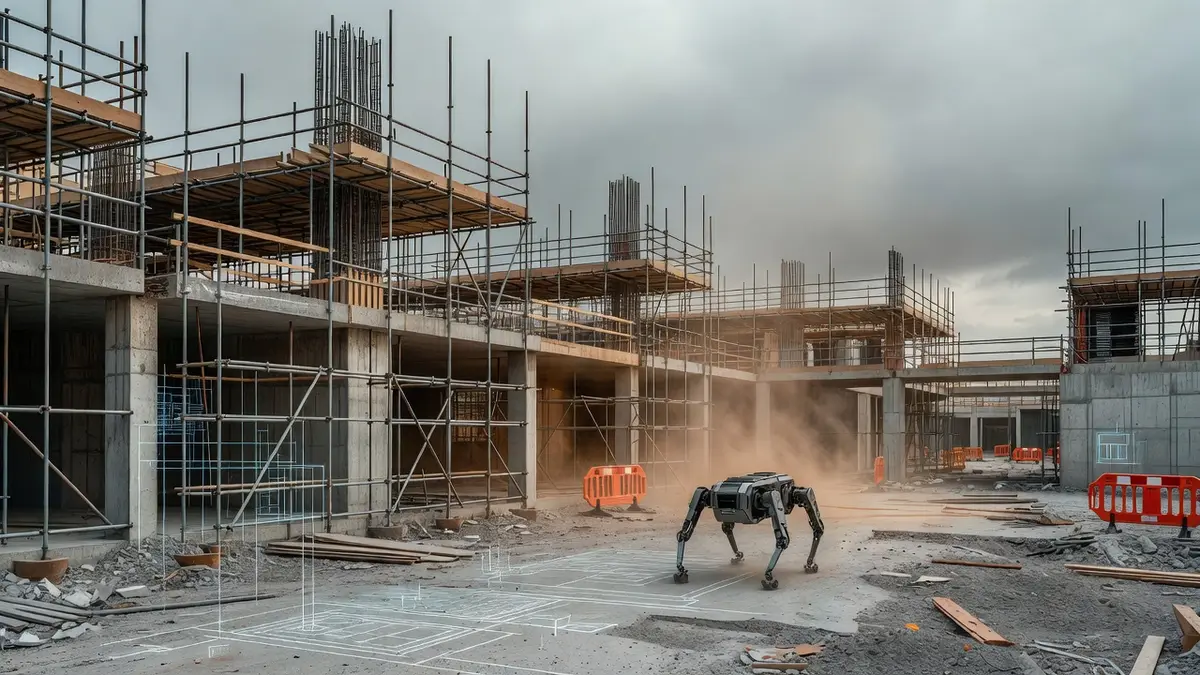
On 6 July, McLaren Construction announced it was deploying autonomous quadruped robots across its UK sites through a new partnership with California-based FieldAI. On 1 July, the Technology and Construction Court published its first revised guide in four years, with AI governance rules embedded for the first time alongside dedicated Building Safety Act 2022 procedures. And on 1 October, the Building Safety Levy goes live, a hard charge on new residential development that industry voices are starting to describe as a viability timebomb.
Take any one of these in isolation and it's a story. Together, they represent a sector being reshaped from three directions at once.
The Robot on the Scaffold
McLaren's deal with FieldAI marks the firm's formal entry into autonomous site monitoring at scale. The robots will initially capture 360-degree site imagery, generate point cloud data and support progress verification, model-to-site deviation analysis, safety compliance patrols and quality assurance. Regular automated scans create a spatial record of work as it is installed, and AI-enabled analysis compares that data against the design model, cutting the time between installation and identification of quality issues.
McLaren's group pre-construction director Adam Nicholson put it plainly: the deployment moves the industry "beyond machines that are remote controlled or pre-programmed for a limited range of tasks and routes" toward robots that handle stairs, doors and other obstacles autonomously.
FieldAI has already deployed across hundreds of sites in Europe, Asia and North America. This is its UK market entry. McLaren and FieldAI have said they will work together to ensure compliance with UK regulatory and data security requirements as deployment grows. That last point matters more than it sounds. The BSR's Golden Thread requirements mean every piece of site data now has potential legal weight. A robot generating continuous point cloud records is not just a quality tool; it is, whether the parties intend it or not, a compliance instrument.
The Court Catches Up
The TCC Guide 2026, which came into force on 1 July, is the court's fourth edition and first revision since October 2022. For the first time, the guide provides dedicated guidance on proceedings involving the Building Safety Act 2022. It also addresses the use of artificial intelligence in TCC litigation. The section is reportedly concise but is being read carefully by practitioners because it signals that the court now expects AI to be part of how cases are prepared and argued.
The same month brought the first High Court ruling on the quantification of a contractor's contribution claim against a supplier of a defective external cladding system, under section 149 of the BSA. In parallel, the Civil Justice Council published proposals on using AI in drafting court papers. Mayer Brown, writing in its July construction law update, noted that the 2026 Guide includes new sections on Building Safety Act proceedings and that AI in the TCC is addressed for the first time.
For contractors currently working through Gateway 2 applications, the practical message is clear: AI-generated site records are entering the evidentiary chain. That has implications for how data is captured, stored and disclosed.
The Levy Lands in 65 Days
The Building Safety Levy comes into force on 1 October 2026. It applies to all residential development schemes of ten or more dwellings and is collected via the building control approval process. Rates vary by local authority and are higher for greenfield sites, with a 50% reduction for brownfield development. Schemes of fewer than ten dwellings are exempt, as are social housing and certain community-benefit developments.
The levy's estimated yield is £3.4 billion for cladding remediation. The Home Builders Federation has argued it is an anti-development tax that will reduce housing supply and disproportionately hit smaller operators. PBC Today, writing this week, went further, calling the industry's response "a bit too relaxed" given that the levy arrives late in the delivery process, is linked to building control, and can directly block a scheme from reaching completion and occupation if developers fail to pay before completion certificates are issued.
Building control applications submitted before 1 October 2026 are not subject to the levy. Some developers are accelerating programmes to beat the deadline.
The Brand Gap No One Is Talking About
Run the numbers from a company formation and trademark perspective and you get a telling picture. AI Business Dispatch analysis of Companies House and UK IPO data shows that 1,213 new SIC 41.20 (general building construction) companies were incorporated in 2026-Q3, down 76.8% on the prior period. Class 11 UK trademark filings (covering heating, ventilating, water and sanitary installations) fell 70.1% to 442 in the same quarter. And 99.6% of active SIC 41.20 companies hold no Class 11 trademark at all.
AI Business Dispatch analysis of Companies House (MC) and IPO (TMD) data, as of 2026-07.
The formation slowdown tells you something real: new entrants are hesitating in a market carrying building safety liability, levy exposure and tightening regulatory competency requirements. The trademark gap is a different signal. Firms deploying AI-enabled site tools, autonomous robots and digital compliance platforms are building brand equity on infrastructure they do not protect. When FieldAI and McLaren are generating continuous spatial datasets that may end up cited in TCC proceedings, the question of who owns the methodology, the workflow and the product identity matters commercially.
The industry built most of the twentieth century without worrying about intellectual property. The twenty-first century is considerably less forgiving on that front.
What Comes Next
The Building Safety Regulator's latest figures, covering the 12 weeks to 28 June 2026, showed Gateway 2 applications achieving a 77% approval rate. External remediation approvals reached 85%, above the regulator's 65% target. Progress is real. But the October levy, new TCC rules and an accelerating robotics market arriving together means the compliance and commercial picture is more complex now than at any point since the post-Grenfell reforms began.
Contractors who can demonstrate an auditable, AI-supported record of site delivery will be better placed in both BSR gateway applications and any future TCC proceedings. Those who cannot are carrying more risk than they may realise.