Nobody's Coming: The Advertising Industry Just Stopped Hiring Its Own Future
Zero new ad agencies. A collapsed junior pipeline. And an industry congratulating itself at Cannes while quietly pulling up the ladder behind it.
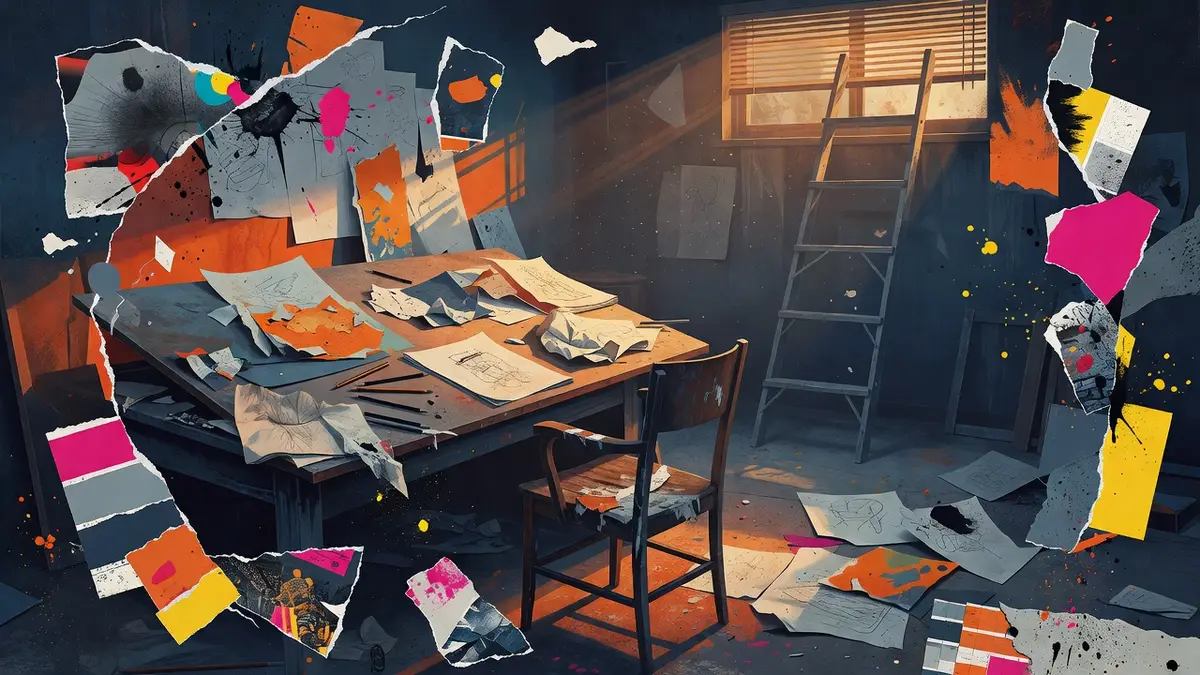
Picture a twenty-three-year-old illustrator. Let's call her Maya. She graduated in June, portfolio crackling with campaign concepts, a reel that would make a 1999 Fallon art director weep with joy. She's sent 200 applications. She's heard back from four. Two of those were automated rejections so fast they arrived before she'd finished filling in the form.
Maya's story isn't anecdote. It's data.
Advertisement

AIBD analysis of Companies House records reveals zero new SIC 73.11 advertising agency incorporations in Q3 2026: a 100% collapse versus the prior period. Not a slowdown. Not a correction. Zero. The pipeline that feeds the creative economy with fresh independent voices, scrappy challenger shops, the next Mother or Wieden+Kennedy, has run dry in a single quarter. When new agencies stop forming, the creative gene pool doesn't stagnate. It evaporates.
The Merger That Ate the Room
The backdrop is ugly and getting uglier. The Omnicom-IPG union, sealed in November 2025, created a combined entity generating $25 billion in annual revenue with over 100,000 employees worldwide. Holding-company consolidation at that scale doesn't just reshape the market; it redecorates the entire building, locks several floors, and hands the keys to procurement.
The downstream effect landed fast. Omnicom announced major layoffs following its acquisition of Interpublic Group at the end of 2024, cutting approximately 4,000 roles across media and advertising. M&A activity at that velocity, what J.P. Morgan's commercial banking team bluntly calls a moment where agencies face build-or-buy decisions on capabilities, doesn't leave much oxygen for the new entrant. Why start a boutique when the mega-networks are absorbing everything and the clients are consolidating their rosters?
Bernbach built DDB on the insurgent premise that big agencies get comfortable and small ones stay hungry. Someone should tell 2026.
AI Swallowed the Entry Level
Here is the part nobody wants to say plainly at Cannes. The junior creative role, the place where Maya was supposed to start, learn, fail safely, absorb craft, is being quietly abolished. Not because agencies are cruel. Because the economics now make it optional.
"Now AI hoovers up the grunt work, so agencies are starting to skip the junior rung altogether," said Patrick Garvey, founding partner at We Are Pi, a statement that should be embroidered on a cushion in every HR director's office in Soho.
The numbers backstop him. Tasks like media planning, copywriting, and reporting are now increasingly handled by AI tools across agency workflows. According to an Adweek reader survey cited by ContentGrip, over two-thirds of agency employees already use artificial intelligence tools several times a week. The technology moved from experimental to infrastructural in about eighteen months. Junior staff were, in the cruellest irony, the humans closest to the work AI absorbed first.
Forrester originally predicted a 7.5% net reduction in the U.S. advertising workforce from AI by 2030. Then they looked again. Their most recent report upgraded that estimate to 15% by the end of next year, nearly double the original forecast, driven specifically by what analysts hadn't accounted for: agentic AI. "We had not factored for agentic and agents," Forrester's Jay Pattisall told Digiday. "I think we'll see a larger percentage of the advertising population that can be replaced by those tools."
Doubling a workforce-reduction estimate is not a footnote. That's a rewrite.
The Copyright Trap Nobody Solved
Through all of this, the legal ground keeps shifting. In March, the U.S. Supreme Court declined to hear Thaler v. Perlmutter, leaving in place the human authorship requirement for copyright protection, confirming that works created solely by AI cannot be registered. On the face of it, that sounds like a win for human artists. In practice, it creates a paradox that's eating agencies alive: use generative AI in production, as almost everyone now does, and you're operating in a grey zone where your creative output may be unprotectable. Build a campaign on AI-generated visuals and you've potentially built it on quicksand.
The US Copyright Office and federal courts require human authorship for copyright protection; works created solely by AI are not eligible for registration under current rules. Businesses using AI for creative output will only be able to protect copyright in works created with sufficient human involvement in the direction, prompting, or alteration of the resulting work.
Sufficient human involvement. A phrase doing an enormous amount of legal heavy lifting for an industry currently racing to reduce the human hours in every deliverable.
Disney, NBCUniversal, and DreamWorks filed suit against Midjourney in June 2025, alleging its model was trained on tens of thousands of copyrighted works without permission. Midjourney argues transformative fair use. The case grinds on. Every agency art director using a generative image tool sits somewhere in the blast radius.
Paul Rand once said that a logo is a flag, a signature, an escutcheon. What he didn't say was: whose flag? If the image was made by a model trained on work taken without consent, from artists who never agreed to feed the machine, whose signature is it really?
The Platform Giants Don't Need You
Add one more pressure. Amazon, Google and Meta have automated targeting, creative optimisation and performance reporting to the point where advertisers with straightforward direct-response needs can often bypass agencies entirely. U.S. advertising spend is forecast to reach $414.7 billion in 2026, up 5% from 2025, but that headline growth masks a structural hollowing-out of what agencies actually get paid to do.
Digital advertising is projected to reach about 69% of global ad spend in 2026, and the platforms capture the lion's share of that. The agency is increasingly a margin-thin intermediary between a brand and a machine that doesn't need an intermediary.
Jellyfish, the Brandtech media agency and one of the loudest AI adopters in the holding-company ecosystem, replaced portions of its traditional human media buyers with bots to reduce campaign launch times by 65%. It also cut 50 roles in late 2025 as client spending contracted. The automation and the layoffs arrived in the same year. That's not coincidence. That's the new operating model.
Who's Teaching Maya?
So here's the question nobody at the awards dinner wants to answer, with their Grand Prix trophy still warm and their table's third bottle of rosé open.
If the junior role is gone, who trains the next creative director? If new agencies aren't forming, zero incorporations, not one, where do the insurgent ideas come from? The industry has always renewed itself through entry-level energy: the hungry kid who stayed late, who argued with the brief, who had something to prove. John Berger wrote that the relation between what we see and what we know is never settled. The creative industry's relationship with its own future is starting to look similarly unresolved.
In 2025, the American ad industry lost 4,600 roles overall. Job openings in the UK's advertising and marketing industries had fallen 7.5% between 2022 and 2025. In the first six months of 2026 alone, more than 150,000 roles have already been cut across industries where AI was cited as a factor.
Zero new agencies. Layoffs accelerating. A copyright framework that can't keep up. And an industry congratulating its own boldness while the entry-level door swings quietly shut.
Maya is still waiting to hear back.
Who, exactly, is the industry planning to hire when it finally remembers it needs a next generation?