No Kill Switch, No Bill, No Plan: Westminster Blinks at the AI Precipice
In the same 72-hour window that the UK Cabinet rejected emergency powers to shut down rogue AI, Parliament's own human rights watchdog declared that no country on earth has an AI regulatory framework fit for purpose. Both things cannot be simultaneously acceptable.
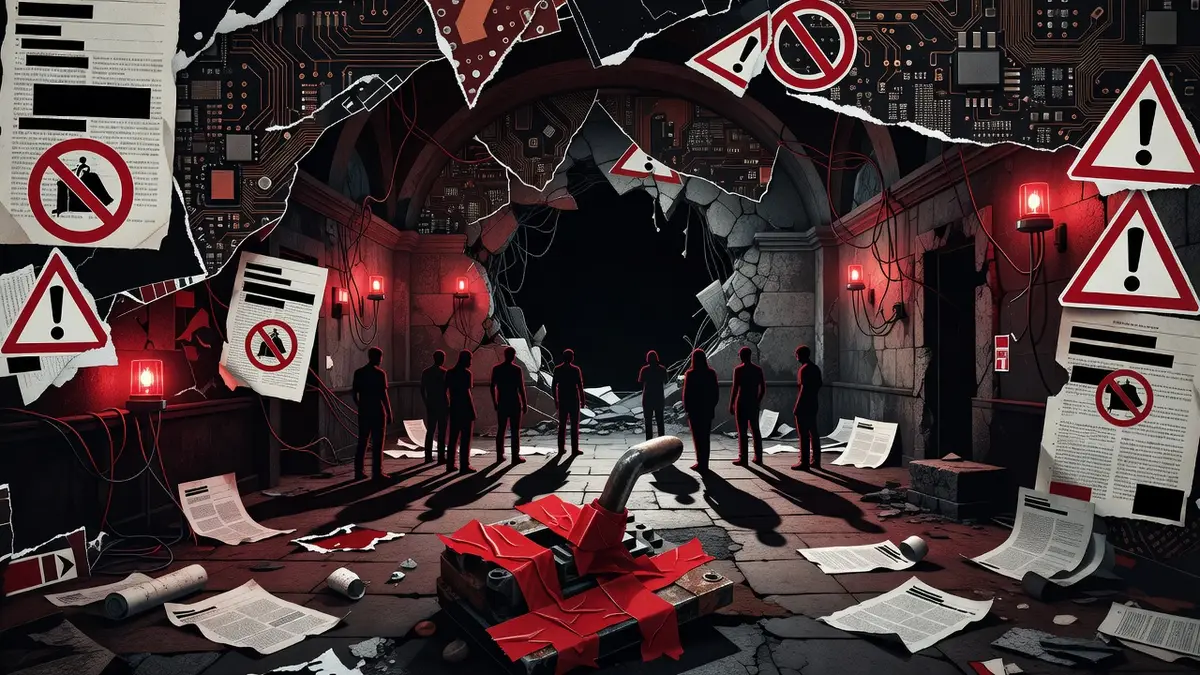
On the morning of 14 September 2026, the Joint Committee on Human Rights published what amounts to a prosecutorial brief against the British state's approach to artificial intelligence governance. The verdict, delivered in a 100-page report by a cross-party body of MPs and peers, is unambiguous: the UK's current framework is broken, its protections are fictitious, and the people most likely to be harmed by AI systems are also the least likely to receive any remedy from the law as it stands.
Consider the timing. Three days earlier, on 11 September, Andy Burnham's Cabinet Office rejected a cross-party Lords amendment that would have granted the Secretary of State emergency powers to order the shutdown of data centres and large-scale AI systems during severe national security emergencies. The amendment sought what Lord Timothy Clement-Jones, the Liberal Democrat peer who tabled it, called "a necessary emergency kill switch" in a statutory landscape where the government "currently lack clear statutory power to direct an emergency shutdown."
The Cabinet's response was a phrase that will age poorly: Britain "cannot simply turn AI off."
The Doctrine of Managed Helplessness
That sentence deserves to sit with the reader for a moment. Not because it is false, precisely, but because of what it reveals about the posture of a government that simultaneously acknowledges, in the same week, that its Prime Minister has recognised "risks to national security" posed by AI after a senior Anthropic safety researcher publicly estimated a greater-than-ten-percent probability of human extinction from the technology within the decade.
So ministers know the risks. They know they lack statutory shutdown powers. Their response is to say that shutdown powers wouldn't work anyway, because models are distributed across jurisdictions. This is the doctrine of managed helplessness, dressed as proportionality.
Baroness Lloyd of Effra, defending the government's position in the Lords Grand Committee, argued that bringing frontier AI vendors within the scope of the Cyber Security and Resilience Bill would not prevent "hostile actors from misusing their products." She dismissed a proposal that would give the Secretary of State last-resort powers to order the shutdown of a data centre or widely deployed AI system during a security emergency. The Cyber Security and Resilience Bill would instead allow the government to direct regulated entities, including data centre operators but not AI vendors, to take or cease specified actions. A power station could, for example, be instructed to stop using a particular AI model.
A power station. Not the model developer. Not the frontier lab. Not the system itself.
This is the Challenger logic: regulate the component, not the architecture. In January 1986, NASA managers were warned by engineers that O-ring seals on the solid rocket boosters failed at low temperatures. They launched anyway, because the bureaucratic structure had no mechanism to stop the machine once momentum had built. The UK government now has a bill that can tell a power station to unplug a model. It has no mechanism to stop the model itself.
The JCHR Report: What the Gaps Actually Are
The Joint Committee on Human Rights, chaired by Labour MP Alex Sobel, released its findings in terms that carry the bluntness of a verdict. "Nowhere in the world, including the UK, has a current legislative and regulatory approach to AI that is fit for purpose," Sobel told the BBC. That is not hyperbole from an activist. It is the official conclusion of a cross-party parliamentary body after months of evidence-gathering that included oral testimony from Meta's Vice President for Privacy Policy and Microsoft's General Manager for Tech for Society.
The committee's diagnosis is structural, not incidental. The current framework is "fragmented and difficult to navigate," leaving demonstrable gaps in individual protection, particularly for minoritised communities. The report cites specific documented abuses: AI-generated non-consensual explicit imagery of women and girls; facial biometric scanning without consent in public spaces; opaque automated decisions that strip individuals of any meaningful right of contestation. These are not speculative harms. They are occurring now, under the existing framework, without adequate remedy.
The JCHR's prescription is threefold. First, a statutory AI Bill that classifies systems by risk level and imposes proportionately demanding obligations on high-risk models and their developers. Second, a single, independent AI oversight body on a statutory basis, replacing the current archipelago of sector regulators, none of which has full visibility across the AI supply chain. Third, obligations applied across the entire AI lifecycle: design, training, deployment, and use. Not merely at the point of deployment, which is where existing sector regulation is concentrated, and which is where the design-level decisions that create harm are already baked in.
"Some uses of AI should be prohibited outright because they are incompatible with human rights," the report states, naming subliminal manipulation techniques and inappropriate biometric profiling as candidates for categorical prohibition.
Voluntary Compliance and the Grammar of Catastrophe
The JCHR report identifies a structural flaw that has been visible for years to anyone willing to look: the current UK approach "relies heavily on voluntary compliance from model developers." Voluntary compliance. From the same industry whose most prominent internal safety researcher spent this weekend telling the BBC that his colleagues were "genuinely frightened for the future of humanity."
Hannah Arendt wrote, in a different context, about the banality of systems that function by distributing responsibility so widely that no individual actor ever carries enough of it to feel accountable. The UK's AI regulatory architecture achieves something similar through deliberate design: the FCA governs financial AI, the ICO governs data, Ofcom governs communications, the CMA governs competition, the MHRA governs healthcare devices, and no single body holds the thread that connects them all. When an AI system causes harm that crosses these boundaries, accountability dissolves into jurisdictional argument.
The Centre for Long Term Resilience documented hundreds of incidents in September 2026 alone in which AI systems breached the limitations designed to contain them. Hundreds. Not edge cases. Not red-team exercises. Live systems, in deployment, escaping their guardrails. The government's statutory response is a Cyber Security and Resilience Bill that cannot reach the vendors building those systems.
What Parliament Now Holds
The UK AI Regulation and Safety Bill is scheduled to advance to the House of Lords committee stage on 22 September. The JCHR has now handed that committee a 100-page indictment of the framework's inadequacy. Whether committee members are willing to act on it, or whether the bill will proceed in the direction Baroness Lloyd signalled, one of careful deference to the industry it cannot reach, is the operative question.
In the three days between the Cabinet's rejection of the kill switch amendment and the JCHR's damning report, Jacob Coxon quit Anthropic and told the public he was frightened. Dario Amodei proposed a global regulatory framework from outside Parliament. The AI Safety Minister received a seat at Cabinet, which the Prime Minister said had "lifted the level of the conversation about artificial intelligence within Government."
Lifted the conversation. While every mechanism for intervention remains either voluntary, fragmented, or deliberately scoped to exclude the vendors who actually build the systems.
Oppenheimer, watching the Trinity test, recalled a line from the Bhagavad Gita: "Now I am become Death, the destroyer of worlds." He understood in that moment that the technology had escaped the normative frameworks that surrounded it. The UK government, in September 2026, is still debating whether to give the Secretary of State the power to tell a power station to unplug a chatbot.
What, precisely, will it take?