Modal Labs Hits $1B ARR on Serverless GPU: Why the Sandbox Architecture Is the Quiet Infrastructure Bet of 2026
A 200-person company just crossed a billion dollars in annualised revenue by solving one specific, unglamorous problem: letting AI agents run untrusted code safely, at scale, without making developers think about servers. The infrastructure layer beneath the agentic boom is becoming its own market.
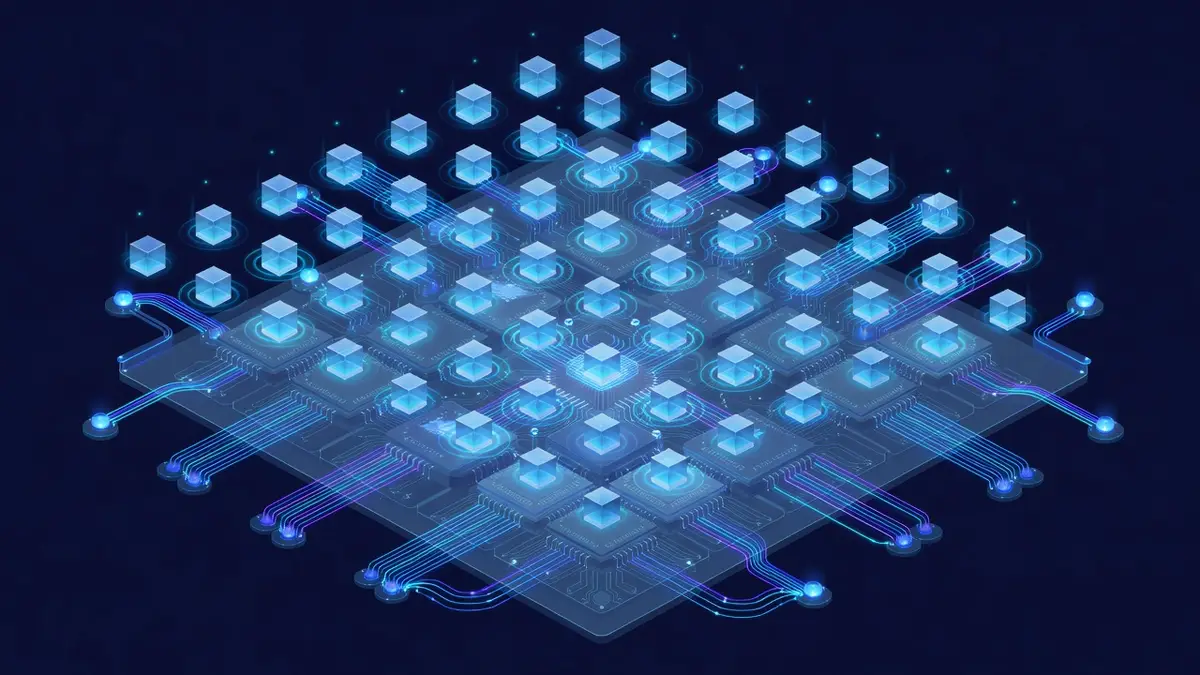
Something quietly extraordinary happened on 14 October 2026. Modal Labs, a serverless compute startup with roughly 200 employees spread across New York, San Francisco, and Stockholm, announced it had crossed $1 billion in annualised run rate, up from approximately $300 million when its Series C closed five months earlier in May. The same announcement attached a $750 million Series D led by Accel, with Kleiner Perkins joining as a new investor, valuing the company at $15.75 billion post-money.
That is a 3.4x valuation step-up in five months. Even in a market that has repriced AI infrastructure companies aggressively upward, the pace is notable.
Advertisement

What Modal Actually Is
The company sells serverless GPU compute. Developers write Python (or TypeScript, or Go), and Modal handles everything below that abstraction: GPU provisioning, container scheduling, file systems, networking. There is no baseline reservation cost; if nothing runs, nothing is billed. Think of it as the difference between owning a water tower and paying for the tap. The billing model that made AWS Lambda interesting for web functions, applied instead to the economics of running large models.
The most instructive number in the announcement is not the $1B ARR figure. It is the decomposition of it. Modal's Sandboxes product alone accounts for approximately $300 million of that run rate, after spinning up three billion containers since launch. That single product line is growing faster than the overall company was twelve months ago.
Sandboxes are, architecturally, isolated execution environments for AI-generated code. When a coding agent writes a function and needs to test it, something has to run that code without allowing it to touch the host system, exfiltrate secrets, or brick adjacent workloads. That something is a sandbox. Modal's implementation uses gVisor, a userspace kernel written in Go by Google, which intercepts an application's system calls and acts as a guest kernel: stronger isolation than a standard container, less overhead than a full virtual machine. The custom scheduler underneath keeps cold starts sub-second even with large custom images, and the platform supports up to one million concurrent sandboxes, with documented throughput exceeding 10,000 new sandbox creations per second.
Consider the traffic engineering problem: one million lanes of traffic that can each open and close in under a second, each running in a separate sealed room, with the whole road network managed by a single control plane. That is the operational surface Modal is maintaining at production scale.
The Agentic Demand Curve
Modal's trajectory makes the most sense when read as a proxy for agentic AI adoption. Coding agents that generate and execute code, the kind being deployed by companies like Ramp to write commits autonomously, need exactly this infrastructure: secure ephemeral compute that spins up instantly, runs untrusted code without risk to surrounding systems, and bills only for actual execution time. The three-billion-container figure is not a benchmark; it is production traffic from real engineering teams.
This is why the round arrived in the same week as Supabase raising $150 million on the back of 70% agent-provisioned database growth and Arena raising $200 million at a $3.1 billion valuation on AI model evaluation infrastructure. The pattern is not coincidental. Every layer of the agentic stack is being capitalised simultaneously because they are all downstream of the same application wave.
The competitive field is intensifying. Baseten, focused primarily on inference serving, closed two funding rounds in 2026 alone and is chasing a $13 billion valuation. Fireworks AI raised $1.5 billion last month. Where those companies focus on model-serving throughput, Modal is positioning as a broader platform: sandboxed execution, inference, training, and batch processing in a single control plane, pooling GPU capacity across more than 20 cloud providers to hedge against the scarcity that has made raw GPU procurement a bottleneck for the industry.
The Infrastructure Stack, Briefly Explained
At the core is a custom container runtime, scheduler, and file system built from scratch rather than assembled from existing open-source primitives. The architectural choice matters: off-the-shelf Kubernetes was designed for long-running stateful workloads with predictable resource profiles. Agentic workloads are the opposite, bursty, ephemeral, heterogeneous, with startup latency directly affecting the user experience of the agent loop. Adapting Kubernetes to this access pattern is roughly analogous to running a Formula 1 race on a motorway: technically possible, never optimal.
Modal's engineering team, founded by CEO Erik Bernhardsson (a former Spotify engineer who built that company's recommendation infrastructure), built a scheduler and runtime specifically for this latency profile. Memory snapshotting allows containers to resume from a checkpoint rather than cold-booting from scratch. The multi-cloud capacity pool abstracts GPU availability across providers, so a developer does not need to know or care whether their H100 call resolves on AWS, GCP, or a third-party data centre.
The capital deployment plan is telling: multi-node training, reinforcement learning and post-training infrastructure, inference improvements, and expanded virtual-machine support within Sandboxes. The RL addition signals that Modal expects the next wave of demand to come from teams doing post-training runs on custom models, not just inference on existing ones, a bet that the model development cycle is moving downstream into product companies.
What the Trademark Data Shows
The broader software IP market tells a consistent story. AIBD analysis of UK Intellectual Property Office data shows 3,392 Class 9 trademark filings in Q4 2026, a 68.1% decline versus the prior period. Class 9 covers downloadable software, the traditional on-premise or installable form factor. The collapse in that filing category tracks structurally with Modal's thesis: compute is migrating from installed software to cloud-executed, serverless runtime. Companies building the next generation of AI tooling are not filing downloadable-software trademarks; they are filing for hosted services under Class 42, or not filing at all because their product is the API.
The trademark data is a lagging signal, but the direction is unambiguous. The registered-software model that defined the 1990s and 2000s, install, licence, patch, is ceding ground to execution-as-a-service. Modal's $1B ARR is partly a financial milestone and partly a measurement of how much of that shift has already happened in production environments.
Six to Twelve Month Implications
The RL and post-training roadmap expansion is the most consequential near-term signal. If Modal ships credible multi-node training infrastructure on a serverless billing model, it will compete directly with the reserved-cluster model that CoreWeave, Lambda Labs, and hyperscaler GPU products depend on. That puts significant pricing pressure on reserved GPU contracts, which enterprise AI teams have been signing at rates that looked rational in 2024 but may look expensive by mid-2027.
For developers: the sandbox-as-infrastructure category is now definitively validated at scale. Building an agentic system without a dedicated sandboxed execution layer is an architectural debt that will need repaying. The question is no longer whether to use sandboxes but which implementation fits the threat model.
For the infrastructure market broadly: Modal's three-billion-container figure shows that AI agent deployment is already a large-scale production workload, not a research curiosity. The compute layer beneath the agent economy is consolidating fast. Von Neumann's stored-program architecture gave us the instruction cycle; Modal's bet is that the agentic era needs a new execution primitive to sit above it.