Made Smarter Pushes Automation Into Bakeries as New Entrants Collapse 81%
The government-backed Made Smarter programme is wiring up chocolate temperers, flow wrappers and process monitors across small food factories - including bakeries - just as Companies House data shows new SIC 10.71 formations have fallen off a cliff.
A programme that is actually moving metal
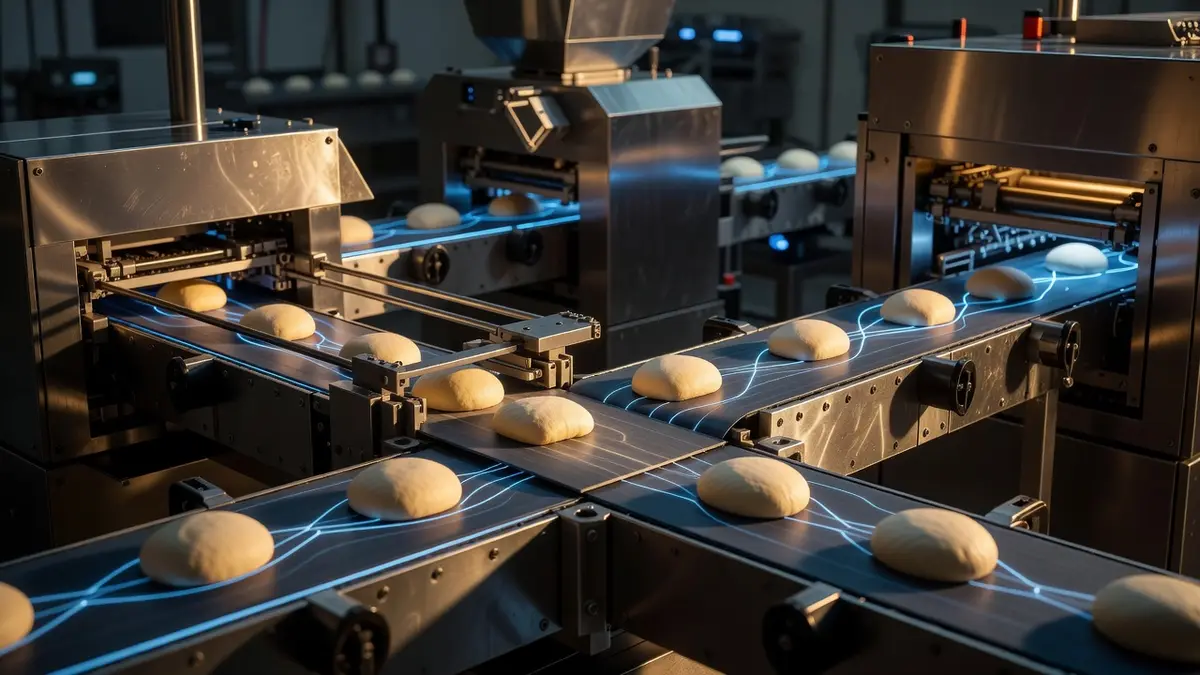
Yesterday, IN Food confirmed that Made Smarter is accelerating practical automation across smaller food factories, with current projects spanning chocolate, bakery, sauces, brewing, bacon and packaging. The work is not a pilot scheme in a single showcase facility. It covers tempering, flow wrapping, filling, capping, labelling, slicing and process monitoring: the unglamorous middle of the production line that most automation vendors prefer to skip. The programme combines capital grants with technical guidance, leadership support and workforce development, meaning it is trying to solve the skills problem at the same time as the kit problem.
The timing matters. The UK bread and bakery goods manufacturing sector (SIC 10.71) carries a market size of £8.8bn in 2026, down from £9.1bn in 2025, and has shed revenue at a CAGR of roughly 1.6% over the past five years, according to IBISWorld. It is not a shrinking industry in terms of sheer scale: approximately 2,933 businesses employ around 84,000 people. But the margin environment is brutal and the cost of doing nothing is rising faster than the cost of automation.
Advertisement

The formation collapse hiding in plain sight
AI Business Dispatch analysis of Companies House data shows just 55 new SIC 10.71 companies registered in Q3 2026, an 80.8% collapse versus the prior period (AIBD analysis of Companies House data, as of July 2026). That is a dramatic signal. You do not need to be a structural economist to read it: the conditions that once made it attractive to start a bread or pastry business in the UK have deteriorated sharply. Rising input costs, labour shortages and the capital requirements of competing with automated incumbents are filtering out marginal entrants before they get started.
Branding tells a similar story. UK Class 7 trademark filings, the NICE class covering industrial machinery and automation equipment, fell to 327 in Q3 2026, a 68.6% decline versus the prior period (AIBD analysis of IPO/TrademarkDashboard data, as of July 2026). More pointedly, 97.3% of active SIC 10.71 companies hold no Class 7 trademark whatsoever. Class 7 filings in this context serve as a rough proxy for companies that have reached the scale and IP-consciousness to invest in proprietary processing equipment or automation technology. Their near-total absence among bakery manufacturers confirms what Made Smarter's project list implies: automation in this sector is something that happens to SMEs through external support, not something they generate internally.
The skills chasm behind the numbers
Make UK's report, AI, Skills and the Future of the UK Manufacturing Sector, published in June, found that only 2% of UK manufacturers say AI is widely embedded across their operations. Adoption in core operations is particularly weak: just 11% use it in production, 7% in supply chain and logistics, and 6% in quality control. The sector is losing around £6bn in output annually due to unfilled vacancies and digital capability gaps, according to Make UK's own estimates, while broader digitalisation could unlock a £150bn GDP boost by 2035 if firms move from experimentation to implementation.
The barriers are not technological. Barclays published research on 20 July finding that 49% of food and drink manufacturers already use AI in some form, with 72% planning investment within three years and 90% believing AI can improve decision-making speed. Predictive maintenance alone could cut downtime by 10–25%. Yet the Barclays analysis and the Make UK report converge on the same conclusion: competitive advantage will belong to manufacturers that turn better data into better decisions, and the biggest brake on that process is skills and data literacy, not access to the technology itself.
Made Smarter appears to be the one mechanism that bridges that gap practically. By bundling grants, technical guidance and workforce training, it removes the three-way stalemate, no capital, no skills, no confidence, that keeps most small food factories on manual operations indefinitely.
What the factory floor still needs
The warehouse automation literature running in parallel is instructive. The UK logistics sector has moved decisively toward retrofitting automation into existing brownfield sites rather than designing new-build facilities around single systems. That shift reflects land scarcity, capital discipline and the simple reality that most operators cannot suspend production to rip out their floor. The same logic applies, arguably more acutely, in food manufacturing. You cannot stop a proving oven to install a monitoring system during peak output.
Made Smarter's project-by-project approach, a tempering machine here, a flow wrapper there, mirrors exactly the modular, phased investment logic that warehouse operators have converged on. It is not glamorous. It will not feature on a Smart Manufacturing Week showreel. But for the 2,900-odd bakery businesses sitting outside the orbit of a Warburtons or Allied Bakeries, it may be the only automation pathway that actually connects.
The formation collapse says the market is thinning. The skills data says capability is concentrated at the top. Made Smarter is, at least in bakery and food processing, trying to hold the middle ground before it disappears entirely.