Databricks CEO Calls 2026 a 'Terrible' Year to IPO. He's Probably Right, and That's the Story.
SpaceX just became the largest IPO in history. Anthropic and OpenAI are queuing behind it. And the CEO of a $134 billion AI unicorn just told Bloomberg TV this is the worst possible moment to go public.
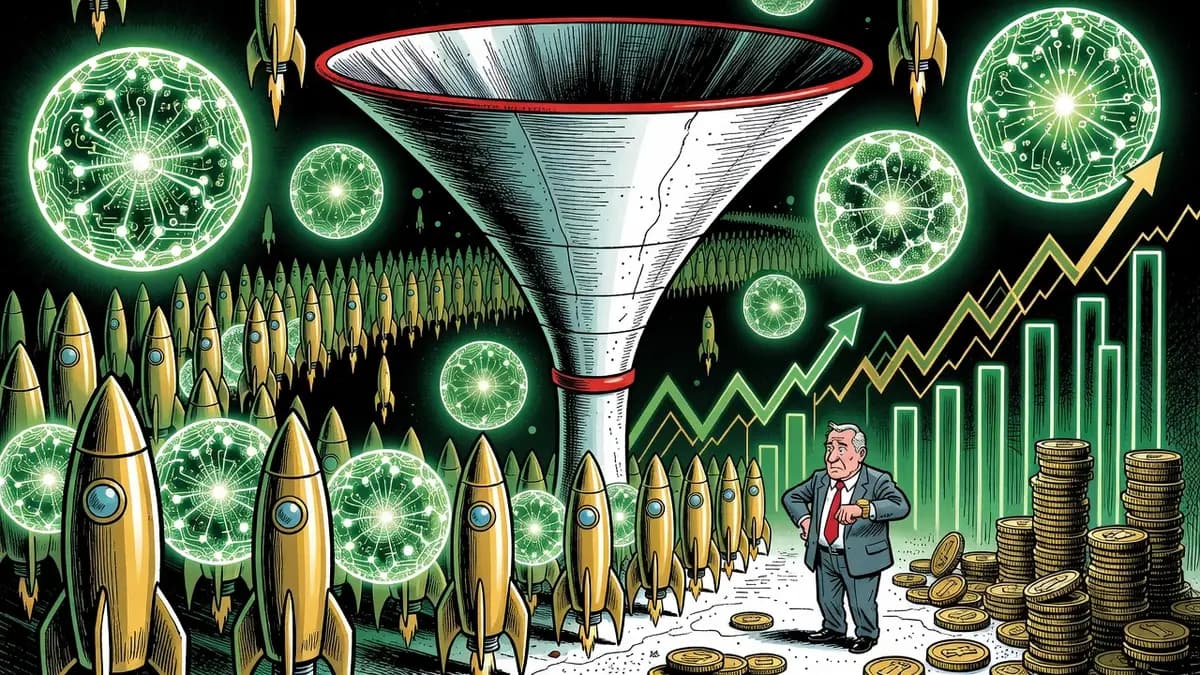
$3 Trillion of Queue, One Window
Let's do the maths. SpaceX debuted on Nasdaq this month, crossing $2 trillion in market valuation after the largest IPO in recorded history. Anthropic filed a confidential S-1 on June 1 at a reported $965 billion valuation, on roughly $47 billion in annualised revenue. OpenAI followed one week later with its own confidential filing, sitting at an $852 billion private valuation and approximately $25 billion in ARR. Combined potential demand from those two alone exceeds the entire 2025 US IPO market. By up to four times.
And into this queue walks Databricks CEO Ali Ghodsi, who told Bloomberg TV in June that 2026 is a "terrible" year to IPO, precisely because of SpaceX, OpenAI, and Anthropic. Say what you like about the timing of that soundbite. The man is not wrong.
Capital Doesn't Stretch Infinitely
The investor universe is not unlimited. Institutional allocators have finite mandates, finite risk budgets, and finite appetite for liquidity events happening simultaneously at nine-figure scale. When SpaceX, a $1.75-to-$2 trillion ask, lands in the same calendar window as two near-trillion-dollar AI lab IPOs, the oxygen in the room gets thin fast.
Polymarket bettors currently price Anthropic's chances of IPO-ing before September 2026 at 46%. Zero odds by June 30. So even the market that trades on outcomes isn't convinced the filing pace equals a listing pace. Confidential S-1s are table stakes, not finishing lines.
This is the paradox Ghodsi is naming. Databricks has a genuine fundamental case: $5.4 billion in ARR, 65%-plus growth, positive free cash flow, and over 20,000 enterprise customers including government agencies. Two product lines, AI products and data warehousing, each clearing $1 billion in ARR independently. That's rare. But a clean fundamental case doesn't survive an attention market that's already full.
The Supercycle's Dirty Secret
Here's what the Q1 2026 numbers reveal about who this boom is actually for. Four rounds, OpenAI's $122 billion, Anthropic's $30 billion, xAI's $20 billion, Waymo's $16 billion, absorbed $188 billion, or roughly 65% of all global venture investment in the quarter. AI captured 80% of total global VC. The previous record, set in Q1 2025, was 55%.
Capital concentration at this level is historically unambiguous. It isn't a rising tide. It's a funnel. Charlie Munger had a phrase for markets that mistake concentration for health: he called it "the lollapalooza effect," multiple forces compounding in the same direction until the result looks rational when it isn't. Seed-stage AI startups are now valued 42% above non-AI peers at the same stage, with median pre-money valuations around $17.9 million. The median Series B AI company hits $143 million. At the top end, multiples run 20x to 50x revenue, with the median sitting around 20-to-30x.
We are pricing microwave meals at restaurant prices and calling it fine dining.
What the Public Markets Are Actually Saying
Cerebras (CBRS) IPO'd in May, raising $5.55 billion at a $95 billion market cap and gaining 68% on day one. That's the data point the bulls are running with. PNC's Amanda Agati noted it signals the IPO window is "reopening" and sets the stage for H2 activity.
But Cerebras is AI infrastructure, the chips-and-compute layer that every other AI company needs to buy from someone. It's not a frontier model lab burning capital on research with diffuse monetisation paths. The public market welcomed it because it has a product, customers, and a clear revenue model. That test gets harder as the valuation multiples expand and the stories get bigger.
Anthropic's reported $47 billion in annualised revenue at a $965 billion valuation implies roughly a 21x revenue multiple at listing. OpenAI's $852 billion private valuation on $25 billion in ARR implies 34x. Nasdaq at the peak of the dot-com boom was trading the S&P 500 tech cohort at 10x revenue. We are running at three times that, on businesses that still have existential cost structures and no clear moats beyond brand and talent.
The Databricks Problem Is Everyone's Problem
Ghodsi's "terrible year" comment is actually an indictment of the entire structure. He leads arguably the strongest pure-play data-and-AI infrastructure company headed to market, with financials that would be the envy of any sector in any other cycle. But a Databricks debut at $134 billion would immediately pressure Snowflake, which trades at less than half that valuation on comparable revenue. Snowflake is already public, already visible, already a benchmark. Every new AI listing resets the comparative set.
So the incumbents get repriced. The newcomers fight for the same allocation pools. And the mega-listings, the trillion-dollar ones, hoover up the capital that would otherwise find its way to the second tier.
The SpaceX IPO is the linchpin, as aifundingtracker.com noted in its tracker: a clean first-day pop opens the window for every name behind it. A stumble resets 2026 expectations entirely. SpaceX crossed $2 trillion. Window open. But open for how many?
The Prediction
Databricks does not IPO in 2026. Ghodsi already said it. He knows his window is H1 2027, when the mega-cap AI listings have either succeeded and created appetite, or stumbled and reset multiples to something he can price against without getting buried. Either scenario works for him. Neither works right now.
OpenAI prices in Q4 2026 at somewhere between $800 billion and $1 trillion, absorbs institutional allocation that would have gone to five other companies, and then the second-tier AI IPO market stalls out through Q1 2027. Anthropic follows in early 2027 at a valuation that looks modest compared to where it filed, because the market will have spent six months recalibrating what frontier AI is actually worth when the quarterly earnings reports start arriving.
Nassim Taleb would call the current setup a "hidden fragility," a system that looks resilient precisely because nothing has broken yet. The 2026 AI IPO supercycle is real. So was the 2000 dot-com IPO calendar, right up until March.