AI to Hollow Out the Site Office Before It Touches a Trowel, Warns New UK Construction Analysis
A fresh assessment published yesterday by London Construction Magazine puts a number on which construction roles face AI displacement before 2030 - and it's not the bricklayers. The threat is sitting in the project office, and contractors ignoring it may find themselves priced out of higher-risk work.
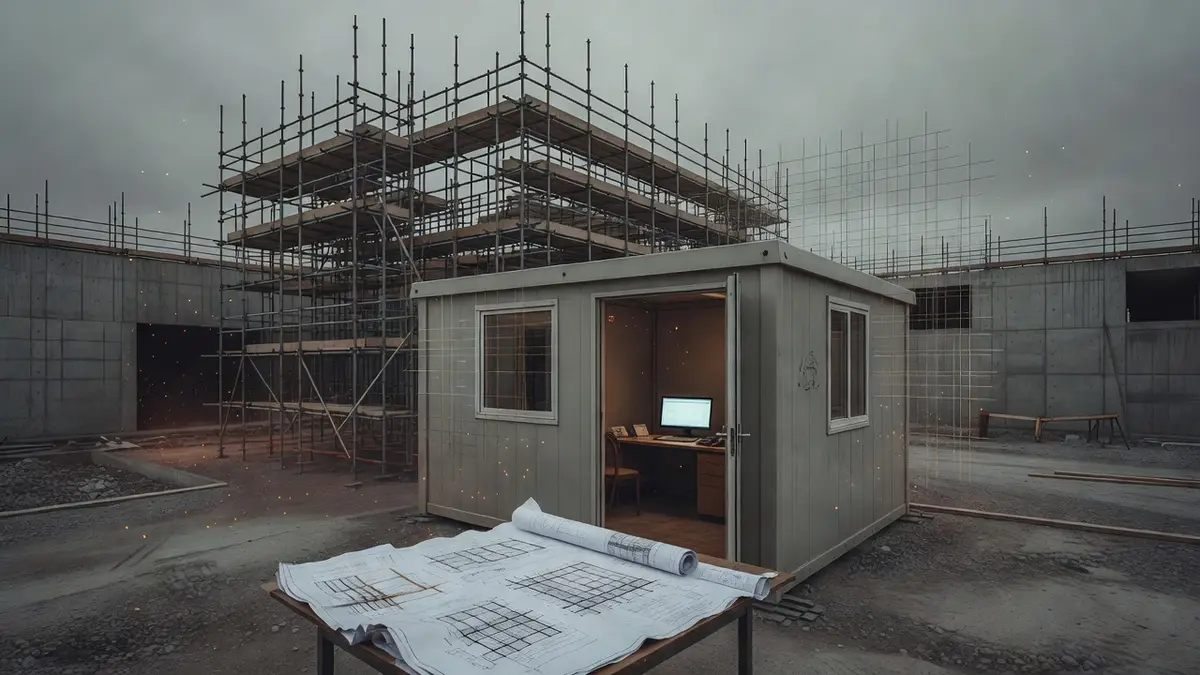
The machinery of disruption, as any site manager will tell you, rarely starts where you expect it. A new evidence-based assessment from London Construction Magazine, published on 8 October 2026, makes the case bluntly: artificial intelligence is far more likely to compress the UK construction industry's administrative and junior-professional workforce than it is to replace a single skilled tradesperson before the end of the decade.
The Office Is on Notice
The analysis identifies document controllers, junior estimators, assistant quantity surveyors, procurement administrators and routine project-controls staff as the roles most immediately exposed to automation. That is not a soft landing for the industry. These are precisely the functions that keep a project's paper trail, and increasingly its Golden Thread, alive.
The timing is not accidental. The Building Safety Act 2022 has created a structural demand for structured, auditable digital records across higher-risk buildings. Regulatory pressure, not innovation hype, is now the primary engine of AI adoption on UK sites. As one industry analysis puts it, firms without AI-enabled workflows are beginning to face "exclusion from complex or higher-risk schemes, where deliverability is now assessed through data integrity" as much as technical capability. That is a commercial threat with a specific deadline attached: Gateway 2 evidence, dutyholder sign-offs, and the Golden Thread obligation are not optional extras.
The numbers behind that pressure are sobering. AI adoption in UK construction sits at just 6 per cent, the lowest of any sector surveyed in a 2026 benchmark analysis. The broader UK SME picture is not much more reassuring: the British Chambers of Commerce found 54 per cent of SMEs now actively use AI, up from 35 per cent in 2025, but adoption remains uneven and construction firms consistently lag behind professional services and technology peers.
Human Oversight Is Non-Negotiable
The analysis is careful not to let the technology off the governance hook. Cameras and sensors can monitor PPE, exclusion zones and plant movements, but that does not transfer legal accountability to an algorithm. The RICS professional standard on the responsible use of AI, effective since March 2026, requires members and regulated firms to consider governance, data management, reliability, professional judgement and client communication wherever AI materially affects surveying services. The principle is plain: an automated warning is not a substitute dutyholder.
That point carries extra weight given the dutyholder regime review, which the government's own Single Construction Regulator prospectus committed to reporting in autumn 2026. The Ministry of Housing, Communities and Local Government published its consultation response in July, confirming that a Single Construction Regulator will be built on the existing Building Safety Regulator, which moved into standalone arm's-length status in January this year, but with implementation not expected before 2028. Until then, the patchwork of responsibilities across principal designers, principal contractors and accountable persons remains. AI tools can accelerate evidence gathering; they cannot change who signs the form.
The 2030 Horizon and What Lies Beyond
The London Construction Magazine assessment sketches three scenarios for the decade ahead. Before 2030, the most credible disruption is a senior professional discovering that AI allows a project to run with fewer people beneath them, not a robot at the wall-tie end of a scaffold lift. After 2030, the more consequential shift could be the arrival of an AI project-control layer that watches cost, programme, procurement and physical progress continuously, a different order of change entirely, one that would reshape contractor headcount structures rather than just trim back-office numbers.
The industry has a window. But trademark data suggest the product side of built environment technology is thinning, not thickening. According to AI Business Dispatch analysis of UK Intellectual Property Office data, Class 11 trademark filings, covering lighting, heating, ventilation and sanitary apparatus, fell to just 96 in Q4 2026, a 93.2 per cent drop on the prior period (AIBD analysis of IPO (TMD) data, as of October 2026). Whether that reflects a market consolidating around proven platforms or simply a chilling of speculative launches is not yet clear. Either way, it is not the picture of a sector confidently flooding the market with new built-environment technology.
What Contractors Should Do Now
For any firm currently operating on or bidding for higher-risk building work, the operational checklist is tightening. Document intelligence, compliance checking and AI-assisted Gateway 2 evidence preparation are the categories where live adoption is already forming. Robotics remain behind the main operational curve for now. The construction industry has historically been the last sector to let any technology into the site hut, let alone the site itself. But the regulatory framework introduced by Grenfell's aftermath has, in effect, made digital competence a contractual and statutory requirement, whether or not the industry is ready to describe it that way.