AI Goes From Pilot to Plumbing in UK Hospitality - but New Restaurant Starts Collapse 91%
Across UK restaurants, hotels and dark kitchens, artificial intelligence has crossed from experiment to operational infrastructure in 2026. The catch: Companies House data shows new restaurant incorporations have fallen off a cliff, raising real questions about who will actually benefit.
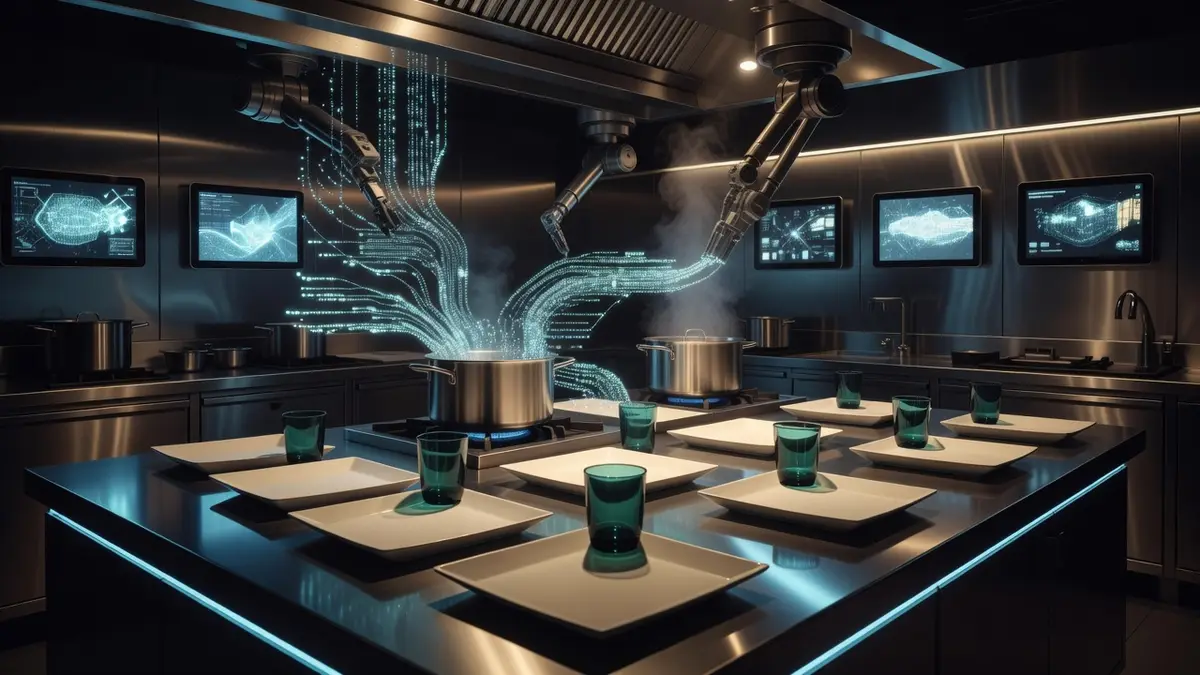
Something shifted in UK hospitality this year. It is not the arrival of AI; operators have been piloting that for three years. It is the realisation that AI has quietly become load-bearing. Scheduling systems, inventory forecasting, guest-communication engines, dark kitchen order aggregation: these tools are no longer add-ons. They are the plumbing.
And yet the sector carrying that technology surge is contracting sharply at entry level. According to AI Business Dispatch analysis of Companies House data, just 889 new SIC 56.10 (full-service restaurant) companies were incorporated in Q3 2026, a collapse of 91% against the prior period. That number demands attention. It suggests that whatever efficiency gains AI is delivering to established operators, the conditions for new entrants remain hostile: rising labour costs, business rates reform, and tightening consumer spending.
Advertisement

The 'Escape Velocity' Moment
The language among tech vendors and operators has changed. Where 2024 was about pilots, 2026 is about system-wide rollouts. As one industry observer put it to The Food Institute, AI adoption is now "hitting escape velocity," with pilot projects converting into permanent infrastructure across multi-site groups.
In the UK specifically, the pressure driving that acceleration is well documented. Sixty-seven percent of UK restaurant owners cite labour costs as their top operational concern, while 78% of diners now expect online booking, ordering and payment as standard. AI bridges those two realities: it reduces the administrative load on thin teams while delivering the frictionless experience customers expect.
The numbers that vendors quote are striking. AI-powered scheduling tools have reportedly helped one UK pub group cut labour costs by 2.8% while growing like-for-like sales by 7.7%. Burger King UK is said to have achieved a cost-neutral labour model through AI-led rota management. These are not pilot-scale results. They are operational baselines.
Hotels: Cautious But Committed
In UK accommodation, the conversation has matured beyond enthusiasm into accountability. At the International Hotel Technology Forum held at CodeNode London in June 2026, sessions were framed around a pointed question: which technologies actually deliver value? The agenda included a session bluntly titled "The Business Case for Hotel Tech in the UK: Who Pays, Who Benefits?"
That question reflects a broader reality. A global study by hospitality consultancy h2c, examining 171 hotel chains across more than 11,000 properties, found that while 78% of hotel chains are using AI, only 7% have implemented a company-wide AI strategy. Most initiatives remain experimental, hampered by legacy system integration and organisational inertia. Independent UK operators appear to be moving faster than the big groups, precisely because they have less legacy infrastructure to untangle.
PwC's hotels forecast for 2026 projects a 1.5% increase in revenue per available room and 1.2% growth in occupancy across UK regions, underpinned by strong international demand and event-driven travel. In that context, AI tools for dynamic pricing, pre-arrival upsell, and housekeeping demand forecasting are margin-protection tools, not luxury items.
The Hospitality Tech Expo, scheduled for ExCeL London on 29-30 September 2026, reflects how mainstream this conversation has become. Confirmed exhibitors span workforce management, robotics, payment infrastructure, AI guest engagement and cybersecurity: a roster that shows the tech stack of a modern UK hospitality business has become genuinely complex.
Dark Kitchens: The AI-Native Layer
If hotels are retrofitting AI into existing operations, dark kitchens were built with it from the start. University research published earlier this year found that one in seven food outlets listed on the UK's main delivery apps now operates as a dark kitchen, accounting for 15% of all online food retailers in England. That is a substantial, largely invisible segment of the takeaway market.
The UK food delivery market has more than doubled in value, from £7.6 billion in 2019 to £14.3 billion in 2025. Dark kitchens are a structural beneficiary of that growth, offering 30-50% lower operating costs than traditional restaurant formats and the ability to run multiple virtual brands from a single kitchen. AI is what makes multi-brand operations viable: aggregating orders across Uber Eats, Deliveroo and Just Eat into one dashboard, optimising delivery routing in real time, and adjusting menus based on demand signals.
The same research that mapped the sector's scale also flagged its regulatory shadow. UK food laws have not kept pace with the dark kitchen model. The Food Standards Agency has issued no specific guidance, leaving Environmental Health Officers to interpret requirements differently across local authorities. Allergen cross-contamination risk, when several brands share one kitchen, remains an under-scrutinised hazard. Technology is racing ahead of governance. That gap will need closing.
Margin Reality Check
The 91% drop in new SIC 56.10 incorporations is the number that should sit uncomfortably alongside every bullish AI adoption statistic. AI can optimise a restaurant's scheduling, cut food waste and personalise its loyalty offers. It cannot, on its own, make a new restaurant viable when business rates have just introduced a higher multiplier for properties above £500,000 rateable value, National Living Wage has moved again, and consumer confidence remains uncertain.
What the data actually describes is a bifurcating market. Established multi-site operators, the ones who can absorb the capital cost of AI integration and have the data volume to make machine learning useful, are pulling ahead. New entrants face a structural squeeze that no amount of AI concierge software resolves.
The front-of-house energy in UK hospitality is real. The tech investment is real. But the pipeline of new businesses entering SIC 56.10 is not. And without new entrants, the competitive diversity that keeps this industry interesting and keeps incumbents honest quietly erodes.