UK Warehouse Automation Hits Scale - But Most Manufacturers Are Still Watching From the Car Park
Capital is flowing into UK logistics robotics at a rate not seen since the post-pandemic reshoring push, yet a structural split is widening between large-scale deployers and the long tail of manufacturers who cannot bridge the gap from pilot to production.
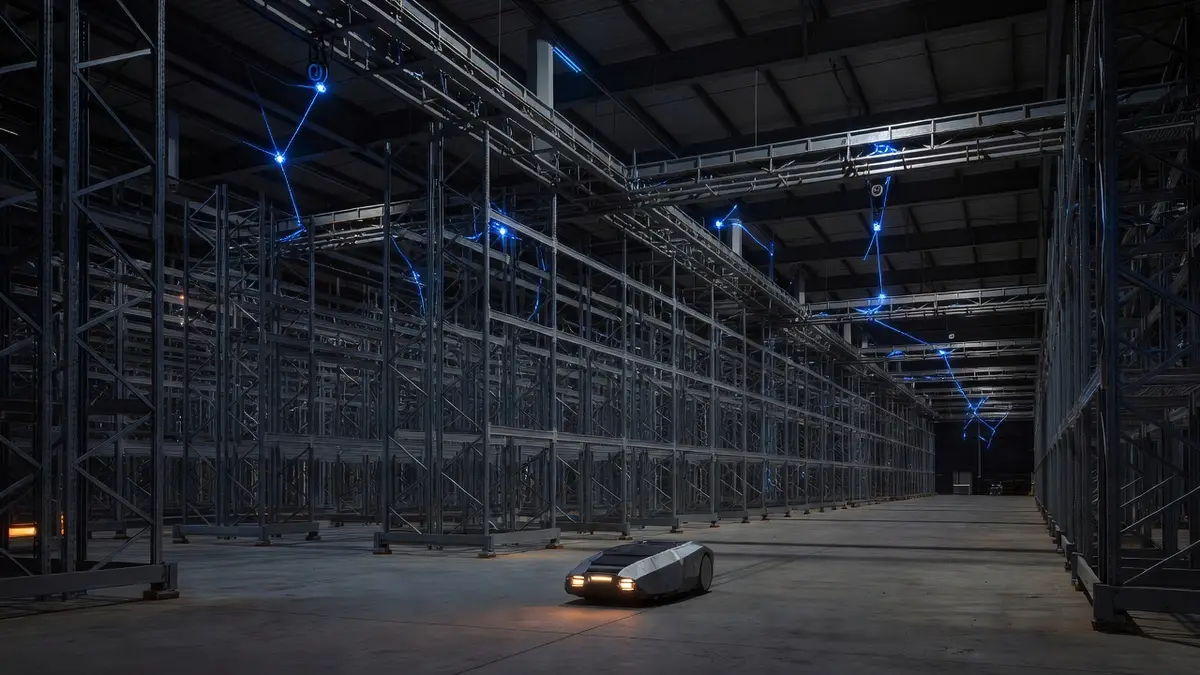
The numbers are striking enough to make a logistics economist sit up straight. The UK warehouse automation market reached $2.4 billion in 2025 and is on a trajectory toward $5.6 billion by 2034, according to IMARC Group research. The country's logistics robotics sector is growing at a compound annual rate of 16.3%, meaningfully outpacing much of Europe.
And yet.
Advertisement

A report from The Manufacturer published in June warned that UK manufacturers risk "falling behind in the AI race" precisely because adoption keeps stalling at proof-of-concept stage. The sector sits ranked 24th globally for robotics density, at just 111 robots per 10,000 employees. The UK accounts for a mere 0.5% of the world's manufacturing robots, against 1.2% in France and 1.6% in Italy - countries with comparable industrial scale. That is not a technology problem. It is a deployment problem.
The Pilot Trap, Again
The Manufacturer's report names the pathology with commendable directness: a "pilot trap", where promising AI and automation projects fail to progress into long-term operational deployments. The barriers are familiar to anyone who has spent time on a factory floor. Legacy production systems, fragmented industrial data, uncertainty over return on investment, limited access to test environments, and workforce capability gaps are the usual culprits.
Only about 15% of supply chain companies across Europe have reached what Oliver Wyman, writing with Prequel Ventures in their 2026 EU Supply Chain Tech Report, calls "full industrialization" of AI. Two-thirds of executives cite poor and fragmented data quality as the primary obstacle. The top 15% of early adopters enjoy nearly three times the technology advantage over laggards. That gap is not closing; it is widening.
Gartner's freshly published top supply chain technology trends for 2026, released at the end of June, frame the direction of travel. Polyfunctional robots, physical AI combining IoT sensors with real-time execution, and agentic AI capable of planning and adapting without human sign-off on every decision are the technologies CSCOs are being urged to prioritise. By 2031, Gartner projects 60% of supply chain disruptions will be resolved without human involvement. That is a reasonable forecast. The question is which manufacturers will be in a position to benefit from it.
Where the Money Is Going
DHL Supply Chain's £550 million commitment to the UK and Ireland, deploying 1,000 additional robots across its operations, is the most visible signal of where institutional confidence sits. The company has implemented over 3,200 digitalisation projects across UK and Ireland sites since 2017. Robots handling up to 700 packages per hour; picking accuracy hitting 99.99%; doubled productivity at some sites. These are not speculative projections. They are production results.
techUK's spring 2026 report put a number on the broader opportunity: £150 billion in potential value from UK robotics adoption. The Manufacturing Technology Centre has reported up to 40% productivity gains and 30% cost reductions from specific robotic deployments. Oxa, backed partly by the National Wealth Fund, secured £103 million to scale autonomous vehicle technology into logistics and agriculture. The investment case is not in doubt.
The structural problem is that these headlines belong almost entirely to large operators. Robotics-as-a-Service is beginning to address the capital barrier for mid-sized warehouses, offering subscription-based fleet deployments rather than the upfront spend that has historically kept SMEs out of the market. Software integration, though, is where the real complexity lives. Robot telemetry, sensor feeds, and task completion data are only valuable when they connect to broader WMS and ERP systems, and most smaller manufacturers are not close to having the data architecture for that.
A Structural Signal Hidden in the Numbers
Proprietary data from AI Business Dispatch's analysis of Companies House and IPO filings adds a layer of texture that market forecasts miss entirely.
In Q3 2026, just 17 new companies were incorporated under SIC 10.71 (bread and related bakery manufacturing), representing a collapse of 94.1% against the prior period, a cohort that historically serves as a proxy for small food manufacturing entrants. Class 7 UK trademark filings (covering machinery and machine tools) came in at 121 for the same quarter, down 88.4% from the prior period. Taken together, these figures suggest that the wave of small manufacturers and equipment innovators who entered the market on the back of post-pandemic supply chain anxiety is now receding sharply.
Perhaps most telling: 97.4% of active SIC 10.71 companies hold no Class 7 trademark whatsoever. Source: AIBD analysis of Companies House and IPO data, as of July 2026. In plain English, the overwhelming majority of small manufacturers in food processing, the segment with the most acute labour shortage pressure and the most to gain from automation, have no meaningful claim on the machinery technology they depend on. They are buyers, not builders. When supply chains tighten or vendor terms shift, they have no proprietary alternative.
The Second Wave Needs Better Infrastructure
Dematic's 2026 Vision Paper for the UK warehousing sector describes what is happening as "a second wave of automation, driven by necessity, not novelty." Labour shortages intensified by Brexit-era demographic shifts, constrained land supply, and rising service-level expectations are compressing the decision window for operators who have been sitting on the fence.
Necessity is not the same as readiness. The government has committed £4.3 billion for Advanced Manufacturing over five years, with £2.8 billion earmarked for R&D in automation, robotics, and smart factories. The Manufacturer's June report recommends a national AI front door, SME fast-track adoption schemes, and a network of AI lighthouse manufacturing sites. All sensible. None of it moves fast enough for a warehouse manager trying to decide whether to sign a three-year RaaS contract next quarter.
The honest read on the UK's position is this: the large operators are automating aggressively and the productivity case is proven. The small manufacturers are still watching. The trademark and incorporation data suggests the cohort of entrants who might have bridged that gap, the nimble equipment builders and niche food manufacturers, is shrinking, not growing.
Something to keep an eye on.