The Parabolic Moment: When AI Infrastructure Demand Outstrips Enterprise Readiness
Jensen Huang's stark declaration at Dell Technologies World crystallises a brutal corporate truth: useful AI has arrived, but most boards remain dangerously unprepared for the economic and operational reality of agentic transformation.
The Economics of Computation Have Permanently Changed
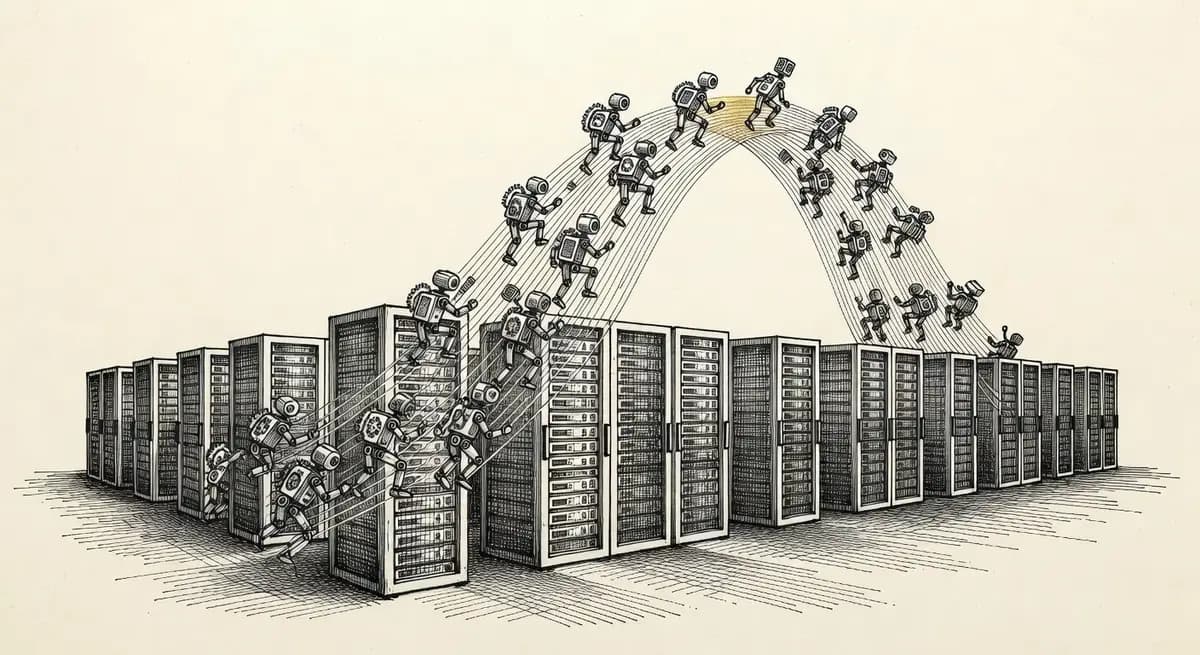
"We've now arrived at the era of useful AI, which is the reason why demand is going parabolic, utterly parabolic," declared NVIDIA's Jensen Huang at Dell Technologies World this Monday. The casual precision of that word choice deserves our attention. Huang was not describing linear growth requiring careful quarterly management. He was describing a mathematical curve that bends towards infinity.
Worldwide AI infrastructure spending could reach $3-4 trillion by 2030, with token consumption projected to grow 3,400% in the same window. "There is a massive AI investment boom thats already underway, and a productivity boom is beginning, and in some companies, including ours," Dell said. Let me translate: enterprises face infrastructure demand curves their finance teams cannot model and procurement processes cannot handle.
Advertisement

"You're not renting CPU cores anymore. You're generating tokens and marketing them. That's the economics of this AI curve. And so, the AI wants to generate, run its work, and generate the right tokens as quickly as possible, because that's the element of the intelligence." This represents the complete destruction of traditional IT cost accounting. Enterprises spent decades optimising server utilisation rates and storage efficiency metrics. Those frameworks are now obsolete.
The Agent Problem No Board Has Solved
The first moment arrives when AI stops being a tool and starts being an actor. Agentic AI systems plan, reason, orchestrate with other agents, and execute workflows autonomously. They touch sensitive data and influence decisions at scale. Yet 96% of organisations are already using AI agents in some capacity, and 97% are exploring system-wide agentic AI strategies. The findings signal a clear shift from pilots to production as businesses embed AI into mission-critical operations.
The mathematics are unforgiving. 94% of organizations report concern that AI sprawl is increasing complexity, technical debt, and security risk. But here is the question every chairman should pose to their CTO: Who is accountable when an agent makes the wrong call? How are decisions audited? When does the machine escalate to a human?
Agent sprawl will mirror the shadow IT crises of the past decade, but the stakes are categorically higher. Enterprises must establish agent lifecycle management, clear autonomy boundaries, policy enforcement, and continuous performance monitoring. The organisations that ignore this governance imperative will discover they have built distributed decision-making systems they cannot control.
The Strategic Miscalculation
"The survey revealed that in the shift to an AI-powered workforce, most leaders are mistaking basic access or adoption metrics for transformation," said Swagatam Basu, Senior Director Analyst, in the Gartner HR practice. "This 'enablement illusion' is hiding risks and draining ROI." Gartner's data exposes a stunning leadership failure: only 27% of executives have a comprehensive AI strategy, and just 20% believe their workforce is truly AI-ready.
Companies are tired of AI point solutions that don't talk to each other and just create chaos. They want AI to be a unified operating layer for their business, with AI coworkers grounded in their company's context, connected to internal systems, external data sources, and governed by the right permissions and controls. This is not a technology integration problem. This is a corporate architecture problem that will separate the organisations that understand AI as infrastructure from those that treat it as software.
As AI tools accelerate application development and shipping, attackers are using the same capabilities to move faster, causing the window between app store publication and first hostile contact to disappear. Another key finding cuts to the root cause: agentic AI has reset the economics of software attacks. 87% of monitored mobile applications faced attacks in 2026, up from 55% in 2022. Your competitors are not the only entities learning to move at machine speed.
The Control Paradox
"CIOs are aggressively pivoting to hybrid AI," the CEO said. "The risk is not the cloud. The risk is losing control of your data, your cost, your security, your intellectual property, and your speed. In the agent era, lock-in does more than slow innovation. It actually limits what your company can become."
Michael Dell understands what many boards do not: the central question is not whether to adopt agentic AI, but whether you will control the infrastructure that controls your business. AI is no longer a feature. It is becoming the operating model of the modern enterprise and the companies that redesign their work around it will gain advantage faster than any generation in history.
The gap between 90% and 100% is precisely where enterprise value lives. It is also where leadership is tested. The decisions you make in the coming months will determine whether AI becomes your most powerful source of durable advantage or your most expensive lesson in misplaced confidence.
The boards that recognise this moment will build the computational foundations for the next decade of competitive advantage. The rest will discover that falling behind a parabolic curve means never catching up.