Robots on the Tools, Levy on the Till: UK Construction's AI Safety Reckoning
McLaren Construction just sent a four-legged robot to do a site manager's rounds. On the same day, the government hit medium-sized residential developments with the Building Safety Levy. The industry's AI moment and its regulatory crunch landed on the same date - and neither is going away.
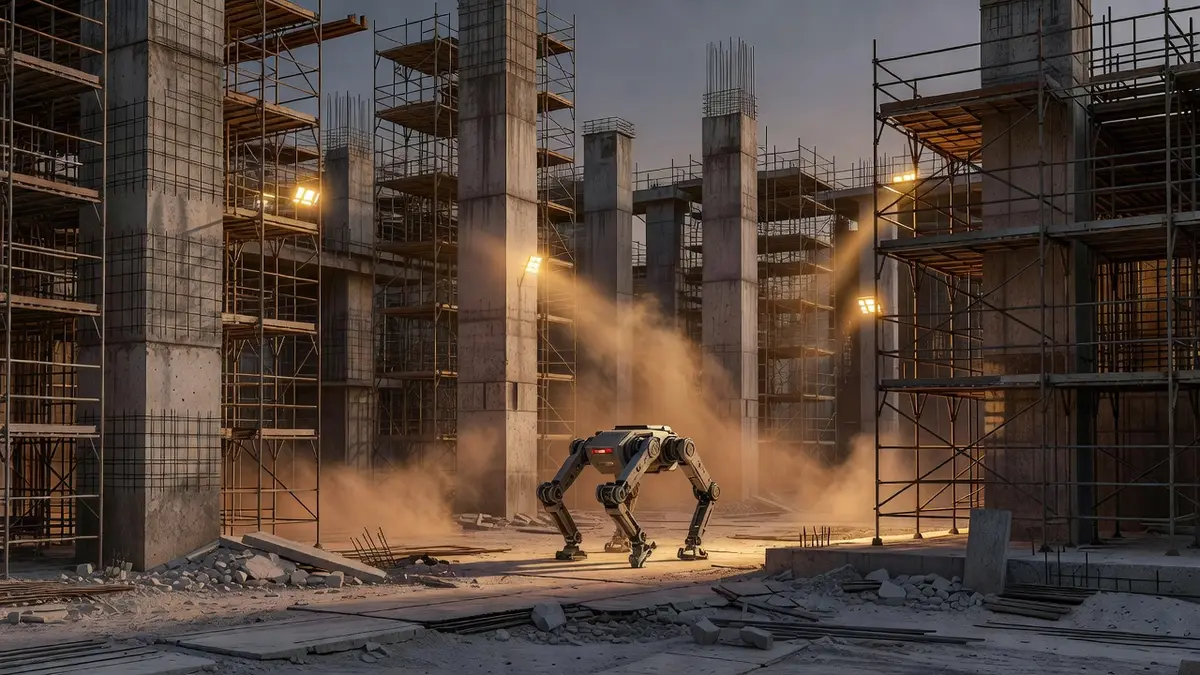
On 6 July 2026, two things happened simultaneously that sum up where UK construction now sits. McLaren Construction announced a partnership with FieldAI to deploy quadruped robots across its British projects. And the government amended the Building Safety Levy, stripping out an exemption for medium-sized sites and extending the charge to new residential developments expected to raise £3.4 billion for remediation work.
One headline was about technology. The other was about money. Both are about the same thing: safety, and who pays for it.
Advertisement

Dogs on Site
The FieldAI robots are not gimmicks. They use Field Foundation Models to navigate sites independently, capturing 360-degree imagery and point cloud data. Beyond progress tracking, they patrol for safety compliance and run quality assurance checks, comparing real-time data against design models to flag deviations before they become costly rework. The deployment is part of a five-year digital transformation strategy McLaren launched in 2022, so this is not a press-release pivot. It is a programme milestone.
What makes the timing significant is the pressure behind it. Provisional HSE figures for 2024/25 put fatal injuries to construction workers at 40, with falls from height still the leading cause. The HSE estimates annual costs of work-related injury and ill health in the sector at £1.4 billion, with around 79,000 workers affected by health issues every year. The regulator secures convictions in 94% of its cases, with fines scaled to company turnover. That is a powerful commercial argument for any technology that reduces site risk.
The robots, then, are not just a safety measure. They are a hedge against liability.
Compliance Is the Real Driver
Strip away the hardware and the story underneath UK construction AI is less dramatic, but more consequential. The biggest deployment wave is not physical robots. It is document intelligence, automated reporting, and computer vision, in that order.
The Building Safety Act 2022, Gateway 2 submission requirements, and Golden Thread obligations are generating documentation volumes that project teams can no longer manage through manual processes alone. Contractors are deploying AI copilots to interrogate specifications, RAMS, NEC clauses, and Gateway 2 evidence records faster than any traditional review method could manage. Voice-to-text site diaries and reality-capture systems are reducing administrative burden on teams already stretched thin.
As of 2026, 74% of UK construction firms report using AI and 65% use BIM on at least half their projects. That critical mass did not come from enthusiasm. It came from the Act making auditable, continuously updated digital records a legal expectation rather than a best-practice aspiration. Firms without that data infrastructure are increasingly being frozen out of higher-value projects.
The PropTech market reflects this logic. The structural shift is toward integrated Asset Information Management platforms: live, auditable environments rather than static document storage. The handover phase, where data passes from contractor to owner, has become the commercial pinch-point. Get it wrong, and the remediation costs dwarf whatever was saved on software licences.
A Two-Speed Market
Zoom out and there is a harder picture. Turner & Townsend's Global Construction Market Intelligence report, published 8 July 2026, describes a construction sector splitting in two. Demand is concentrated in AI-driven infrastructure (data centres, energy, logistics) while traditional residential and commercial sectors face labour constraints, supply chain volatility, and geopolitical headwinds.
That squeeze is showing up in Companies House data. According to AI Business Dispatch analysis of Companies House and IPO data (as of July 2026), just 419 new SIC 41.20 (general building construction) companies were incorporated in Q3 2026, a drop of 92% against the prior period. New entrant formation in the general housebuilding sector has collapsed. UK Class 11 trademark filings covering building and construction-related goods fell to 199 in Q3 2026, down 86.5% period-on-period. New ventures are not registering. They are not branding up. They are not arriving.
The incumbents present a different problem. A striking 99.6% of active SIC 41.20 companies hold no Class 11 trademark whatsoever, pointing to a sector with very little brand investment in the technology or product space. AI-led PropTech entrants are quietly filling that gap from the outside.
The Liability Gap Nobody Has Solved
Here is the part that does not make the press releases. As AI outputs proliferate on site, auto-generated RAMS, AI-assisted progress reports, computer-vision safety flags, the question of who is responsible when something goes wrong remains legally unresolved. The legal and professional duty still sits with the human duty holder. Sign-off still requires competent human validation, particularly for Building Safety Act submissions where Golden Thread traceability is non-negotiable.
Contract frameworks have not kept pace. Teams are trusting AI outputs without fully interrogating the source logic or missing evidence layers inside the system. Lawyers are already flagging personal injury exposure from autonomous systems and gaps in insurance coverage.
The EU AI Act becomes generally applicable on 2 August 2026, requiring construction firms operating in or supplying the EU market to assess whether their AI tools fall into the high-risk category, especially those used for safety-critical applications or worker monitoring. The UK's own AI Bill has been delayed until at least the second half of 2026.
The regulation is coming. The robots are already here. The contracts are catching up.
McLaren's four-legged site walker is an interesting machine. The harder work is in the documents, the data pipelines, and the duty-holder sign-off chains that no robot can shortcut. Get those right, and the AI pays for itself. Get them wrong, and the HSE will not care how sophisticated the point cloud data was.