GPT-5.6 Sol on Cerebras: 750 Tokens/Second and the Architecture of Tiered Inference
OpenAI's decision to run its flagship model on wafer-scale silicon at 15x typical GPU throughput signals a fundamental split in how frontier AI is deployed - and who can afford to stay in the game.
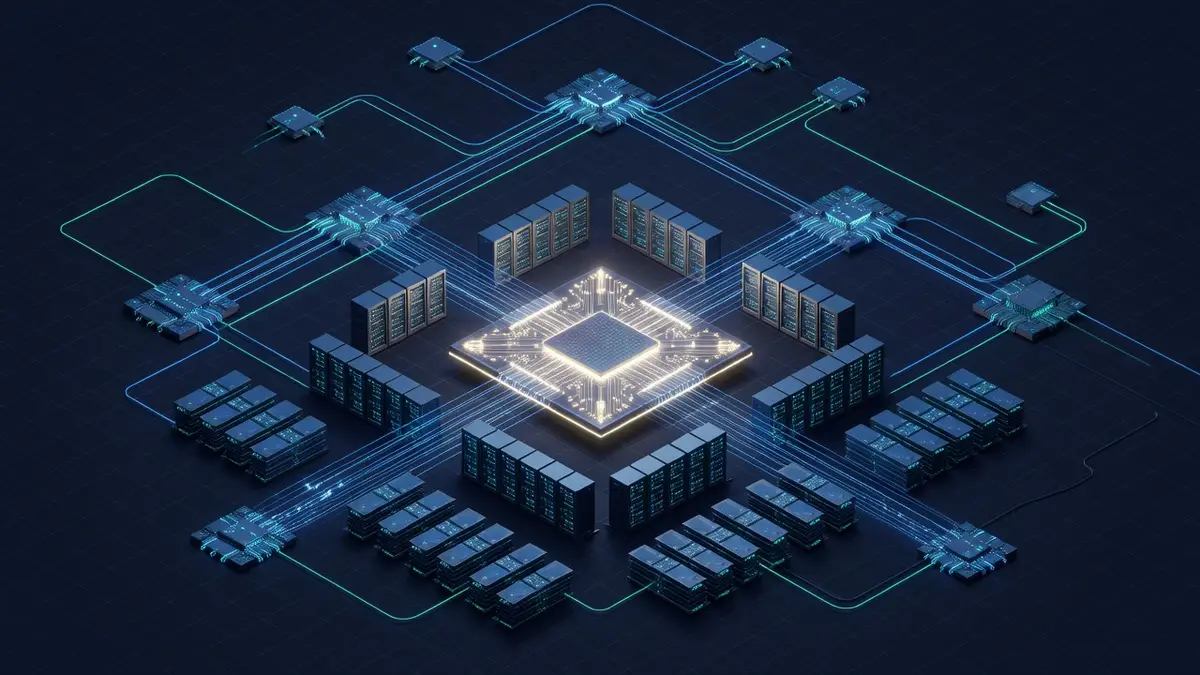
Something quietly extraordinary happened this fortnight in AI infrastructure. OpenAI announced it would run GPT-5.6 Sol, the flagship tier of its new three-tier model family, on Cerebras wafer-scale hardware at up to 750 tokens per second. For context: typical frontier model API throughput sits somewhere between 50 and 80 tokens per second on GPU clusters. Cerebras's approach eliminates the inter-chip communication bottleneck entirely by etching the whole compute fabric onto a single die the size of a dinner plate. Von Neumann would have recognised the problem immediately. Moving data between chips is expensive; keeping it local is fast. Cerebras just took that principle to its logical extreme.
The Three-Tier Architecture
The GPT-5.6 family is not a single model. It is a deliberate routing system baked into the product tier itself. Sol is the high-capability flagship. Terra is the balanced mid-range option. Luna is the fast, affordable volume tier. OpenAI previewed the family on June 26, initially limiting access to approximately twenty government-vetted partner organisations, with broad general availability expected in mid-to-late July. Think of it as a motorway with three lanes, each with a different speed limit and toll, the routing decision made before the car even enters.
Advertisement

The engineering implication is significant. At 750 tokens per second, Sol on Cerebras does not merely run faster; it changes the interaction model for agentic workflows entirely. Agents waiting on a 60 t/s API call are like a production line waiting for a single lathe. At 750 t/s, the bottleneck moves. It moves to your orchestration logic, your tool-call latency, your database reads. That is a different class of systems problem, and one the developer community has not fully reckoned with yet.
Luna, priced at $1 per million input tokens and $6 per million output tokens, will directly redefine the volume tier. Terra at $2.50/$15 goes head-to-head with Anthropic's Claude Sonnet 5 introductory pricing of $2/$10, which runs through 31 August before rising to $3/$15. That price convergence at the mid-tier is not accidental. It is a features race being fought by accountants.
Where Sonnet 5 Actually Sits
Claude Sonnet 5, released June 30, is genuinely interesting architecturally. It posts 63.2% on SWE-Bench Pro, up from Sonnet 4.6's 58.1%, and ships with a native 1 million token context window as standard. It self-checks output without prompting, a behaviour multiple testers have independently noted. That is not a marketing claim; it maps to visible changes in task-completion rates on multi-step agentic runs.
Sonnet 5 edges ahead of Opus 4.8 on knowledge work benchmarks despite sitting at a lower price point. The implication: Anthropic has managed to distil a meaningful fraction of Opus-class reasoning into a significantly cheaper inference profile. That is not luck. That is months of careful RLHF tuning and probably some architectural compression work that has not been publicly disclosed.
The ceiling, meanwhile, is Claude Fable 5. Epoch AI's Capabilities Index has it at 161, one point ahead of GPT-5.5 Pro. Fable 5 leads SWE-Bench Pro at 80.3% and GDPval-AA at 1,932 Elo, priced at $10/$50 per million tokens. It returned to global access on 1 July after an 18-day government-mandated suspension following a jailbreak that exposed software vulnerability identification and exploit-generation capabilities. That suspension, the first time a frontier model was pulled offline by regulatory order, is its own infrastructure story: the pipe was there, the valve was closed, and the lesson is that deployment architecture now has a political layer sitting on top of it.
The Open-Weight Pressure Below
While frontier labs compete on throughput and tiering, the floor is rising fast. Z.ai's GLM-5.2, MIT-licensed and released June 13, posts 62.1% on SWE-Bench Pro with a 1M-token context window at $1.40/$4.40 via hosted API, or fully self-hostable. DeepSeek V4 Pro, also MIT-compatible and freely self-hostable, reaches 80.6% on SWE-Bench Verified at $0.28/$0.42. Those numbers are not rounding errors. They are within a few percentage points of models costing thirty times as much to run via API.
CNBC reported this week that Chinese model releases from DeepSeek and Z.ai are increasingly being evaluated by US enterprise teams as OpenAI and Anthropic API costs climb. The routing-for-cost argument is now a serious architectural decision, not just a procurement conversation. For teams with the infrastructure and appetite for self-hosting, the open-weight tier has effectively become a fourth lane on that motorway, one with no toll booth at all, provided you can build and staff the road yourself.
Kimi K2.5 from Moonshot AI, a 1T-parameter MoE with 32B active parameters per inference under a Modified MIT Licence, leads GPQA Diamond at 87.6% and SWE-Bench Verified at 76.8%. The Mixture-of-Experts architecture is key here: you pay only for the active parameters on each forward pass. It is the GPU equivalent of only heating the rooms you are actually using.
The Meta Watermelon Variable
One number worth filing. Business Insider reported on July 2 that Meta's Chief AI Officer Alexandr Wang told a closed briefing that Meta's model in training, internally codenamed Watermelon, uses an order of magnitude more compute than Meta's previous frontier model. If Meta's prior frontier run used approximately 100,000 H100-equivalent GPUs, Watermelon is training on around 1 million GPU-equivalents. Meta has an estimated 600,000 H100s in production and has announced plans for a 1-million-GPU cluster. The claimed performance target is GPT-5.5 class.
That is not a product announcement. It is a geological event visible before the eruption. When Watermelon ships as an open-weight model, and Meta's pattern strongly suggests it will, it would represent the most capable open-weight release in the field's history, at a parameter scale that only a company with Meta's inference infrastructure can casually contemplate running.
The Registration Signal
AIBD's own analysis of Companies House data offers a useful ground-truth check on the engineering investment picture. SIC 62.01 (computer programming activities) saw only 274 new company registrations in Q3 2026, a 97.7% decline versus the prior period. One reasonable interpretation: the low-friction phase of "start an AI software company" is over. The teams that registered in the 2023-2025 wave are either building or gone. What remains is less experimentation and more infrastructure-grade consolidation. The picks-and-shovels phase tends to follow exactly that pattern in historical technology transitions: initial proliferation, then sharp contraction, then a smaller number of better-capitalised operators controlling the plumbing.
The 6-12 Month Read
Three forces are converging. Proprietary frontier models are differentiating on inference speed and tier architecture rather than raw benchmark scores alone; Sol at 750 t/s is a product decision as much as an engineering one. Open-weight models at MIT licensing are compressing the cost floor faster than most enterprise procurement cycles can respond. A regulatory layer, comprising government-gated access, export-control suspensions, and pre-release review windows, is becoming a permanent fixture in the deployment stack.
The developer tools that win over the next 12 months will be the ones that abstract across all three of these layers cleanly: routing requests intelligently across tiers and providers, handling regulatory-mandated availability events gracefully, and making the self-hosting option legible to teams that currently lack the infrastructure expertise to evaluate it. That is a genuinely hard systems problem. It is also a good one.