Google's TPU 8i Redefines AI Infrastructure with Dedicated Reasoning Hardware
The first specialized silicon for agentic AI delivers 80% better performance per dollar through breakthrough memory architecture and a novel network topology
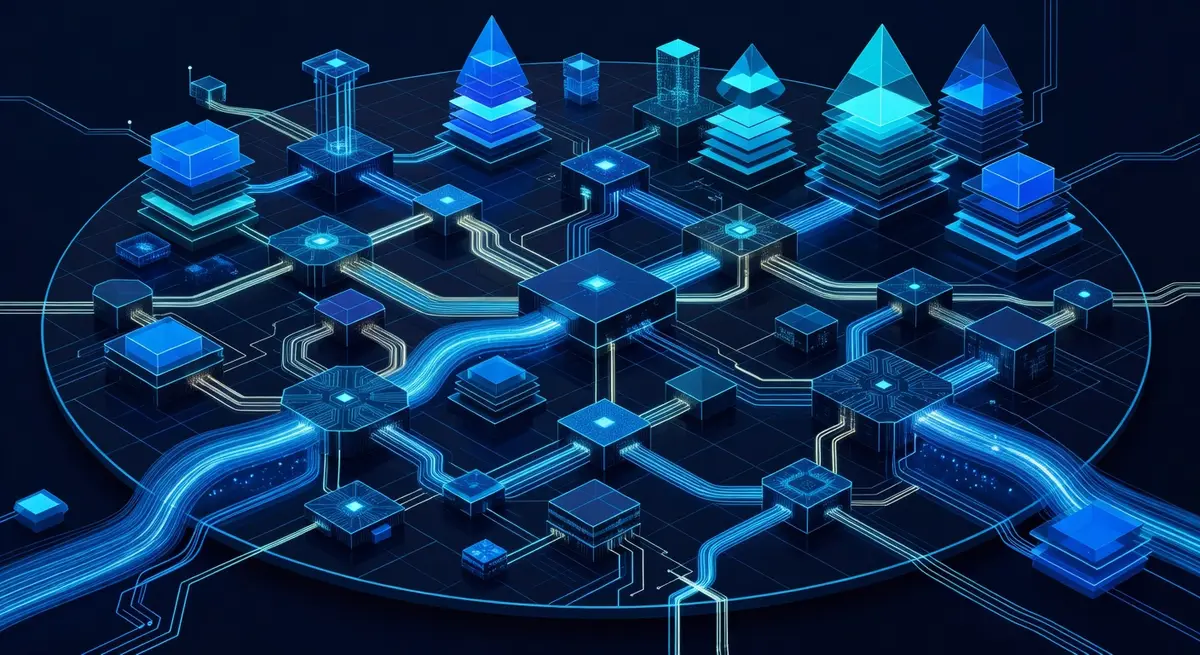
Something quietly extraordinary happened last week in the plumbing of artificial intelligence.
Google unveiled its eighth-generation TPU architecture, but not as a single chip—for the first time in a decade, the company split its custom silicon into two distinct processors. The TPU 8t handles training workloads, while the TPU 8i tackles inference. But it's the inference chip, codenamed "Zebrafish," that represents the more radical architectural departure.
The TPU 8i isn't just faster silicon; it's purpose-built for a different computational pattern. Where previous generations optimised for raw throughput, the 8i optimises for latency—the metric that determines whether an AI agent feels responsive or sluggish.
Advertisement

Breaking the Memory Wall
The core innovation sits in the memory hierarchy. Google tripled the on-chip SRAM to 384 MB, specifically sized to host the key-value cache for reasoning models at production scale. This keeps the model's "working memory" entirely on silicon, eliminating the processor idle time that compounds when running thousands of concurrent agents.
Paired with 288 GB of high-bandwidth memory, the design addresses what engineers call the "memory wall"—the growing gap between compute speed and memory access time. For agentic workloads, where an AI might make 200 small tool-use calls in a single session, this architectural choice matters more than peak FLOPS.
Traditional inference chips force frequent trips to external memory, creating bottlenecks that multiply across agent swarms. The 8i's enlarged SRAM cache means fewer memory stalls, higher utilisation, and—critically for businesses—the ability to serve nearly twice the customer volume at the same infrastructure cost.
Collectives Get Their Own Silicon
Google introduced a dedicated Collectives Acceleration Engine (CAE)—a fixed-function block that handles reduction and synchronisation operations during autoregressive decoding and chain-of-thought processing. The CAE replaces the four SparseCores from the previous generation, representing a philosophical shift in silicon allocation.
The engineering insight: collective operations—those moments when chips must coordinate their work—have become the bottleneck in reasoning-heavy workloads. By giving these operations their own hardware, Google reduces on-chip collective latency by up to 5x. In practice, this means less time waiting and more time computing for the millions of agents required in production agentic systems.
AI has evolved beyond simple transformer inference. Modern reasoning models spend significant cycles synchronising state across distributed computations. The CAE turns what was once a software coordination problem into a hardware acceleration target.
Topology Meets Reality
Perhaps the most consequential change is nearly invisible: the Boardfly interconnect topology. Google abandoned the 3D torus network it's used since TPU v2, replacing it with a hierarchical design inspired by dragonfly networks from supercomputing.
The maths tells the story. In a 1,024-chip 3D torus configuration, the worst-case packet traverses 16 hops. Boardfly cuts this to 7 hops—a 56% reduction in network diameter that directly benefits Mixture-of-Experts models requiring frequent all-to-all communication across unpredictable chip pairs.
When an AI agent processes a complex query, expert routing decisions happen across the entire chip mesh. Shorter paths mean lower latency, which cascades into better user experience. The difference between a 200-millisecond and 50-millisecond response time determines whether agentic AI feels magical or merely adequate.
The Anthropic Signal
The market validation came before the announcement. Anthropic committed to using up to 1 million TPUs in October 2025, expanding to 3.5 gigawatts of TPU capacity by 2027. This represents the largest external TPU deployment in Google's history—a customer willing to bet billions on Google's silicon roadmap.
Andrej Karpathy captured the developer sentiment in an X post that drew over 2 million views: "TPU 8i's 384 MB on-chip SRAM changes the dispatch-overhead arithmetic for agentic inference in a way that will reshape serving architectures." When Karpathy gets excited about memory hierarchies, the industry pays attention.
AI infrastructure is bifurcating. Training and inference have diverged to the point where a single general-purpose design compromises both workloads. Google's split acknowledges what practitioners have known for months—agentic AI demands different trade-offs than traditional LLM serving.
What This Means by November
The TPU 8i's architectural choices will influence AI application development through 2026. With 80% better performance per dollar for inference, the economics of serving large reasoning models improve dramatically. Businesses that couldn't afford to deploy agents at scale now have a viable path.
The dedicated reasoning hardware validates agentic AI as a distinct computational category. We're seeing the emergence of inference-optimised silicon from multiple vendors—Google's TPU 8i, potential AWS Inferentia updates, and rumours of specialised NVIDIA chips. The pattern suggests agentic workloads will drive the next wave of custom silicon development.
The TPU 8i ships to Google Cloud customers later this year. For the first time, reasoning-specific silicon will be available at hyperscale.