Companies House Pauses Record Destruction as Review Debates 20-Year Policy
A quiet administrative change that could reshape decades of corporate archaeology
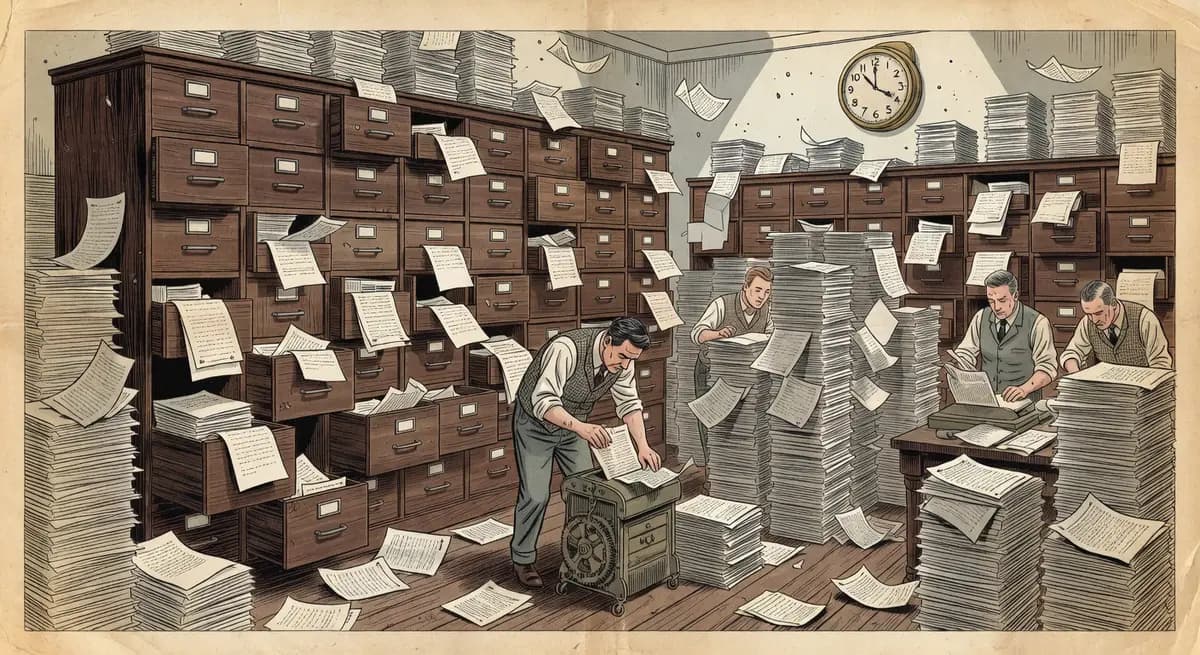
12 May 2026: The Document Graveyard Gets a Stay of Execution
Companies House has paused its destruction of dissolved company records while reviewing its 20-year retention policy. The announcement, buried in a Monday morning press release, suspends the transfer of "selected records" to The National Archives and the permanent deletion of everything else.
This matters more than the institutional prose suggests. For nearly two centuries, Companies House has operated like a methodical librarian with a strict weeding policy: keep everything while companies remain active, hold dissolved company records for 20 years, then send the historically significant bits to the archives and destroy the rest.
Advertisement

Now that orderly procession has stopped. The shredders are silent.
What This Means for Your Monday Morning
Record requests will continue to work during the pause. The Find and Update service remains operational, and the Search for Dissolved Company service functions normally. If you need records not available online, Companies House will still retrieve them for a fee.
But the underlying question (how long should dissolved company records survive) remains unanswered. The review stems from "concerns that records should be held for longer than 20 years," though Companies House offers no specifics about who raised these concerns or why.
This is bureaucratic speak for "someone important wants this changed."
The Administrative Archaeology of Corporate Life
Consider what currently happens to a dissolved company's records under the existing policy. When a company dies (whether through voluntary liquidation, compulsory winding-up, or simple striking-off) its corporate corpse enters a 20-year purgatory at Companies House.
During this period, the records remain searchable and retrievable. Creditors hunting for assets, investigators tracking complex ownership structures, and historians researching industrial patterns can all access the files.
After 20 years, archivists at The National Archives review the records using selection criteria developed with Companies House. Some files (typically those of historically significant companies or containing unique information about economic or social developments) get preserved forever in the national collection.
The rest face destruction. In practice, this means 99% of dissolved company records are eventually deleted, a percentage that would make even the most aggressive data retention policy seem lenient.
The Enforcement Paradox
The timing of this review reveals an interesting tension. Companies House has spent the past two years transforming from passive record-keeper to active enforcement agency under the Economic Crime and Corporate Transparency Act. It can now query, reject, and investigate company filings with unprecedented authority.
Yet simultaneously, it's considering keeping dissolved company records longer. This creates a paradox: more scrutiny of active companies alongside potentially permanent preservation of dead ones.
The practical implications extend beyond historical research. Financial crime investigations often require reconstructing complex ownership structures spanning decades. Money laundering schemes frequently involve companies that are dissolved and recreated in cycles. Asset recovery claims can surface years after companies disappear.
A 20-year retention period made sense when Companies House filed documents in physical ledgers and storage space carried real costs. Digital storage changes that calculation entirely.
What Comes Next
The review will conclude with public consultation on any proposed changes. This suggests the government already has ideas about extending the retention period but wants to test them against practical concerns from users.
Expect pushback from privacy advocates who argue that dissolved company records containing personal data shouldn't survive indefinitely. Directors' addresses, shareholder details, and other personal information currently have a defined deletion date. Extending retention eliminates that certainty.
Businesses may split depending on their circumstances. Those involved in complex reconstructions or facing potential claims might welcome longer retention. Others, particularly smaller companies, may prefer the clean slate that deletion provides.
The consultation timeline suggests implementation in 2027 at earliest. Until then, the destruction pause means dissolved company records will accumulate indefinitely.
The Next Deadline on the Horizon
While Companies House reviews its housekeeping, remember that living companies still face fixed deadlines. The identity verification transitional period ends in November 2026 for existing directors. Miss that deadline, and your enforcement-empowered Companies House will have very current records of your non-compliance indeed.
Some ironies write themselves.