$852 billion OpenAI and the mathematics of madness
OpenAI just raised more money in a single round than the GDP of Hungary. The numbers don't add up—until you realize they're not supposed to.
When nations become footnotes
OpenAI closed a $122 billion funding round Tuesday at an $852 billion valuation. To put that in perspective: this single round exceeds the market cap of Intel, AMD, and IBM combined. It's roughly equivalent to the entire venture capital deployed globally in 2021.
The company now generates $2 billion monthly—up from $1 billion quarterly at the end of 2024. Math checks out, right?
Advertisement

Wrong.
Let's do the maths
Even with generous assumptions, the numbers reveal an industry betting on miracles. OpenAI committed to spending $1.4 trillion over eight years building data centres. Against just $13 billion in current revenue.
Assuming a 25% gross margin, they'd need to scale AI revenues to $160 billion annually just to break even on one year's investment. For a solid return on invested capital? We're talking $400-500 billion.
That's just 2025 capex. If 2026 spending matches expectations, the implied future revenue runs into the trillions.
"Even assuming a generous 25% gross margin, break-even requires scaling AI revenues to $160 billion per year," noted CEIBS finance professors in their recent analysis.
The bubble that isn't (yet)
Here's where it gets interesting. Unlike the dot-com era, current AI valuations are backed by actual profits. The S&P 500 trades at 23 times forward earnings—stretched, but nowhere near the dot-com peak of 60 times.
Capital Economics' John Higgins argues one AI bubble already burst. Price-earnings ratios for Big Tech peaked at 75% in late 2024, then fell to pandemic lows by October 2025.
But Higgins warns of something rarer: "The bubble actually may be in the earnings themselves."
The revenue recycling problem
A significant chunk of AI revenue comes from companies selling to other companies in the ecosystem. Amazon invests $50 billion in OpenAI. OpenAI spends billions on AWS compute. Nvidia provides chips, then invests in OpenAI. SoftBank co-leads the round, then partners on data centres.
Classic circular financing—the same disease that killed dot-com companies when demand from actual end users vanished.
"Put simply, today's 'booming' AI revenue isn't necessarily from new, organic customers with demand for AI services," Warren Street Wealth Advisors noted. "It's an internal recycling of investment capital."
Q1 2026: The most consequential quarter ever
Global venture funding hit $300 billion in Q1—an all-time record, up 150% year-over-year. AI captured 80% of that total at $242 billion.
Four of the five largest venture rounds in history closed in Q1 2026: OpenAI ($122B), Anthropic ($30B), xAI ($20B), and Waymo ($16B). Together, they raised $188 billion—65% of global venture investment in the quarter.
The earnings mirage
Bloomberg Intelligence estimates Magnificent Seven earnings growth at 18% versus 11% for the remaining S&P 493. Nvidia reported $68.1 billion Q4 revenue, up 73% year-over-year.
Sustainable? MIT's Media Lab found that despite $30-40 billion in enterprise GenAI investment, "95% of organisations are getting zero return."
Goldman Sachs estimates $539 billion in AI capex for 2026. McKinsey reports 88% of companies use AI regularly, but adoption may be stalling due to employee anxiety about displacement.
The infrastructure bet
Unlike previous tech bubbles, this one's built on physical infrastructure. Data centres, chips, power grids—assets that don't disappear when sentiment shifts.
SoftBank's participation signals their return to massive AI bets after WeWork taught expensive lessons about founder-led hypergrowth. But OpenAI CFO Sarah Friar described the round as "surpassing even the largest IPOs in scale."
The company is building what it calls a "unified AI superapp"—combining ChatGPT, coding, browsing, and agentic capabilities. Enterprise revenue now represents 40% of total, up from 30% last year.
When music stops
So far, AI companies fund infrastructure spending from earnings, not debt. The capex-to-free-cash-flow ratio sits below 1.0—well under the dot-com peak of nearly 4.
But geopolitical risks are mounting. Iran's war halted helium output in Qatar—one-third of global supply for chip manufacturing. Energy prices threaten data centre economics. Supply chain disruptions cascade through semiconductor manufacturing.
"The greater risk to AI earnings will be if the economy remains in a precarious position," Higgins warned.
The prediction
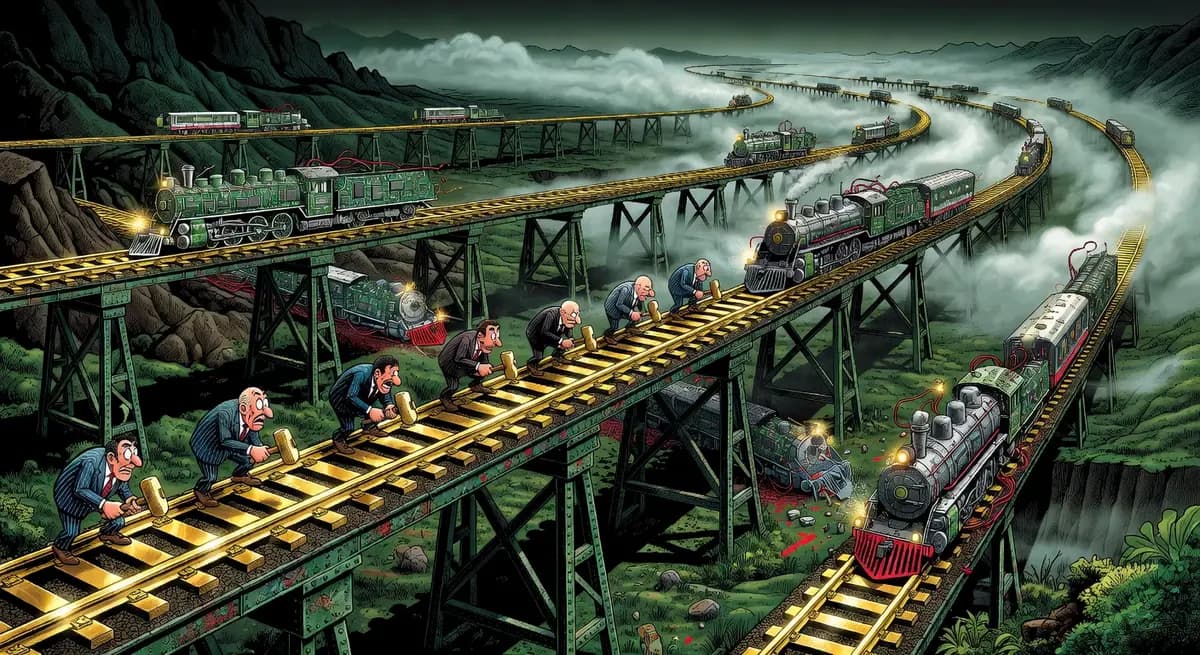
AI isn't the internet in 1999. It's the railroad in 1869—transformative technology requiring massive upfront capital with uncertain returns. Some builders will create generational wealth. Most will go broke laying track.
OpenAI's $852 billion valuation assumes they become the railroad that survives. At 27x revenue multiples for Anthropic and 50x+ for frontier labs, investors are pricing in near-perfect execution.
The bubble isn't in the technology—it's in the assumption that current leaders will capture proportional value from the transformation they're funding.
By year-end, expect OpenAI's IPO at a $1 trillion+ valuation and at least three $100B+ AI funding rounds. The infrastructure gets built regardless. The question is who owns it when the music stops.