$3.5 Billion Walks Into a Bar. Kleiner Perkins Just Placed Its Biggest Bet on the AI Arms Race
Venture capital's old guard just raised 75% more money than their last fund. Either they know something Wall Street doesn't, or they're buying lottery tickets with other people's money.
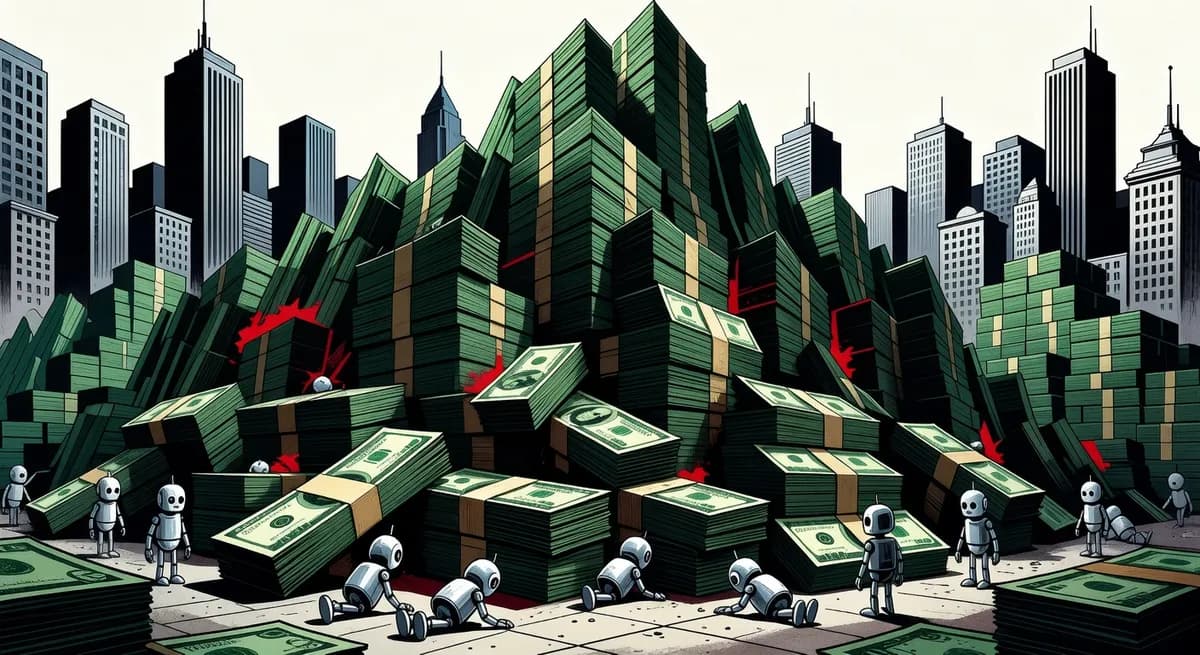
The Numbers Don't Add Up Until They Do
Kleiner Perkins closed $3.5 billion Tuesday across two simultaneous funds—$1 billion for early-stage bets and $2.5 billion for late-stage scaling. That's a 75% increase from their $2 billion raise less than two years ago. Either the firm founded in 1972 has lost its mind, or everyone else is missing the trade of the decade.
Let's do the math. KP now manages five partners across $21 billion in total assets under management. That's $4.2 billion per partner. When Benchmark's Bill Gurley warns "one day, I just think we trip and run out of money" on AI investments, maybe Kleiner Perkins should listen.
Advertisement
Except the returns are already talking.
The Anthropic Card Changes Everything
Kleiner Perkins holds shares in Anthropic, valued at $380 billion after its $30 billion Series G in February. They also backed Harvey (the AI legal platform at $8 billion), Together AI, and OpenEvidence. If Anthropic goes public in 2026 at anything near its private valuation, that single exit could return multiples of KP's entire current fund.
This isn't speculation. It's portfolio math.
"The AI super-cycle is one of the most important company-building moments in our lifetimes," KP's fundraising announcement states. Translation: we're not chasing hype, we're positioning for the largest technology transition since the internet. The firm that backed Google, Uber, and Airbnb generally knows what transformative looks like.
But here's the twist. KP's growth fund targets a 35% net IRR hurdle rate. That's private equity-level return expectations in a venture capital wrapper. It's either breathtakingly confident or catastrophically naive.
The Bubble Signs Are Everywhere
February 2026 became the largest startup funding month in history—$189 billion globally. But 83% went to just three companies: OpenAI ($110 billion), Anthropic ($30 billion), and Waymo ($16 billion). Without those mega-rounds, it would've been an ordinary month.
AI startups now capture 41% of all venture dollars, according to Carta data. That's $52 billion flowing into artificial intelligence in a single year. The S&P 500 trades at 23 times forward earnings. The Case-Shiller P/E ratio just exceeded 40 for the first time since the dot-com crash.
Sam Altman himself says it's a bubble while raising money at $730 billion valuations. Ray Dalio calls current AI investment levels "very similar" to the dot-com era. Even the Bank of England warned about AI valuation risks in equity markets.
Meanwhile, enterprises report essentially zero productivity gains from AI despite billions in investment. The math is restaurant prices for microwave meals.
The Concentration Risk Nobody Talks About
Kleiner Perkins isn't alone in the feeding frenzy. Thrive Capital raised $10 billion. General Catalyst reportedly targets similar levels. Founders Fund closed $6 billion for its growth vehicle. Together, those four firms have $25+ billion earmarked specifically for AI.
That's not diversification. That's a cartel betting on the same outcome.
Five companies now represent 30% of the S&P 500 and 20% of the MSCI World—the highest concentration in 50 years. If AI enthusiasm wanes, the carnage won't be contained to venture portfolios. It'll cascade through public markets, credit markets, and GDP growth itself.
AI-related capital expenditure already accounts for 1.3% of US GDP. It's projected to hit 1.6% in 2026. When the hyperscalers finally blink, the ripple effects will be measured in trillions, not billions.
The Kleiner Perkins Calculation
Mamoon Hamid has led KP's turnaround since 2017, returning more than $13 billion to limited partners. The Figma IPO alone delivered returns that sources describe as "extraordinary." He's not gambling with reputation or track record. He's doubling down on conviction.
The early-stage fund will hunt for the next Anthropic at seed valuations. The growth fund will capture late-stage scaling opportunities as AI companies approach public markets. If the IPO window opens in 2026—and both Anthropic and SpaceX are flagged as expected candidates—KP could deliver the largest venture-backed exits in history.
But if it doesn't, they'll own the most expensive portfolio of PowerPoint presentations ever assembled.
Prediction: Reality Check by Labor Day
By September 2026, either AI companies will demonstrate clear paths to profitability that justify current valuations, or the market will force a brutal repricing. Morgan Stanley estimates capex-to-sales ratios will hit 37% by 2028—higher than dot-com peaks.
Kleiner Perkins is betting $3.5 billion that AI infrastructure becomes the new railroad system: expensive to build, essential to own, impossible to replicate. History suggests they're either perfectly positioned for the next industrial revolution or spectacularly positioned for the next financial correction.