$187 billion. That's what AI burned through in two months.
OpenAI's $122B round in March, Anthropic's $65B in May. The fundraising arms race is accelerating, and someone's going to get hurt.
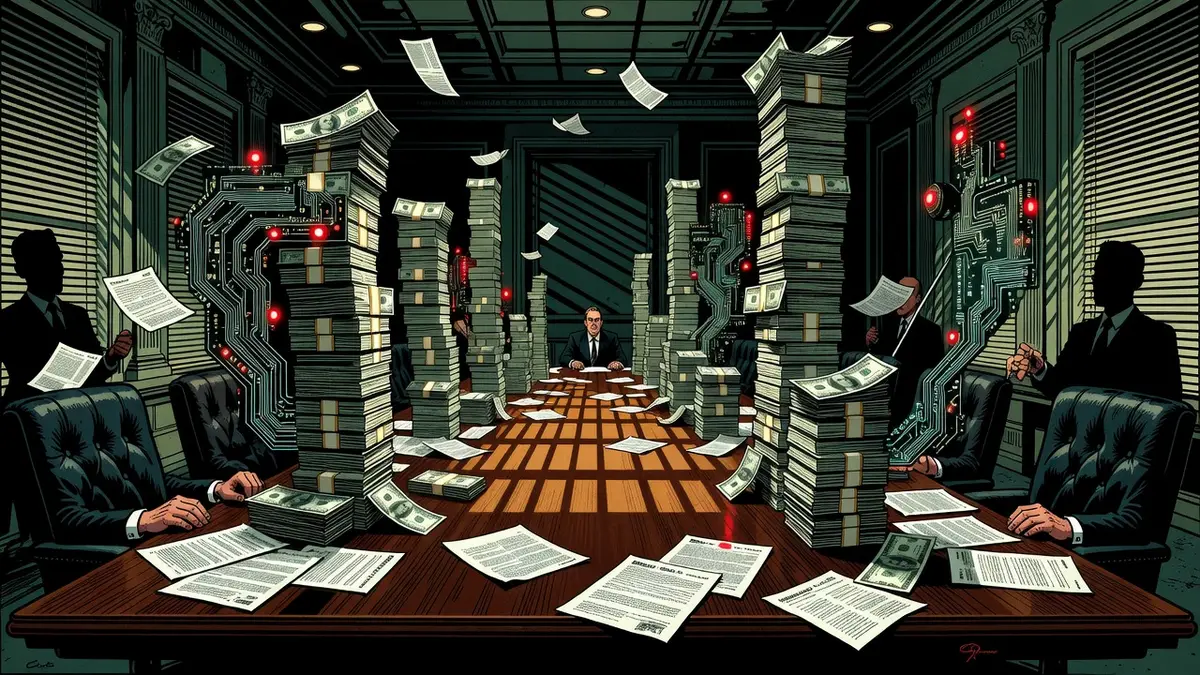
The Numbers Don't Lie
$187 billion. In eight weeks. Two companies.
Let's do the maths: OpenAI closed $122 billion at $852 billion valuation on March 31. Anthropic followed with $65 billion at $965 billion on May 28. That's more capital than Ireland's GDP, raised by two companies that, let me check my notes, still don't turn a profit.
Advertisement

But here's where it gets interesting. Anthropic just became the world's most valuable private company. At $965 billion, it's now worth more than Tesla, Berkshire, or Meta. More expensive than any company Warren Buffett has ever owned, built on a chatbot that launched three years ago.
The venture math has officially broken.
Amazon's $50 Billion Shell Game
Amazon led OpenAI's round with $50 billion. Sounds impressive until you read the fine print. According to Bloomberg, $35 billion is contingent on OpenAI going public or achieving AGI (artificial general intelligence, that mythical milestone nobody can define).
That's not investment. That's a really expensive option contract.
Meanwhile, Amazon also committed $5 billion to Anthropic's round. Plus up to 5 gigawatts of AWS compute capacity. Notice the pattern? Amazon isn't just investing in AI companies: it's ensuring they buy Amazon services.
As Charlie Munger would say: "Show me the incentive, I'll show you the outcome."
Revenue Reality Check
OpenAI claims $2 billion monthly revenue, or $24 billion annually. At 35x revenue multiple, that's aggressive even for SaaS darlings. For context, Salesforce trades at 8x revenue.
Anthropic's $47 billion run rate looks better at 20x revenue. Still rich, but not insane. The company's growth from $4 billion last July suggests real enterprise traction, particularly with Claude Code driving adoption.
But run rates lie. They project current momentum infinitely forward, ignoring competition, market saturation, or economic cycles. Ask any dot-com survivor.
The Infrastructure Ponzi
Here's the beautiful circular logic: OpenAI raises money to buy Nvidia chips and Amazon cloud. Nvidia and Amazon invest in OpenAI. Oracle borrows $50 billion to build data centres for OpenAI.
Everyone's making money except the companies actually building AI.
Nvidia's profit margins? 73%. Amazon Web Services? 30%. OpenAI? Still burning cash faster than a Russian oligarch's yacht.
The picks-and-shovels sellers always win the gold rush. The prospectors? Most go broke.
IPO Pressure Cooker
Both companies are reportedly prepping IPOs. OpenAI extended participation to retail investors for the first time: 3,000 individuals putting up $3 billion total. That's desperation dressed as democratisation.
Public markets won't tolerate these valuations without path-to-profitability clarity. Meta trades at $1.3 trillion with $135 billion revenue and 25% margins. These AI darlings need to prove they're platforms, not features.
Fortune reports Anthropic confidentially filed IPO paperwork Monday. The race to public markets accelerates, but first-mover advantage expires when everyone moves first.
The Coming Reckoning
Taleb's wisdom applies: "The market can stay irrational longer than you can stay solvent." But even irrationality has limits.
Consider this data point: AI captured 34% of global VC despite being 18% of funded companies. That's concentration risk masquerading as conviction.
When the music stops, someone's holding worthless chairs. My money's on late-stage investors who paid trillion-dollar valuations for companies that may never justify them.
Prediction Time
By year-end, one of these IPOs will trade below issue price. The infrastructure winners (Nvidia, Amazon, Microsoft) will keep printing money. The AI pure-plays will face Wall Street's harsh reality: growth doesn't matter if you can't get profitable.
$187 billion in two months. That's not sustainable capital allocation. That's a bubble measuring its own expansion rate.